


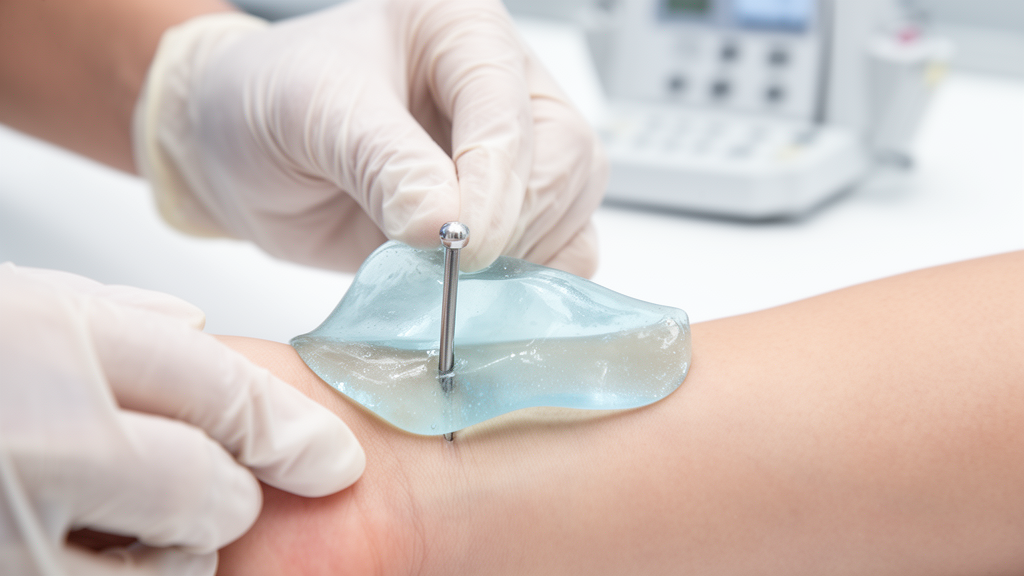
External fixators are among the most versatile tools in orthopedic surgery, allowing fractured bones to be stabilized with metal pins that pass through the skin and anchor directly into the skeleton. Yet this ingenious design carries an inherent vulnerability: the pin tracks, where metal meets skin, are open channels through which bacteria can migrate toward bone. Pin-site infection, or PSI, remains one of the most pervasive complications of external fixation, and its prevention has long been hampered by the absence of any consensus on optimal wound care. A new pilot study from researchers at Universiti Kebangsaan Malaysia, published in Scientific Reports, offers an early glimpse of whether a modern antimicrobial gel might outperform the traditional flavin-based dressings that have dominated pin-site care for decades.
The study, led by Badrul Akmal Hisham Md Yusoff and colleagues in the Department of Orthopedics and Traumatology, was conducted as a prospective cohort trial running from April 2024 to December 2025. Sixteen patients fitted with external fixators were enrolled and divided into two groups according to their consent to treatment: ten patients received Hydrocyn gel as their dressing agent, while six received conventional flavin-based dressing. Both groups performed self-dressing every three days, an important design feature because it tested whether the gel could perform under real-world conditions in which patients, not clinicians, manage their own pin sites at home. Patients were then followed weekly for four weeks, with any infection diagnosed and graded using the Checkettts-Otterburn scale, a widely used clinical classification that ranges from mild cellulitis to severe infection requiring pin removal.
The results, while preliminary, were striking. In the Hydrocyn gel group, only two of the ten patients developed a pin-site infection, a rate of 20 percent. In the flavin group, four of six patients became infected, a rate of 66.7 percent. The pattern of infections also differed between the groups. Patients treated with Hydrocyn gel developed only Grade 1 infections, the mildest category on the Checkettts-Otterburn scale. One of these resolved spontaneously without intervention, while the other worsened and required surgical debridement and removal of the affected pin. In the flavin group, by contrast, infections appeared earlier and more frequently, with one patient requiring early debridement and multiple cases progressing to Grade 2 and Grade 3 severity. Encouragingly, no patient in either group developed osteomyelitis, the feared deep bone infection that can follow untreated pin-site sepsis.
To understand why a superoxidized gel might hold an advantage, it helps to examine the chemistry. Hydrocyn gel belongs to a family of agents based on stabilized superoxidized solutions, or SOS, which contain reactive oxygen species such as hypochlorous acid suspended in a hydrogel matrix. These reactive species attack microbial cells through multiple pathways simultaneously, oxidizing cell membranes, denaturing proteins, and disrupting biofilms, the sticky bacterial communities that are notoriously resistant to conventional antiseptics and antibiotics. The gel formulation offers an additional practical benefit: it maintains prolonged contact with the wound surface, keeping the antimicrobial agent in place between dressing changes, whereas liquid antiseptics can drain away or evaporate within hours of application.
The conventional comparator in the study, flavin-based dressing, represents the historical standard of pin-site care. Flavins are photosensitizing dyes with antimicrobial properties that have been used in wound management for generations, and they remain common in many orthopedic centers around the world. However, their mechanism of action is narrower, and concerns about cytotoxicity to human cells and limited activity against biofilm-embedded bacteria have prompted surgeons to search for alternatives. The Malaysian team’s hypothesis was that a broad-spectrum, reactive-oxygen-based agent with sustained contact time could suppress bacterial colonization more effectively at the vulnerable pin-skin interface.
The Checkettts-Otterburn grading system deserves particular attention because it transforms infection from a binary event into a spectrum of clinical severity. Grade 1 infections involve mild pin-tract redness that responds to simple measures, while higher grades indicate increasing inflammation, discharge, and loosening of the pin, with the most severe grades requiring surgical intervention and raising the specter of osteomyelitis. By grading infections rather than merely counting them, the researchers could show not only that fewer Hydrocyn gel patients became infected, but that the infections that did occur were less severe on average. This distinction matters clinically, because the burden of pin-site infection lies less in the occasional mild irritation and more in the progression to deep infection that can compromise fracture treatment entirely.
Despite the encouraging numbers, the authors are careful to frame their findings as hypothesis-generating rather than proof of efficacy. The study was a pilot, and several methodological limitations temper any strong conclusions. Most importantly, treatment allocation was based on patient consent rather than randomization, meaning that patients who chose the gel may have differed systematically from those who chose flavin dressing in ways that influenced infection risk. The sample size of sixteen patients is far too small to exclude the role of chance, and because the trial was registered retrospectively, on 2 March 2026, after data collection had begun, no inferential statistical tests were performed at all. The reported rates of 20 percent and 66.7 percent are therefore descriptive observations, not statistically compared estimates, and the true difference between the two treatments could be smaller or larger than what was observed.
These limitations are not trivial, but they are also not unusual for early-stage surgical research. Pilot studies of this kind serve a specific purpose in the clinical development pipeline: they generate preliminary effect sizes, test the feasibility of recruitment and follow-up, and identify practical challenges before larger randomized trials are attempted. The fact that patients in both groups successfully performed self-dressing every three days and completed weekly follow-up for four weeks suggests that a definitive trial is logistically feasible. The authors’ decision to report descriptive results honestly, without dressing them in statistical significance they cannot support, reflects a commendable commitment to scientific transparency in a field where small studies are often oversold.
The broader context of pin-site infection makes the search for better dressings clinically urgent. External fixators are indispensable in trauma surgery, particularly for open fractures, limb reconstruction, and the correction of deformities, and the duration of fixation can extend for months. Every week that pins remain in place is another week of exposure to bacterial colonization, and infection rates reported across the literature vary enormously, in part because there has never been agreement on the best cleaning regimen, dressing material, or frequency of care. This lack of consensus means that patients in different hospitals, and even different wards within the same hospital, may receive entirely different pin-site care based on local tradition rather than evidence. A rigorous trial demonstrating superiority of one agent over another would have immediate practical value for thousands of patients worldwide.
For now, the message from Kuala Lumpur is one of cautious optimism. Hydrocyn gel, with its reactive oxygen species and sustained-release hydrogel format, was associated with a lower observed rate of pin-site infection and a milder pattern of disease than conventional flavin dressing in this small trauma population, and no patient in either group developed the deep bone infection that surgeons dread most. Whether that association survives the scrutiny of a properly randomized, adequately powered trial remains to be seen, but the pilot provides exactly the kind of preliminary signal that such a trial needs. If future studies confirm the trend, a simple change in dressing material, applied by patients themselves at home, could meaningfully reduce one of the most common and troublesome complications of modern fracture care.
Subject of Research: Pin-site infection prevention in external fixation using a superoxidized hydrogel dressing compared with flavin-based care
Article Title: A prospective pilot cohort study of hydrocyn gel as a dressing agent compared with conventional flavin-based pin-site care for infection prevention
Article References: Md Yusoff, B. A. H., Jasmin, L. N. A., Nik Kamaruzman, N. K. A., Mohamad, N., Ramlan, M. K. R., & Azwan Aziz, M. (2026). A prospective pilot cohort study of hydrocyn gel as a dressing agent compared with conventional flavin-based pin-site care for infection prevention. Scientific Reports. https://doi.org/10.1038/s41598-026-75590-1
Image Credits: AI Generated
DOI: 10.1038/s41598-026-75590-1
Keywords: external fixator, pin-site infection, Hydrocyn gel, superoxidized solution, flavin dressing, Checkettts-Otterburn scale, orthopedic trauma, wound care, antimicrobial hydrogel, biofilms, osteomyelitis, pilot cohort study
Cite Scienmag News
Denise Maddox. (October 14, 2026). Superoxidized Hydrogel Gel Shows Promise Against Pin-Site Infections in Pilot Trial. Scienmag. https://scienmag.com/superoxidized-hydrogel-gel-shows-promise-against-pin-site-infections-in-pilot-trial/
Denise Maddox. "Superoxidized Hydrogel Gel Shows Promise Against Pin-Site Infections in Pilot Trial." Scienmag, 14 October 2026, https://scienmag.com/superoxidized-hydrogel-gel-shows-promise-against-pin-site-infections-in-pilot-trial/. Accessed 14 October 2026.
Denise Maddox. "Superoxidized Hydrogel Gel Shows Promise Against Pin-Site Infections in Pilot Trial." Scienmag. October 14, 2026. https://scienmag.com/superoxidized-hydrogel-gel-shows-promise-against-pin-site-infections-in-pilot-trial/


