


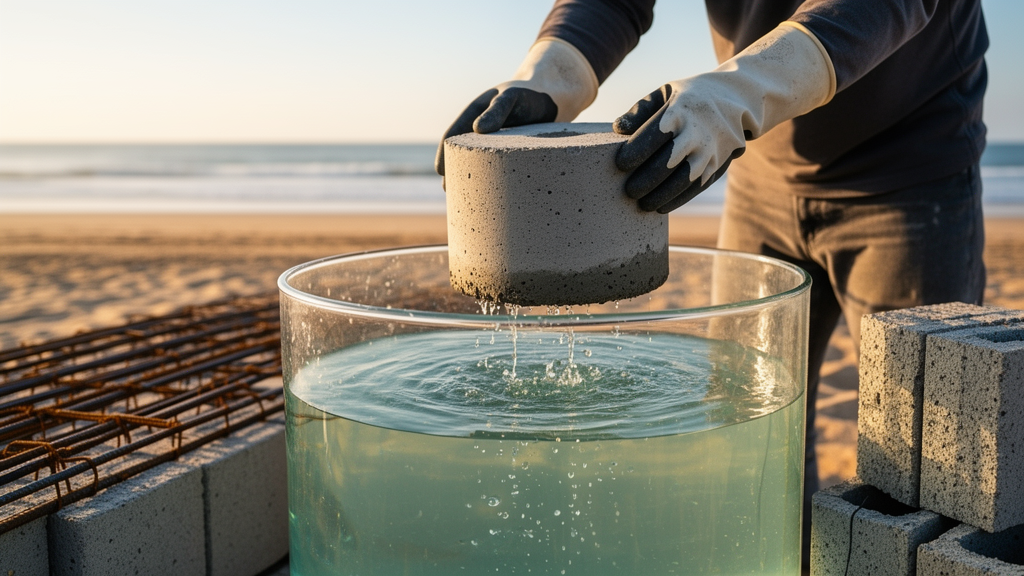
Concrete is the workhorse of marine infrastructure, but the ocean is a hostile place for it. Seawater carries chloride, sodium, magnesium, and sulfate ions that react with cement hydration products, generating expansive compounds that crack the matrix from within. Those cracks then let more chloride ions penetrate, and once the chloride concentration at embedded steel reinforcement crosses a critical threshold, corrosion accelerates rapidly. The rusting steel expands, weakens its bond with the surrounding concrete, and eventually triggers cracking and spalling. For precast concrete elements destined for offshore platforms, piers, and floating structures, the problem has an awkward twist: components are manufactured in factories, cured only briefly, and then transported and installed at sea, often before they have finished curing. That means seawater can bathe a partially hydrated element at the most vulnerable stage of its life, and until now, the consequences for fiber-reinforced materials were poorly understood.
A new study published in Case Studies in Construction Materials by Seon Yeol Lee, Seoung Ik Choi, Taek Hee Han, and Jun Kil Park tackles this gap by asking a deceptively simple question: what happens when polyethylene fiber-reinforced mortar is exposed to real seawater while it is still curing? The researchers focused on ultra-high-molecular-weight polyethylene fibers, which, unlike steel fibers, are immune to corrosion and chemically robust in marine conditions. Polymer fibers of this kind are the backbone of engineered cementitious composites, materials famous for their ability to hold cracks below roughly 60 micrometers in width, a scale fine enough to slow chloride ingress dramatically. Recent variants have even embraced seawater and sea sand as mixing ingredients to conserve freshwater and terrestrial aggregates, making the question of seawater’s influence on mechanical development all the more urgent.
What distinguishes this work from earlier research is its attention to timing. Previous studies had either mixed seawater directly into the concrete, submerged specimens immediately after demolding, or exposed them to seawater only after 28 days of standard curing. Each approach interacts with cement hydration at a different stage, and prior work on cement pastes had shown that the age of first seawater exposure significantly alters which hydration products form. The Korean team designed their experiment around the practical scenario facing precast marine elements: mortar cured in tap water for 0, 3, 7, or 14 days, then transferred to natural seawater collected from Busan, with a total curing period of 28 days for every condition. They compared these against control specimens cured entirely in tap water or entirely in seawater.
The material itself was engineered for high performance. The mortar used Type I ordinary Portland cement, Australian silica sand, a water-to-cement ratio of just 0.25, and a polycarboxylate superplasticizer to keep the mix workable at that low water content. The polyethylene fibers were remarkably slender, with an average diameter of 23.5 micrometers and a length of 12 millimeters, giving an aspect ratio above 500, an elastic modulus of 100 gigapascals, and a tensile strength of 3000 megapascals. Three fiber contents were tested: zero, one, and two percent by volume. The team targeted a compressive strength of at least 80 megapascals, placing the material at the lower bound of the high-strength engineered cementitious composite range considered suitable for harsh marine loading including earthquakes, typhoons, and tsunamis.
The results, drawn from flexural, compressive, and length-change tests on hundreds of specimens, revealed a strikingly nuanced picture. Every series showed improved first-crack behavior, quantified as the Limit of Proportionality, as seawater exposure lengthened. For the unreinforced mortar, the first-crack toughness rose by up to 132.8 percent under full seawater curing compared with tap-water curing. But the peak flexural performance, the Modulus of Rupture, split the fiber-reinforced series in opposite directions. The one-percent fiber mortar grew stronger and tougher with seawater, while the two-percent fiber mortar grew weaker, with its peak toughness falling by 34.9 percent under full seawater exposure relative to its tap-water counterpart.
The best overall performer was the one-percent fiber mortar cured in tap water for seven days and then exposed to seawater for 21 days. Compared with the same mix cured entirely in tap water, its first-crack strength, deflection, and toughness increased by 94.2, 66.7, and 174.2 percent respectively, while its peak strength, deflection, and toughness rose by 5.6, 23, and 42.8 percent. This mix also achieved the highest compressive strength of the entire study, 98.3 megapascals. The findings suggest that a brief freshwater pre-cure followed by seawater exposure may actually be an ideal sequence for precast marine elements, turning an unavoidable logistical constraint into a performance advantage.
The mechanism behind these gains lies in cement chemistry. When chloride ions from seawater react with tricalcium aluminate phases and calcium hydroxide in the cement paste, they form Friedel’s salt, a chloride-bearing aluminate phase that fills capillary pores and accelerates hydration. Seawater also promotes the formation of a high-surface-area calcium silicate hydrate gel, the glue of concrete, refining the pore structure. Earlier studies cited by the authors reported that seawater-mixed pastes showed a 12 percent reduction in 28-day porosity and finer pore networks. The result is a denser microstructure and, crucially, a strengthened interfacial transition zone, the porous region surrounding each fiber where cracks preferentially begin. Because flexural and tensile behavior are far more sensitive to this zone than compressive behavior, the improvements showed up most dramatically in the bending tests, and the measured expansion of the specimens tracked neatly with the strength gains.
So why did the two-percent fiber mix falter? The answer lies in a phenomenon known as the group effect. When fibers are packed too closely together, they interfere with one another, concentrating stress in the matrix and reducing the reinforcing efficiency of each individual fiber. Using a constitutive model developed for steel fiber-reinforced concrete, the team calculated that fiber spacing in the two-percent mix, 171.2 micrometers, sat uncomfortably close to the fiber effect distance of 141 micrometers, the threshold at which the group effect activates. Seawater exposure strengthens the fiber-matrix bond, which extends that effect distance, pushing the crowded two-percent mix over the edge. Image analysis of polished cross-sections confirmed the story: while the overall fiber distribution appeared more uniform at higher dosage, the count of distinct fiber objects dropped by about 14 percent, indicating local clustering, and crack surfaces of the two-percent specimens showed visible clumps of fibers where uniform dispersion was expected.
The practical implications are considerable. For engineers designing precast elements for offshore wind platforms, submerged tunnels, and coastal defenses, the study suggests that one percent polyethylene fiber offers the sweet spot, and that seven days of tap-water curing before seawater exposure yields the best flexural performance under the tested conditions. It also adds momentum to the broader movement toward seawater and sea-sand concrete, which could relieve pressure on freshwater supplies and river aggregates in coastal construction booms. Because polymer fibers cannot corrode, they sidestep the classic failure mode of steel-reinforced marine concrete entirely, and the microcrack-control ability of these composites further delays chloride penetration.
The authors are careful to note the limits of their work. The study covers only the first 28 days of strength development, and the formation of Friedel’s salt and high-surface-area calcium silicate hydrate was inferred from the literature and from expansion measurements rather than directly verified with microscopy or spectroscopy. Fiber orientation was not quantitatively evaluated, the seawater’s chemistry was not analyzed, and seasonal temperature variations were not considered. Future work involving X-ray diffraction, thermogravimetric analysis, scanning electron microscopy, three-dimensional fiber imaging, and pull-out tests should pin down the mechanisms more firmly. Long-term exposure studies will be essential before these findings translate into design codes. Still, the central message stands: the ocean, so often cast as concrete’s enemy, can under the right curing schedule and fiber dosage become an unexpected ally in building tougher, more durable marine infrastructure.
Subject of Research: Effects of seawater exposure timing during curing on the flexural behavior of polyethylene fiber-reinforced mortar for marine precast concrete
Article Title: Effects of seawater exposure during curing on the flexural behavior of polyethylene fiber-reinforced mortar
Article References: Lee, S. Y., Choi, S. I., Han, T. H., & Park, J. K. (2026). Effects of seawater exposure during curing on the flexural behavior of polyethylene fiber-reinforced mortar. Case Studies in Construction Materials, 25, Article e06591. https://doi.org/10.1016/j.cscm.2026.e06591
Image Credits: AI Generated
DOI: 10.1016/j.cscm.2026.e06591
Keywords: polyethylene fibers, seawater curing, fiber-reinforced mortar, marine concrete, precast concrete, Friedel's salt, flexural behavior, engineered cementitious composites, chloride ingress, fiber-matrix bond, group effect, durability
Cite Scienmag News
Denise Maddox. (October 14, 2026). Seawater During Curing Can Strengthen Plastic-Fiber Concrete, But Only Up to a Point. Scienmag. https://scienmag.com/seawater-during-curing-can-strengthen-plastic-fiber-concrete-but-only-up-to-a-point/
Denise Maddox. "Seawater During Curing Can Strengthen Plastic-Fiber Concrete, But Only Up to a Point." Scienmag, 14 October 2026, https://scienmag.com/seawater-during-curing-can-strengthen-plastic-fiber-concrete-but-only-up-to-a-point/. Accessed 14 October 2026.
Denise Maddox. "Seawater During Curing Can Strengthen Plastic-Fiber Concrete, But Only Up to a Point." Scienmag. October 14, 2026. https://scienmag.com/seawater-during-curing-can-strengthen-plastic-fiber-concrete-but-only-up-to-a-point/


