


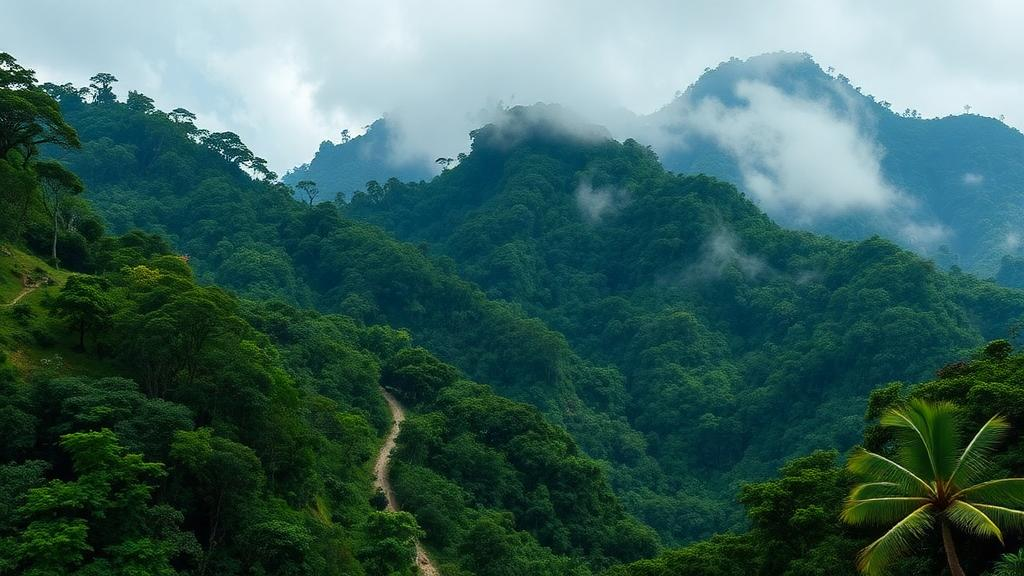
High on the mist-wrapped ridges of Brazil’s Atlantic Forest, two characteristic tree species are running out of room to live. A new modeling study published in Regional Environmental Change projects that Drimys angustifolia, a small heliophilous tree of the Winteraceae family, could lose between 3.9 and 26.8 percent of its climatically suitable habitat by 2080, while its companion Ilex microdonta, a moisture-loving holly that thrives above 700 meters, may see up to 67 percent of its suitable area vanish under the highest emission scenario. The findings, led by Amanda Köche Marcon, Alexandre Siminski, and Cesar Augusto Marchioro of the Federal University of Santa Catarina, offer one of the most detailed pictures yet of how global warming could erode the ecological foundations of montane and cloud forests in one of the world’s most imperiled biodiversity hotspots.
The research team chose their study species with care. Rather than focusing on keystone trees, they selected D. angustifolia and I. microdonta because these species act as reliable indicators of cloud forest environments, appearing in 64 percent and 49 percent of the Atlantic Forest’s cloud forest fragments respectively. Both are endemic to Brazil, confined to the southern and southeastern stretches of the biome where the Serra do Mar and Serra Geral mountain ranges push forests into cool, perpetually humid air. Because their fates are intertwined with the ecosystem itself, their projected declines serve as a warning signal for entire plant communities that depend on the narrow climatic conditions of high elevations.
To map where these trees can survive now and where they might persist in the future, the researchers built species distribution models using the MaxEnt algorithm, a widely used presence-only method that estimates the probability distribution best matching known occurrence records. The team compiled hundreds of records from scientific literature and online databases, including the Global Biodiversity Information Facility and SpeciesLink, then rigorously cleaned the data. After removing invalid coordinates, duplicates, and outliers, and applying spatial thinning with a minimum distance of ten kilometers between records, they retained 89 occurrences for I. microdonta and 82 for D. angustifolia. This careful filtering reduces sampling bias and helps prevent models from overstating suitability in marginal areas.
The environmental backbone of the models came from nineteen bioclimatic variables derived from temperature and precipitation data at a spatial resolution of roughly five square kilometers, supplemented by elevation and soil properties. Because many of these variables are highly correlated, the researchers used variance inflation factors to eliminate redundant predictors, though they deliberately retained annual mean temperature, annual rainfall, and elevation despite their statistical interdependence, given their well-documented ecological relevance to these species. Model tuning explored seventy different parameter combinations for each species, with the best configuration selected using the Corrected Akaike Information Criterion, a statistical approach that balances model fit against complexity to avoid overfitting.
The resulting models performed impressively. Area under the curve values exceeded 0.90 for both species, and Continuous Boyce Index scores surpassed 0.95, indicating that predictions aligned far better with actual occurrence patterns than would be expected by chance. True Skill Statistics of 0.42 for D. angustifolia and 0.40 for I. microdonta fell within the good performance range, while omission rates at strict thresholds were impressively low. The models also passed a null-model significance test, confirming that the observed fit was not an artifact of limited sample size.
Under current conditions, the models identified suitable habitat across southern, southeastern, and central-western Brazil, with the highest probabilities concentrated in Paraná, Santa Catarina, Rio Grande do Sul, and São Paulo states, precisely where montane and cloud forests persist along coastal and interior mountain ranges. Annual mean temperature emerged as the single most influential predictor for both species, with suitability peaking in regions where average temperatures remain below about 18 degrees Celsius and declining sharply as conditions warm. For I. microdonta, rainfall in the wettest month above 150 millimeters also proved critical, underscoring this species’ dependence on abundant moisture. These response curves align closely with the climatic signature of Latin American cloud forests generally, which typically experience average annual temperatures near 17.5 degrees Celsius.
Projecting the models onto future climate scenarios revealed sobering trajectories. The researchers used five independent global circulation models and averaged their outputs to produce ensemble projections for two time periods, 2021 to 2040 and 2061 to 2080, under both intermediate and high emission pathways. For D. angustifolia, range contractions under the intermediate scenario progressed from 3.9 percent in the near term to 18.3 percent by 2080, worsening to 26.8 percent under the high-emission pathway. I. microdonta fared considerably worse, with the high-emission scenario for 2080 erasing 67 percent of suitable habitat. The losses were concentrated in the northern mountainous regions, particularly the Serra do Mar, Mantiqueira, Espinhaço, and Canastra ranges, where tropical-zone populations are expected to shrink first as temperatures climb beyond tolerable thresholds.
Crucially, the study warns that these projections represent changes in climatic suitability rather than guaranteed future distributions. Tree species with limited dispersal capacity may simply be unable to reach newly suitable areas, especially across fragmented landscapes. The researchers note that long-lived trees often lag behind the velocity of climate change, creating a mismatch between where favorable conditions exist and where populations actually grow. In the case of D. angustifolia, their more moderate estimates differed substantially from earlier studies that projected losses exceeding 68 percent, a discrepancy the team attributes to previous models that considered only cloud forest areas and ignored lower-elevation populations, thereby underestimating the species’ full ecological niche.
The researchers also linked their projections to conservation policy by overlaying suitable areas with maps of land requiring restoration under Brazil’s Forest Code, which mandates native vegetation recovery in certain areas. Currently, 25.6 percent of suitable habitat for D. angustifolia and 31.2 percent for I. microdonta falls within restoration-deficit zones. However, these proportions were markedly lower within montane and cloud forests themselves, reflecting the fact that steep terrain has historically shielded high-elevation forests from conversion. Deforestation in mountainous portions of the Atlantic Forest has been estimated at thirteen times lower than in non-mountain areas, making these zones some of the biome’s best-preserved remnants even as only 28 percent of natural vegetation cover survives across the whole biome.
Despite this relative refuge, the study found troubling gaps in formal protection. While protected-area coverage was higher in high-elevation environments, substantial portions of climatically suitable habitat for both species remain outside the current network, particularly in southern Brazil, notably in Santa Catarina, where montane areas showed limited protection. The authors caution that climatically suitable areas beyond a species’ documented range should not be treated as restoration targets, since planting outside natural biogeographic limits risks biotic homogenization. Instead, they argue for strategically expanding protected areas within documented distributions, maintaining connectivity along elevational gradients, and preserving climate refugia. Because land above 1600 meters accounts for less than one percent of the entire Atlantic Forest, the upward migration many species would need is constrained by an absolute scarcity of habitat, making the protection of what remains an urgent priority.
Subject of Research: Projected climate change impacts on montane and cloud forest tree species in the Brazilian Atlantic Forest
Article Title: Climate change threatens montane and cloud forest tree species in the Brazilian Atlantic Forest
Article References: Climate change threatens montane and cloud forest tree species in the Brazilian Atlantic Forest. (n.d.). https://doi.org/10.1007/s10113-026-02703-x
Image Credits: AI Generated
DOI: 10.1007/s10113-026-02703-x
Keywords: climate change, Atlantic Forest, cloud forests, montane forests, species distribution modeling, Drimys angustifolia, Ilex microdonta, MaxEnt, climate refugia, ecological restoration, protected areas, biodiversity conservation
Cite Scienmag News
Sloane Callahan. (October 14, 2026). Cloud Forest Trees Face Steep Losses as Warming Squeezes Brazil’s Mountain Refuges. Scienmag. https://scienmag.com/cloud-forest-trees-face-steep-losses-as-warming-squeezes-brazils-mountain-refuges/
Sloane Callahan. "Cloud Forest Trees Face Steep Losses as Warming Squeezes Brazil’s Mountain Refuges." Scienmag, 14 October 2026, https://scienmag.com/cloud-forest-trees-face-steep-losses-as-warming-squeezes-brazils-mountain-refuges/. Accessed 14 October 2026.
Sloane Callahan. "Cloud Forest Trees Face Steep Losses as Warming Squeezes Brazil’s Mountain Refuges." Scienmag. October 14, 2026. https://scienmag.com/cloud-forest-trees-face-steep-losses-as-warming-squeezes-brazils-mountain-refuges/


