


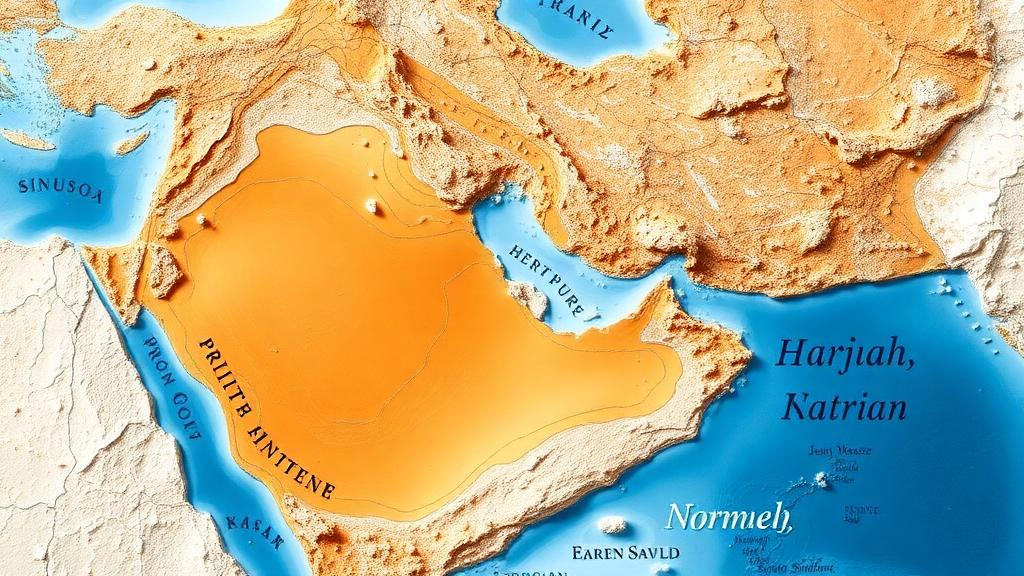
The Persian Gulf is one of the most extreme evaporative basins on Earth, losing roughly 1.44 meters of water to the atmosphere every year while receiving only 0.11 to 0.19 meters of rain. That deficit makes it an inverse estuary, the mirror image of a normal estuary: instead of rivers diluting seawater, the sea itself concentrates salt, and the net flow of water runs from the Indian Ocean into the Gulf. A new high-resolution modeling study published in Ocean Dynamics shows that the fierce winds sweeping this basin—especially the northwesterly Shamal—do far more than rough the surface. They fundamentally redraw the Gulf’s salinity map, reshape its vertical stratification, and more than double the extreme water exchanges surging through the Strait of Hormuz on synoptic time scales.
Led by Seyed Taleb Hosseini of Helmholtz-Zentrum Hereon, the research team ran the unstructured-grid hydrodynamic model SCHISM over the entire Persian Gulf, the Strait of Hormuz, and the Gulf of Oman at resolutions from about 1 kilometer in the strait to 10 kilometers in the open ocean. They performed two otherwise identical nine-year simulations covering 1993 to 2001, one with full forcing including winds, and one with wind switched off entirely. Hourly output from 1997 to 2001, with particular focus on 2001, allowed the team to separate the wind’s fingerprints from tides, evaporation, and river discharge driven by the Shatt-Al-Arab at the Gulf’s head. The design is elegantly simple: any difference between the two runs is attributable to wind alone.
The salinity results are striking. In the wind-forced simulation, the prevailing northwesterly Shamal opposes the intrusion of low-salinity Indian Ocean Surface Water, so waters of 39 practical salinity units remain confined near 52 degrees East in winter. Without wind, that same salinity penetrates all the way to the Gulf head near 49 degrees East. Ekman transport along the shallow southern banks between Qatar and the Strait of Hormuz physically blocks fresher ocean water from entering, producing an extensive hypersaline zone there in winter—even though evaporation rates along those coasts are actually higher in summer. Along the northwestern banks, by contrast, salinity tracks local evaporation and grows from winter to summer. The result is a basin in which wind-driven salt advection, not evaporation alone, dictates where dense Persian Gulf Water is born.
This wind control also dampens the Gulf’s seasonal salinity swing. In the no-wind run, the area-averaged salinity in the upper 50 meters is about 0.65 psu higher in summer than in winter; with winds on, that seasonal difference shrinks to roughly 0.2 psu. Over the full basin, however, the five-year mean salinities of the two experiments differ by less than 0.05 psu, around 41.25 to 41.30 psu. Wind, in other words, is a redistributor rather than a quantity-changer on annual scales: it moves salt and fresh water around the basin dramatically, but barely alters the total. The southern shallow banks emerge as the most wind-sensitive region of the entire Gulf, consistent with earlier findings of wind setup piling water against those shores.
The study then turned to stratification, and here the physics took an unexpected turn. Classical theory of wind straining, developed in positive estuaries like Chesapeake Bay, holds that down-estuary winds stretch the along-channel density gradient and sharpen stratification, while up-estuary winds erode it. The researchers first showed in an idealized inverse estuary that this mechanism reverses: because the estuarine circulation itself flips, upwind forcing restratifies the water column and downwind forcing mixes it. But in the real Persian Gulf, complex bathymetry, tides, and basin geometry obscure this clean signal. Instead, both downwind and upwind conditions generally weaken stratification in both the upper and lower Gulf, with the potential energy anomaly and maximum buoyancy frequency dropping precisely when the wind stress—and the dimensionless Wedderburn number—peak.
The Wedderburn number, which compares along-channel wind stress against the buoyancy force of the horizontal density difference, revealed a fundamental split within the Gulf. In the upper estuarine zone near the head, wind stress magnitudes above roughly 0.05 pascals drive the absolute Wedderburn number past 5, meaning residual circulation there is wind-dominated. In the lower zone near the Strait of Hormuz, the same metric rarely exceeds 1, so density gradients—modulated on a fortnightly cycle by spring and neap tides—control the residual flow. Interestingly, the enhanced stratification seen at the upper Gulf section under downwind conditions is not classical straining at all. It arises because the Shamal confines the low-salinity oceanic front closer to the strait, steepening the background horizontal density gradient, which in turn strengthens vertical shear and stratification at the head. Along the Gulf’s main axis, the wind-forced run stays about 0.5 psu saltier than the no-wind run, and up to 1 psu saltier near the shallow northwestern coasts.
The exchange through the Strait of Hormuz proved even more wind-sensitive. High-frequency net volume fluxes approaching plus or minus 0.6 sverdrups and net salt fluxes reaching plus or minus 22 sverdrup-psu appear in the wind-forced run but collapse to less than half those magnitudes when winds are removed. Extreme inflowing and outflowing salt fluxes exceeding 31 sverdrup-psu are essentially wind-driven. Yet the annual mean net fluxes—about plus 0.01 sverdrup of volume and minus 0.03 sverdrup-psu of salt—remain nearly identical between the two experiments, a signature of the inverse estuary where salt actually flows oceanward rather than landward. Within the strait itself, the two runs revealed two distinct dynamical regimes: with wind, density fronts form on the Iranian side and are advected roughly 60 kilometers laterally, converting into stratification on the deeper Arabian side about a month later—a nonlocal, delayed variance-straining process. Without wind, gradients, shear, and stratification coincide locally, producing an immediate conversion and a pronounced fortnightly oscillation tied to spring tides.
Quantifying these exchanges required three complementary accounting methods. The absolute method, which integrates instantaneous inflows and outflows before averaging, captured high-frequency fluxes of roughly plus or minus 0.54 sverdrups in both runs, only slightly raised by wind. The Eulerian and Total Exchange Flow methods, which average first and integrate afterward, yielded annual residual transports about 70 percent lower, around plus or minus 0.16 sverdrups, because they smooth away tides and synoptic events. All three approaches, however, agreed on the net flux, underscoring that roughly 70 percent of the Gulf’s exchange activity lives at high frequencies that traditional time-averaged budgets miss entirely.
The implications reach beyond the Gulf itself. Persian Gulf Water spills into the Arabian Sea and helps ventilate the northern Indian Ocean, so any wind-driven modulation of its outflow propagates into basin-scale thermohaline dynamics. Climate projections indicate winter Shamal winds may intensify by roughly 5 to 7 percent under future scenarios, with spatially uneven changes along the coastlines—changes that would directly alter the hypersalinity patterns along the sensitive southern shallow banks and the stratification regime of the strait. The authors also note that these physical rearrangements carry consequences for biogeochemistry, including the red-tide-prone waters of the southern Gulf.
What makes this study remarkable is its reversal of intuition. For decades, evaporation was treated as the master variable of the Persian Gulf, and winds were considered mainly a mixing agent. By surgically removing wind from a validated, kilometer-scale model and comparing five years of hourly output, the team showed that the atmosphere’s winds are the Gulf’s great cartographer of salt: they decide where hypersaline water forms, whether the water column stacks or stirs, and how violently water and salt pulse through Hormuz on storm-driven days. The long-term balance barely budges, but the daily choreography—arguably what matters most for marine ecosystems, water mass formation, and coastal management—belongs to the wind. Future modeling of the region, the authors conclude, must treat synoptic wind forcing not as a refinement but as a core ingredient of how this hypersaline sea works.
Subject of Research: Wind-driven salinity redistribution, stratification, and water exchange dynamics in the inverse-estuarine Persian Gulf and Strait of Hormuz
Article Title: Wind impacts on salinity and stratification in the Persian Gulf and on water exchange through the Strait of Hormuz
Article References: Wind impacts on salinity and stratification in the Persian Gulf and on water exchange through the Strait of Hormuz. (n.d.). https://doi.org/10.1007/s10236-026-01867-8
Image Credits: AI Generated
DOI: 10.1007/s10236-026-01867-8
Keywords: Persian Gulf, Strait of Hormuz, Shamal wind, inverse estuary, salinity, stratification, wind straining, Wedderburn number, SCHISM model, ocean circulation, water exchange, hypersalinity
Cite Scienmag News
Violet Maxwell. (October 14, 2026). Shamal Winds Rewrite the Salt Map of the Persian Gulf and Supercharge Hormuz Exchange. Scienmag. https://scienmag.com/shamal-winds-rewrite-the-salt-map-of-the-persian-gulf-and-supercharge-hormuz-exchange/
Violet Maxwell. "Shamal Winds Rewrite the Salt Map of the Persian Gulf and Supercharge Hormuz Exchange." Scienmag, 14 October 2026, https://scienmag.com/shamal-winds-rewrite-the-salt-map-of-the-persian-gulf-and-supercharge-hormuz-exchange/. Accessed 14 October 2026.
Violet Maxwell. "Shamal Winds Rewrite the Salt Map of the Persian Gulf and Supercharge Hormuz Exchange." Scienmag. October 14, 2026. https://scienmag.com/shamal-winds-rewrite-the-salt-map-of-the-persian-gulf-and-supercharge-hormuz-exchange/


