


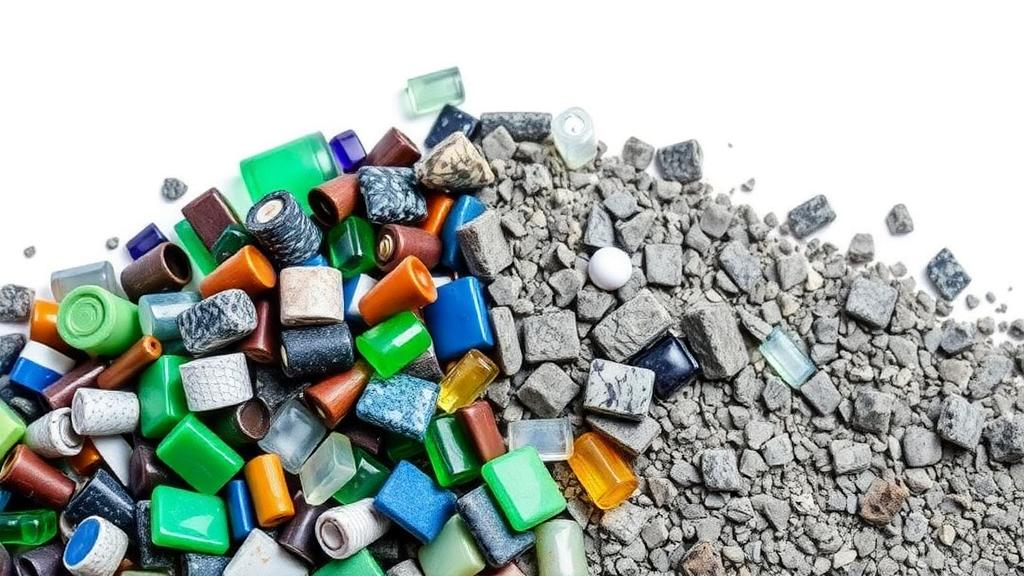
Concrete is the second most consumed material on Earth after water, and its appetite is staggering: more than three tons for every person on the planet, with global demand projected to approach 30 billion tonnes annually. Behind that number lies an uncomfortable climate truth. The Portland cement that binds concrete together is responsible for roughly 8 percent of all human-caused carbon dioxide emissions, and each tonne of cement releases approximately 0.8 tonnes of CO2 during manufacturing. With cement production expected to grow by 30 percent by 2050, researchers have been searching desperately for ways to keep the world building without cooking it. A new study published in Cleaner Engineering and Technology offers one of the most encouraging answers yet: a recipe that swaps out up to 80 percent of cement for two waste streams that cities already produce in abundance.
The research team, led by Baowen Zhang and Md. Uzzal Hossain of Syracuse University alongside Minhajul Islam Aman and Paul Crovella, designed a family of concrete mixtures built around two supplementary cementitious materials, or SCMs. The first is ground glass powder, or GGP, milled from post-consumer glass bottles and processed by KLAW Industries in Binghamton, New York under the trade name Pantheon. The material is cleaned of organic and metallic contaminants and ground below 75 micrometers, fine enough to qualify as an ASTM-approved SCM that can be dropped directly into standard batching procedures. Chemically, it is classic soda-lime glass: about 74 percent silica, 15 percent sodium oxide, and 8.4 percent calcium oxide. The second ingredient is ground granulated blast-furnace slag, or GGBS, a glassy by-product of ironmaking that has long been prized for its latent hydraulic reactivity.
The chemistry of why these wastes work is elegant. In the highly alkaline pore solution of hydrating cement, the silica-rich glass powder undergoes pozzolanic reactions, consuming calcium hydroxide, a weak and soluble by-product of cement hydration, and converting it into additional calcium silicate hydrate gel, the glue that gives concrete its strength. GGBS contributes through its own slow hydraulic reaction while simultaneously lowering the heat of hydration and mitigating chloride ingress. The researchers blended these two materials in equal proportions, replacing Portland limestone cement at total substitution levels of 40, 50, 60, 70, and 80 percent, alongside a binary mix with 20 percent glass powder alone and a pure cement control. Total binder content was held constant at 390.5 kilograms per cubic meter, with water-to-binder ratios between 0.34 and 0.38, so that binder composition was the only variable.
The mechanical results tell a story of patience rewarded. Early on, the blended mixes lagged badly: at three days, the 20 percent glass powder mix was roughly 20 percent weaker than the control, and the 50 percent replacement mix was down 40 percent. Glass powder reacts slowly, and the diluted cement clinker produces less calcium hydroxide to feed the pozzolanic engine. But by 28 days the gap narrowed dramatically, and by 56 days something remarkable happened. The 70 percent replacement mix, BC-3, reached 62.8 megapascals, actually exceeding the control’s 59.8 megapascals, a five percent gain between 28 and 56 days compared with just six percent for pure cement. The 80 percent mix gained 23 percent over the same window. At extreme replacement levels, the slag hydration and glass pozzolanicity act synergistically, refining the pore structure and densifying the matrix long after the cement alone would have finished reacting.
Durability is where the blends truly shine. Surface resistivity, measured with a four-point Wenner probe according to AASHTO T-358, is a proxy for how easily chloride ions, the chief instigators of rebar corrosion, can migrate through concrete. The control mix measured 11.6 kilo-ohm-centimeters, placing it in the high chloride penetrability category. Every blended mix soared past that benchmark: the 60 percent mix hit 81.9, the 70 percent mix 124, and the 80 percent mix a remarkable 156 kilo-ohm-centimeters, a 1,251 percent increase that lands firmly in the very low penetrability class. All blends also suppressed the alkali-silica reaction, the insidious internal swelling that can crack concrete from within, staying well below the 0.10 percent expansion limit of ASTM C1567, while the control crept to 0.098 percent, dangerously close to the threshold. Drying shrinkage, meanwhile, dropped by 46 to 63 percent in the blended mixes relative to the cement-only control.
The environmental accounting is equally striking. Using a cradle-to-gate life cycle assessment aligned with ISO 14040 and 14044, with one cubic meter of concrete as the functional unit, the team quantified five impact categories using source-specific environmental product declaration data rather than generic industry averages, a methodological choice that better captures regional realities. Global warming potential fell from 371.67 kilograms of CO2-equivalent per cubic meter for the control to reductions of 16.4, 38.8, 46.5, 54.3, and 62.1 percent across the escalating blend levels. Eutrophication impacts tracked a similar downward path, and even acidification and smog formation declined, though the slag’s upstream processing burden slightly offset gains at the lowest blend level. Contribution analysis showed the Portland limestone cement share of carbon emissions falling from 86 percent in the control to 50 percent in the highest-replacement mix.
But raw numbers do not tell engineers which mix to pour. To answer that, the team deployed a multicriteria decision analysis using the simple additive weighting method, normalizing eight performance indicators, including slump, compressive and tensile strength, surface resistivity, setting time, CO2 emissions, alkali-silica expansion, and drying shrinkage, onto a common zero-to-one scale with equal weights. The verdict defied the intuitive assumption that maximum replacement wins. The 60 percent replacement mix, BC-2, took first place with a performance score of 0.755, thanks to the program’s best splitting tensile strength at 3.82 megapascals, strong durability, and solid carbon savings. The 70 percent mix ranked second at 0.745, and the 80 percent mix third at 0.715, penalized by an excessive 230-millimeter slump and the highest shrinkage among the blends. The control finished dead last at 0.661.
The researchers then stress-tested their own ranking. Four alternative weighting scenarios, prioritizing mechanical performance, durability, environmental impact, or constructability, each crowned a different leader: BC-2 under mechanical weighting, BC-3 under durability, BC-4 under environmental priorities, and the 20 percent binary mix under constructability. A Monte Carlo analysis sampling 20,000 random weight vectors found BC-2 and BC-4 each ranked first in roughly a quarter of cases. Yet the broader conclusion held firm: the three high-replacement ternary mixes simultaneously outranked the control in 59 percent of sampled weightings, and individually in 60 to 83 percent, making them clearly preferable whenever durability or carbon reduction matters.
The practical implications are considerable. Slower setting times in the blends, with final set stretching from 350 minutes in the control to as long as 735 minutes, complicate construction scheduling but could prove advantageous in hot-weather concreting and mass pours where cold joints are a risk. The extended workability of high-replacement mixes may even allow formulators to reduce or eliminate high-range water reducers, cutting admixture costs. And because the glass powder derives from municipal recycling streams, the approach converts a landfill liability into structural strength, closing a circular loop at the scale of cities.
Caveats remain. The life cycle assessment excluded transportation of finished materials, and because glass powder and slag may travel farther than locally sourced cement, real-world sourcing could shift the environmental rankings. Long-term performance data on flexural strength, freeze-thaw cycling, and field exposure are still needed. But the core finding stands as a genuine milestone: concrete engineered with 60 to 80 percent waste-derived binder can match or beat conventional concrete on strength at later ages, dramatically outperform it on corrosion resistance and alkali-silira stability, and slash its carbon footprint by more than half. For an industry under intense pressure to decarbonize, the humble discarded glass bottle may turn out to be one of the most valuable materials of the coming decade.
Subject of Research: Sustainable concrete design using ground waste glass powder and blast-furnace slag as high-volume cement replacements
Article Title: Designing sustainable concrete to maximize the use of local waste materials: Mechanical, durability, and sustainability-based multicriteria analysis
Article References: Zhang, B., Aman, M. I., Crovella, P., & Hossain, M. U. (2026). Designing sustainable concrete to maximize the use of local waste materials: Mechanical, durability, and sustainability-based multicriteria analysis. Cleaner Engineering and Technology, Article 101335. https://doi.org/10.1016/j.clet.2026.101335
Image Credits: AI Generated
DOI: Not provided
Keywords: sustainable concrete, ground glass powder, GGBS, cement replacement, carbon emissions, life cycle assessment, multicriteria analysis, durability, alkali-silica reaction, chloride resistance, supplementary cementitious materials, circular economy
Cite Scienmag News
Sloane Callahan. (October 13, 2026). Waste Glass and Slag Could Replace Up to 80 Percent of Cement in Concrete. Scienmag. https://scienmag.com/waste-glass-and-slag-could-replace-up-to-80-percent-of-cement-in-concrete/
Sloane Callahan. "Waste Glass and Slag Could Replace Up to 80 Percent of Cement in Concrete." Scienmag, 13 October 2026, https://scienmag.com/waste-glass-and-slag-could-replace-up-to-80-percent-of-cement-in-concrete/. Accessed 13 October 2026.
Sloane Callahan. "Waste Glass and Slag Could Replace Up to 80 Percent of Cement in Concrete." Scienmag. October 13, 2026. https://scienmag.com/waste-glass-and-slag-could-replace-up-to-80-percent-of-cement-in-concrete/


