


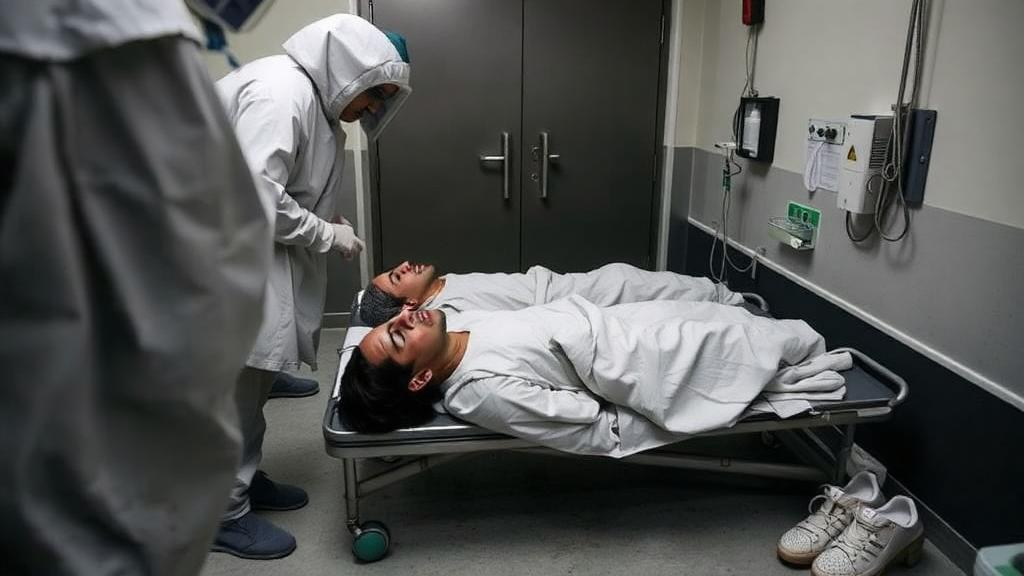
In a morgue in Milan, forensic pathologists have spent a decade quietly documenting one of the starkest and least visible consequences of social exclusion: the deaths of people experiencing homelessness. A new retrospective study, published in the International Journal of Legal Medicine, analyzed 104 medico-legal autopsies performed on homeless individuals in Milan between 2014 and 2024, offering the first systematic forensic picture of mortality in this population anywhere in Italy. The findings are sobering. Most of the dead were men in their early fifties, dying decades before the national average, often in abandoned buildings, railway stations, or on the street. Even more striking, nearly six in ten deaths could not be assigned a definitive cause, a diagnostic void the researchers attribute not to the limits of forensic science itself, but to procedural and structural barriers that prevent the full arsenal of post-mortem investigation from being deployed.
The study was conducted at the Institute of Forensic Medicine of Milan, one of Italy’s largest medico-legal centers, where researchers reviewed the entire autopsy database for the eleven-year period. Of the 7,338 autopsies performed overall, 104 involved individuals classified as homeless, defined as people without a stable residence, including those living on the streets, in public spaces, abandoned buildings, or temporary shelters. That figure represents 1.4 percent of total autopsy activity, but the annual trend tells a more troubling story. The number of homeless decedents rose from a low of just two cases in 2015 to sixteen cases in each of 2023 and 2024, with a marked acceleration in judicially ordered autopsies beginning in 2019. Whether this reflects a genuine rise in deaths, greater awareness among investigators, or both, the trajectory aligns with broader European data showing that homelessness has grown by roughly 70 percent since 2008.
The demographic profile of the dead is itself a form of testimony. Men accounted for 87.5 percent of the cohort, and the median age at death was just 53 years, with a range spanning 18 to 88. No minors were identified, but the researchers noted a progressive decrease in age at death over the study period, with the first cases involving individuals younger than 25 appearing only from 2022 onward. Nearly 59 percent of the decedents were non-Italian, with Romanian and Moroccan nationals forming the largest groups, and statistical analysis showed that Italian decedents were significantly older at death than their foreign-born counterparts, a mean of 54.4 years versus 47.8. Deaths clustered in the colder months, with winter accounting for 35.6 percent of cases and January alone contributing nineteen deaths, a seasonal distribution that differed significantly from chance and underscores the lethal role of environmental exposure.
Where these individuals died speaks volumes about the geography of marginalization. The most common discovery sites were indoor public spaces, which accounted for 43.3 percent of cases: abandoned buildings, railway and metro stations, parking lots, warehouses, and even a cemetery. Hospitals were the second most frequent location at 22.1 percent, followed by streets at 16.3 percent and green areas such as parks at 10.6 percent. The circumstances of discovery also revealed profound social isolation. Only about a quarter of the deaths were witnessed. Among the unwitnessed cases, post-mortem intervals varied wildly, from a few hours to several months, and in one case up to four years elapsed between the last known contact with the deceased and the discovery of the body. More than half of the bodies showed putrefactive changes, a finding the authors link to delayed discovery and limited social networks, which in turn degrade the diagnostic quality of the autopsy itself.
Medical histories, when they could be reconstructed, painted a picture of chronic disease left to run unchecked. Anamnestic data were available for just over half of the cohort, and among those 56 individuals, 75 percent had documented chronic conditions. Type 2 diabetes was the most frequently recorded illness, followed by cardiovascular disease and hypertension, with tuberculosis, epilepsy, liver cirrhosis, and hepatitis C infection also appearing repeatedly. Psychiatric or psychosocial information existed for 43 cases, and within that subgroup, substance use involving drugs or alcohol was documented in nearly three-quarters. Yet only four individuals had a formally diagnosed psychiatric disorder, a discrepancy the researchers attribute to fragmented healthcare access, episodic crisis-oriented care, and diagnostic overshadowing, the well-documented tendency of clinicians to attribute physical symptoms to mental illness or substance use rather than investigating underlying organic pathology. In Italy, historical restrictions on general practitioner access for people without a registered residence compounded these gaps.
The classification of causes of death exposed the study’s central paradox. Natural deaths accounted for 24 percent of the cohort, led by pneumonia, internal hemorrhages, cardiovascular events, and active tuberculosis, conditions that in housed populations are typically caught and treated long before they become fatal. Non-natural deaths, including suicides, homicides, and accidents, made up 16.4 percent, with blunt trauma and transport-related incidents dominating the injury mechanisms. But the single largest category, 59.6 percent of all cases, was undetermined. These were deaths recorded as acute circulatory insufficiency or asystole, a medico-legal designation applied when no macroscopic autopsy findings can support a specific diagnosis. In 45 of these cases, the autopsy revealed nothing abnormal at all; in 17, abnormalities were present but not acutely lethal. For comparison, undetermined deaths made up only 16.3 percent of autopsies on the non-homeless population at the same institute during the same period, a difference so large that the probability of it arising by chance is vanishingly small.
The reason for this diagnostic gap lies less in pathology than in bureaucracy. In Italy, ancillary post-mortem investigations, including toxicological and histopathological analyses, require explicit authorization from the Public Prosecutor, and resource and procedural constraints mean they are rarely requested. In this cohort, toxicology was performed in only 4.8 percent of cases and histology in just 1.9 percent. Yet when these tests were carried out, their diagnostic yield was remarkable. Toxicological analysis revised the initial diagnosis in three deaths that would otherwise have remained classified as presumed natural: one man had died of acute carbon monoxide poisoning, another of a combined cocaine and methadone overdose, and one woman of acute citalopram intoxication. Histology, likewise, identified a myocardial infarction and a case of pneumonia that macroscopic examination alone had missed. In other words, the few ancillary tests that were performed fundamentally changed the forensic conclusions, suggesting that many of the 62 undetermined deaths conceal identifiable causes that routine laboratory work could have revealed.
One of the study’s most statistically robust findings concerns sex. Although women made up only 12.5 percent of the cohort, they were far more likely than men to die from non-natural causes: 46.2 percent of female decedents died violently, compared with 12.1 percent of men, corresponding to a sixfold increase in odds that reached statistical significance. Among the women whose deaths were classified as non-natural, suicide and homicide together accounted for two-thirds of cases. This pattern echoes international evidence that homeless women face heightened exposure to violence and occupy a particularly vulnerable position within already precarious circumstances. The authors caution that the small number of female decedents limits the precision of the estimate, but the direction of the effect, combined with prior cohort studies of homeless women, reinforces the conclusion that sex-specific risks demand targeted prevention strategies rather than one-size-fits-all interventions.
The researchers are candid about the limitations of their work. Housing status was established from circumstantial information in forensic and police records rather than independent verification, and unidentified decedents who were in fact homeless may have gone unrecognized, meaning the true toll is likely higher than 104. Information on the duration and trajectory of each individual’s homelessness was largely unavailable, preventing analysis of how mortality risk changes over the course of housing loss, a dimension that recent Danish register studies have shown to be critical. Those same large-scale studies contextualize the Milan findings: all-cause mortality rate ratios among homeless individuals exceed six compared with the general population, with mean losses of roughly fifteen life-years in both sexes. Against that backdrop, a median age at death of 53 in the Milan cohort is not an anomaly but a local expression of a global mortality penalty.
What emerges from this decade of forensic observation is a portrait of deaths that are neither random nor, in many cases, inevitable. The authors argue that the patterns they documented, premature natural deaths from treatable infections and cardiovascular disease, violent deaths concentrated among women, and a vast reservoir of undetermined causes, are identifiable and largely preventable. Their prescription runs on two parallel tracks. On the clinical side, they call for proactive outreach models such as street medicine, harm reduction services, and continuity of care that follows individuals beyond the hospital door. On the forensic side, they urge standardized protocols that make toxicological and histological analyses routine in deaths of socially vulnerable individuals, rather than exceptional measures requiring special authorization. Comprehensive post-mortem investigation, they contend, is not merely a technical matter of diagnostic accuracy; it is a matter of equity, judicial accountability, and human dignity, ensuring that the deaths of the most marginalized are counted, understood, and, where possible, prevented.
Subject of Research: Forensic analysis of mortality and post-mortem investigation challenges among homeless individuals in Milan, Italy
Article Title: Forensic insights into mortality and challenges in post-mortem investigations of homeless individuals: a 10-year study (2014–2024) in Milan, Italy
Article References: Tambuzzi, S., Valleriani, D., Carsana, C., Arzenati, P., Mazzarelli, D., & Cattaneo, C. (2026). Forensic insights into mortality and challenges in post-mortem investigations of homeless individuals: a 10-year study (2014–2024) in Milan, Italy. International Journal of Legal Medicine. https://doi.org/10.1007/s00414-026-04037-z
Image Credits: AI Generated
DOI: 10.1007/s00414-026-04037-z
Keywords: homelessness, forensic medicine, autopsy, mortality, cause of death, toxicology, histology, public health, social marginalization, Milan, undetermined deaths, healthcare access
Cite Scienmag News
Ophelia Keating. (October 13, 2026). Autopsies Reveal a Hidden Crisis of Early Death Among the Homeless in Milan. Scienmag. https://scienmag.com/autopsies-reveal-a-hidden-crisis-of-early-death-among-the-homeless-in-milan/
Ophelia Keating. "Autopsies Reveal a Hidden Crisis of Early Death Among the Homeless in Milan." Scienmag, 13 October 2026, https://scienmag.com/autopsies-reveal-a-hidden-crisis-of-early-death-among-the-homeless-in-milan/. Accessed 13 October 2026.
Ophelia Keating. "Autopsies Reveal a Hidden Crisis of Early Death Among the Homeless in Milan." Scienmag. October 13, 2026. https://scienmag.com/autopsies-reveal-a-hidden-crisis-of-early-death-among-the-homeless-in-milan/


