


Medical students often choose their future specialties long before they have ever set foot in the relevant clinical environment, and few fields illustrate that paradox more clearly than otolaryngology. Head and neck surgery rarely features prominently in the preclinical curriculum, leaving many first- and second-year students to form impressions of the specialty from secondhand accounts or brief encounters during shadowing. A new prospective study published in BMC Medical Education suggests that a single, carefully structured week of immersion can dramatically change that picture. Researchers at Thomas Jefferson University evaluated the Jefferson Otolaryngology Externship Program, an extracurricular initiative designed to give preclinical students direct, hands-on exposure to the specialty at a single academic medical center, and found that participants reported substantial gains in knowledge, confidence, and career interest after just five days.
The study enrolled first- and second-year medical students who completed the externship during scheduled academic breaks, a design choice that allowed participants to engage fully without competing with required coursework. Across six separate cohorts, 36 students took part in the program, and 34 of them, or 94.4 percent, completed both the pre-program and post-program surveys, giving the researchers an unusually complete dataset for an educational intervention of this kind. The participants had a mean age of 24.4 years, and 58.8 percent identified as female, a demographic profile broadly representative of contemporary medical school classes in the United States. Because the study was prospective, with surveys administered before and after the externship, the investigators could track changes within each individual rather than relying on retrospective recall.
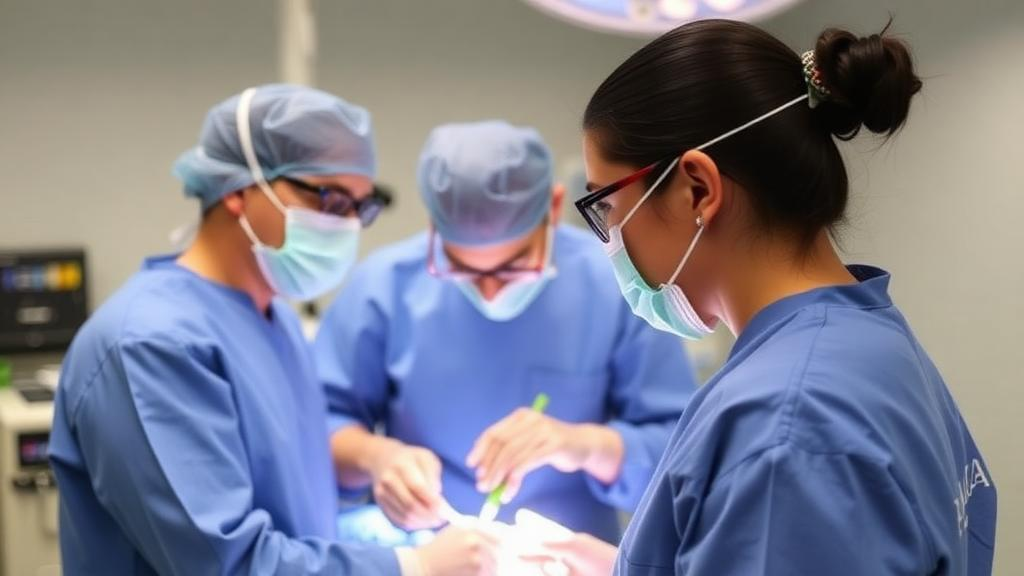
The structure of the externship itself is central to understanding its impact. Rather than offering passive observation, the program rotated students through the operating room, the outpatient clinic, and morning rounds, pairing each setting with resident-led surgical workshops that emphasized practical skills. This combination meant that students saw the full arc of otolaryngology practice: the preoperative evaluation in clinic, the technical demands of surgery, and the postoperative management that follows. The resident-led workshops deserve particular attention, because they positioned near-peers rather than senior faculty as instructors, a format that educational research has repeatedly linked to reduced anxiety and more honest questions from junior learners. For students who had never scrubbed into a case, the opportunity to handle instruments and rehearse techniques under resident supervision represented a first encounter with surgical culture that lectures cannot replicate.
To measure the program’s effects, the researchers used a 15-item survey scored on a five-point Likert scale, in which respondents rated their agreement with statements ranging from 1 for strongly disagree to 5 for strongly agree. The survey items targeted three domains: career interest in otolaryngology, self-assessed knowledge of the field, and confidence in both clinical and surgical settings. Because the same students completed the survey twice, the investigators analyzed the paired responses using Wilcoxon matched-pairs signed-rank tests, a nonparametric statistical method appropriate for ordinal data that does not assume a normal distribution. This choice of analysis is technically important, since Likert-scale responses are inherently ordered rather than continuous, and parametric tests such as the paired t-test can produce misleading results when applied to such data.
The results were striking in both their magnitude and their statistical consistency. Post-program scores were significantly higher than pre-program scores for understanding of otolaryngology as a career, for knowledge of head and neck anatomy, and for confidence in the operating room, with each comparison reaching a p value below 0.0001. In practical terms, a p value that small means the probability of observing such large improvements by chance alone is vanishingly remote, even after accounting for multiple comparisons. The median total survey score rose from 31 before the intervention, with an interquartile range of 24.5 to 35.5, to 44 afterward, with an interquartile range of 40.0 to 45.0, again with a p value below 0.0001. An increase of thirteen points on a scale whose theoretical maximum is 75 represents a shift from the middle of the response range toward its upper end, and the tightening of the interquartile range suggests that the improvement was consistent across participants rather than driven by a few enthusiastic outliers.
The career-interest findings may prove the most consequential for the specialty itself. After completing the externship, 82.4 percent of participants reported increased interest in otolaryngology, and 94.1 percent indicated greater interest in pursuing the field as a career. Otolaryngology is among the most competitive specialties in the National Resident Matching Program, and applicants who discover the field late in their training often struggle to accumulate the research experience, letters of recommendation, and clinical exposure that successful applications require. By introducing students to the specialty in their first or second year, the externship gives them time to build a coherent application narrative, seek mentorship, and confirm that the field genuinely suits them before the match process begins. Early exposure, in other words, functions not only as education but as a pipeline intervention.
The study’s authors describe the program as student-driven, and that characterization carries real weight for institutions considering similar initiatives. The externship was extracurricular, meaning it did not require curricular reform, new course slots, or approval from a medical school committee to operate. Its resource demands were correspondingly low: the essential ingredients were willing residents and faculty, access to operating rooms and clinics that already function daily, and a coordinator to manage logistics. The researchers explicitly note that this structure and its low-resource profile support replicability across institutions, positioning the Jefferson model as a template that other departments could adapt without significant financial investment. Among formally evaluated programs of this kind, the authors report that theirs is one of the first, which makes the prospective data especially valuable as a benchmark for future efforts.
The study did receive ethics approval from the Thomas Jefferson University Institutional Review Board and was conducted in accordance with the Declaration of Helsinki, and the work was presented at the Combined Otolaryngology Spring Meeting in New Orleans in May 2025 before its publication on 13 October 2026. The authors declare no competing interests and received no external funding, details that strengthen the credibility of the findings. Nevertheless, some limitations are worth keeping in view when interpreting the results. The self-reported outcome measures capture perceived knowledge and confidence rather than objectively tested competence, and students who volunteer for an otolaryngology externship are plausibly more predisposed toward the specialty than their peers, a selection effect that no pre-post design can fully eliminate. The single-institution setting, while enabling careful program control, leaves open the question of whether identical results would emerge at schools with different resources or patient populations.
Even with those caveats, the findings arrive at a moment when medical educators are actively searching for scalable ways to counteract what many describe as specialty blindness among preclinical students. The conventional assumption has been that meaningful specialty exposure requires months of clinical time that preclinical curricula cannot spare, but this study suggests that intensity and structure may matter more than duration. A single week, deliberately organized around the operating room, the clinic, rounds, and skills workshops, produced measurable and statistically robust changes in how students understood and valued a surgical specialty. If replicated at other institutions, the model could reshape how medical schools approach early career development, shifting the burden from curricular overhauls to lean, department-level partnerships between residents and eager first- and second-year students. For a specialty competing for talent against fields with far earlier curricular visibility, that is a message worth hearing.
Subject of Research: A prospective evaluation of a structured preclinical otolaryngology externship on medical students' knowledge, confidence, and career interest
Article Title: The early exposure advantage: a prospective evaluation of a structured preclinical otolaryngology externship
Article References: Sina, E. M., Estephan, L. E., Corr, A., Wride, W., Moroco, A., Huntley, C., Goldman, R., & Cognetti, D. (2026). The early exposure advantage: a prospective evaluation of a structured preclinical otolaryngology externship. BMC Medical Education. https://doi.org/10.1186/s12909-026-10579-y
Image Credits: AI Generated
DOI: 10.1186/s12909-026-10579-y
Keywords: otolaryngology, medical education, preclinical students, externship, career development, surgical education, curriculum development, prospective cohort study, Wilcoxon signed-rank test, residency match, experiential learning, Thomas Jefferson University
Cite Scienmag News
Caroline Murphy. (October 13, 2026). One Week in the Operating Room Reshapes How Medical Students See Otolaryngology. Scienmag. https://scienmag.com/one-week-in-the-operating-room-reshapes-how-medical-students-see-otolaryngology/
Caroline Murphy. "One Week in the Operating Room Reshapes How Medical Students See Otolaryngology." Scienmag, 13 October 2026, https://scienmag.com/one-week-in-the-operating-room-reshapes-how-medical-students-see-otolaryngology/. Accessed 13 October 2026.
Caroline Murphy. "One Week in the Operating Room Reshapes How Medical Students See Otolaryngology." Scienmag. October 13, 2026. https://scienmag.com/one-week-in-the-operating-room-reshapes-how-medical-students-see-otolaryngology/


