


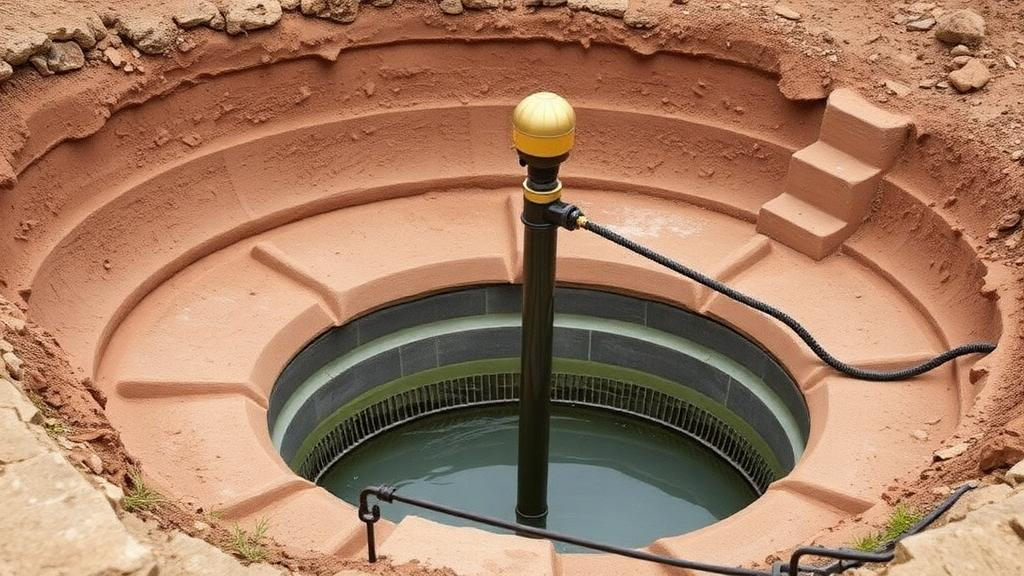
Deep beneath the Jordan Rift Valley, a network of abandoned water wells has been quietly recording something extraordinary: the faint fingerprints of earthquakes before they happen. A new study published in Environmental Earth Sciences reports that a real-time groundwater monitoring system deployed along the Dead Sea Transform fault system detected statistically significant anomalies in water levels and water chemistry more than an hour before a magnitude 5.5 earthquake struck offshore Saudi Arabia, roughly 400 kilometers south of the monitoring sites. The finding, led by Yaakov Anker of Ariel University together with colleagues from Mekorot, Tel Aviv University and Ariel University’s computer science department, offers some of the most concrete evidence yet that ordinary wells can function as early-warning sentinels for tectonic ground movements.
The physics behind the approach rests on how earthquakes nucleate. Before a fault ruptures in the plastic, seismic stage, rock undergoes a slow, elastic stage of stress accumulation. Laboratory experiments on glass samples, used as analogues for rock, have shown that this pre-plastic creep stage manifests in the development of small cracks that coalesce into larger splits, accompanied by measurable electromagnetic radiation. In a confined aquifer, this slow deformation changes the pressure field: in zones of preliminary extension, the groundwater system responds to a lower hydrostatic load before the event and a higher load afterward, while in zones of compression the trend is reversed, with a water-level rise expected before the shock. Because the duration of the elastic stage lengthens as the coming earthquake grows in magnitude, these subtle pressure changes should cross a sensor’s detection threshold earlier for larger events, which is precisely what makes wells a plausible forecasting tool rather than merely a post-event recorder.
History has long hinted at this connection. Abnormal water-level changes were documented in many Japanese wells before both the 1978 magnitude 6.8 Izu-Oshima earthquake and the devastating 1995 Kobe earthquake, alongside shifts in groundwater temperature, radon emission, chloride and sulfate concentrations, and dissolved gas ratios in mineral springs. Those recurring hydrologic precursors prompted the Japanese government to maintain water-level monitoring at more than 30 wells in seismically active areas. In Israel, earlier work along the Dead Sea Transform found indications of two moderate earthquakes in 2004 about one hour before the first seismographic record, in wells located roughly 100 kilometers apart. What has been missing, the researchers argue, is a constant, reliable, high-temporal-resolution dataset capable of turning such sporadic observations into a systematic alert scheme.
To build one, the team selected non-operational wells owned by Mekorot, the Israeli national water company, that satisfied a strict set of hydrogeological criteria. Each borehole had to tap a confined aquifer, because the higher water head in confinement amplifies the tectonic stress-imposed pressure reaction, and had to sit near an active tectonic system that acts as a vector of the regional stress field. The wells also had to be dedicated to observation only, disconnected from pumping systems, and located far enough from neighboring production wells to avoid artificial interference. The final network included the Carmel 13, Ta’anach 4, Nurit 1 and, later, Hindaj 2 wells, all positioned along major faults of the Dead Sea Transform, which links the Red Sea and Suez rifting to the great fault systems of the Eastern Mediterranean, including the Hellenistic arc and the North Anatolian system.
The instrumentation evolved through three research phases. Early observations relied on sporadic water-level readings caught by Mekorot’s maintenance system, then on a SCADA telemetry platform with a 15-minute sampling resolution that proved too coarse. The final configuration paired MSI Scantech potentiometric pressure sensors with GLI International combined temperature and electrical conductivity probes, connected to a 3Gtrack GS282-H2 GPRS data logger that samples every minute and transmits to a central Hydrogeological and Seismological Information Center every 15 minutes. Minute-level resolution matters because the precursory signals are small: groundwater level responses during the study ranged over just a few centimeters, and conductivity shifts of a few hundred micro-Siemens had to be separated from natural daily oscillations of several hundred micro-Siemens driven largely by tidal effects.
The analytical core of the system is short-term forward modeling. Water level, which descends gradually in summer and rises in winter, is modeled with linear regression whose slope and intercept are continually updated from a moving average over the previous 48 hours. Groundwater conductivity, which oscillates with a daily rhythm attributed to lunar tidal effects even in inland confined aquifers, is modeled with a nonlinear cosine-based regression whose amplitude, frequency and datum coefficients are fitted over roughly a day of training data. The model’s forward trajectory is then extrapolated four training-period lengths into the future and compared against incoming measurements. When the correlation between modeled and measured data falls below 0.8, the divergence is flagged as distinct. Anomaly detection combines Seasonal and Trend decomposition using Loess and Differential Seasonal Rolling Z statistics for the linear water-level series with a short-term memory autoencoder and Z-score methods for the nonlinear conductivity series, all applied to raw sorted data because preprocessing steps such as band-pass filtration were found to introduce bias.
The decisive test came on 27 June 2015, when the magnitude 5.5 earthquake struck offshore Saudi Arabia. Both the Hindaj 2 and Carmel 13 wells diverged from their predicted water-level trajectories several hours before the event: Hindaj 2 showed a rise of about one centimeter against its descending trend, while Carmel 13 showed a relaxation of its own decline. More strikingly, groundwater conductivity at both sites increased by approximately 200 micro-Siemens per square centimeter about six hours before the shock, while the correlation with the baseline model dropped by about 20 percent. When the automated detection system was later run on the archived data, it registered four independent indicators across the two wells, generating an alert more than an hour before the earthquake. By contrast, most smaller events, including quakes as weak as magnitude 2.3 offshore Cyprus and twin magnitude 3.1 events near Sinai and Beirut in October 2014, produced only post-event reactions or sporadic single indications that could not be distinguished from natural fluctuation.
The statistical architecture is designed to suppress false positives, the historic Achilles heel of earthquake prediction research. A single anomaly carries no significance, since anomalies attributed to earthquakes have repeatedly appeared only after events or in unsystematic patterns days, weeks or months beforehand. The system therefore requires three independent indications within a single time frame. With a three-day scanning window at five-minute sampling resolution, yielding 432 points per series, the joint probability of three coincidental independent anomalies is calculated as roughly 1.24 times 10 to the minus 8, giving a confidence level above 0.99999 that the pattern is not random. Independence is established both spatially, through multiple monitoring stations, and physically, through different measured parameters drawn from separate sensors. Validation on held-out datasets from 2016 to 2019 showed the calibrated platform reliably identifying events above magnitude 3, including advance identification of a magnitude 3.4 event on 6 March 2019, while smaller magnitude 2.6 events escaped detection.
The study’s conclusion formally rejects the null hypothesis that groundwater pressure and conductivity anomalies are unrelated to tectonic stress. The authors propose that pre-seismic slow motion, part of the pressure accumulation that precedes fault rupture, is reflected in aquifer properties before the seismic event, and that seismic stress is routed along fault systems to hydrologically reactive pressure joints, a mechanism also reported for distant earthquakes in Iran. The practical sensitivity threshold aligns with operational needs: since early warning for events below magnitude 6 is largely redundant, the system’s ability to statistically validate events of that scale and above, using single indicators for shocks above magnitude 3.5 and triple-indicator alerts above magnitude 5.5, matches the hazard that matters. Future development outlined by the team includes an automated warning platform for magnitude 6 and greater events, expanded coverage of both the Dead Sea Transform and the Carmel-Gilboa fault system, a minimum of three monitoring wells per fault system, and a triangulation algorithm that could use indications from different locations to estimate the epicenter of a coming quake.
If the approach matures, the implications extend well beyond the eastern Mediterranean. Confined, fractured rock aquifers near active faults exist along most of the world’s major plate boundaries, and the required sensors, pressure transducers and conductivity probes, are inexpensive compared with seismological networks. The method would not replace P-wave-based early warning systems such as Japan’s, which provide seconds of notice at the epicenter, but it targets a different and potentially more valuable window: hours of lead time, enough for task forces to mobilize, infrastructure to be shut down safely and populations to be alerted. For a field that has chased reliable short-term prediction since the 1970s through foreshocks, geodetic changes, radon emission and even unusual animal behavior, the sight of four independent groundwater sensors agreeing on an impending rupture, an hour in advance, marks a rare and tantalizing step from anomaly hunting toward operational forecasting.
Subject of Research: Groundwater monitoring as an early indicator of tectonic ground movements and earthquakes along the Dead Sea Transform
Article Title: Potential early indication of tectonic ground movements by water-well monitoring datasets, with short-term forward modeling
Article References: Potential early indication of tectonic ground movements by water-well monitoring datasets, with short-term forward modeling. (n.d.). https://doi.org/10.1007/s12665-026-13154-2
Image Credits: AI Generated
DOI: 10.1007/s12665-026-13154-2
Keywords: earthquake prediction, groundwater monitoring, Dead Sea Transform, confined aquifer, early warning systems, hydrogeology, seismology, water level anomalies, electrical conductivity, forward modeling, anomaly detection, Jordan Rift Valley
Cite Scienmag News
Violet Maxwell. (October 12, 2026). Groundwater Wells Gave an Hour’s Warning Before a Major Earthquake. Scienmag. https://scienmag.com/groundwater-wells-gave-an-hours-warning-before-a-major-earthquake/
Violet Maxwell. "Groundwater Wells Gave an Hour’s Warning Before a Major Earthquake." Scienmag, 12 October 2026, https://scienmag.com/groundwater-wells-gave-an-hours-warning-before-a-major-earthquake/. Accessed 12 October 2026.
Violet Maxwell. "Groundwater Wells Gave an Hour’s Warning Before a Major Earthquake." Scienmag. October 12, 2026. https://scienmag.com/groundwater-wells-gave-an-hours-warning-before-a-major-earthquake/


