


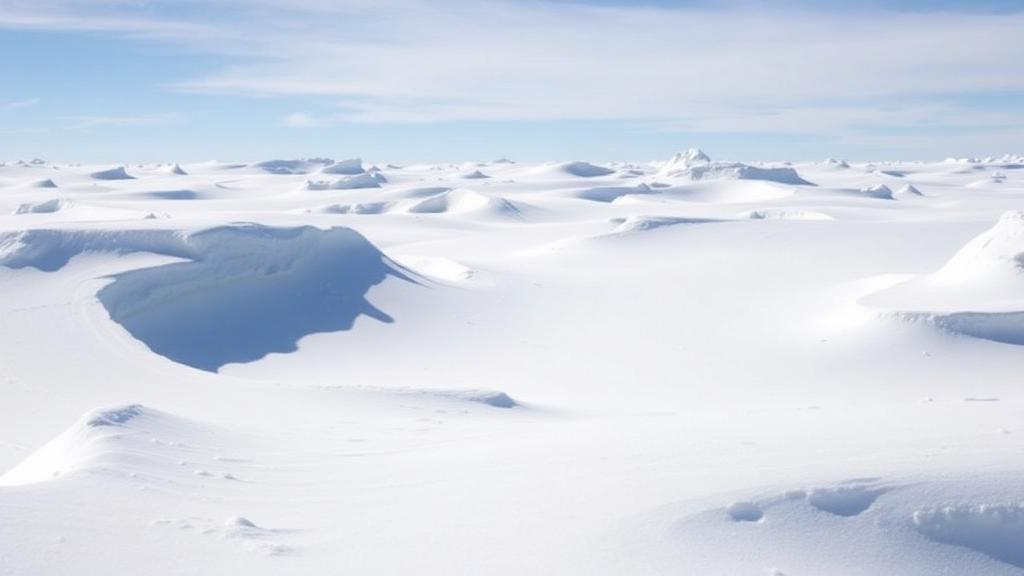
Deep in the Canadian Arctic, the snowpack is not the soft, uniform blanket most people imagine. It is a thin, wind-scoured, fiercely stratified layer of ice crystals that controls whether the ground beneath it freezes or thaws, whether permafrost carbon stays locked away, and whether caribou and lemmings can survive the winter. Yet the snow models embedded in the world’s climate models were largely built for deep alpine snowpacks in the mid-latitudes, and they have long struggled to capture the peculiar physics of Arctic snow. A new study published in Geoscientific Model Development shows that a deceptively simple, single-layer snow model can be taught to handle the tundra, and the results could ripple through climate projections for the entire circumpolar North.
The work, led by Mickaël Lalande of the Université du Québec à Trois-Rivières together with colleagues at Environment and Climate Change Canada, Université Laval, and other institutions, targets the snow scheme inside CLASSIC, the Canadian Land Surface Scheme including Biogeochemical Cycles. CLASSIC is no obscure research toy: it is the land component of the Canadian Earth System Model, the model Canada uses for climate change impact assessments, including the IPCC reports. If its snow physics are wrong in the Arctic, the errors propagate into simulated soil temperatures, permafrost thaw, and the enormous carbon stocks that Arctic soils hold, which contain nearly twice as much carbon as the atmosphere itself.
The team’s diagnosis began with a stark set of biases. At three Arctic sites, Bylot Island, Umiujaq TUNDRA, and Trail Valley Creek, the default version of the model overestimated snow depth by roughly 10 to 20 centimeters, a huge relative error for snowpacks that rarely exceed half a meter, and it overestimated winter soil temperatures by 5 to 10 degrees Celsius. The culprit was an overly insulating simulated snowpack: the model’s compaction scheme capped the maximum density of dry snow at values far below those actually measured in wind-blasted tundra, where bulk densities of 250 to 400 kilograms per cubic meter are common. A snowpack that is too fluffy and too deep is a snowpack that insulates too well, and the soil below stays artificially warm.
The fix is the study’s centerpiece: a novel wind-dependent compaction scheme. When wind speeds exceed a threshold of about 2.5 meters per second, the model now allows thin snowpacks to densify toward higher maximum densities, mimicking the formation of the dense wind slab that caps real Arctic snow. A Gaussian weighting function centers this wind effect on snowpacks around 80 centimeters deep, so that deep mid-latitude snowpacks, where gravity and metamorphism dominate compaction, remain essentially untouched. The elegance of the approach is that it lets a single-layer model implicitly represent the two-layer architecture of tundra snow, a low-density basal layer of depth hoar beneath a dense wind slab, without ever resolving those layers explicitly. The payoff was dramatic: the average snow depth bias across the Arctic sites collapsed from 12.0 centimeters to just 0.1 centimeters.
But the compaction scheme alone was not enough, because the model’s thermal plumbing was also leaking errors. The researchers identified a subtle compensating-bias problem in how the temperature at the snow-soil interface was computed. The old formulation weighted the bulk snow temperature too heavily, underestimating the bottom snow temperature and driving an excessive conductive heat flux from the soil into the snow. That artificially warmed the snow while masking the warm soil bias. Correcting the bottom snow temperature formulation, by weighting the soil and snow temperatures with the inverse of their layer depths, improved the physics, but initially made the soil temperature errors worse, because the old snow thermal conductivity parameterization had been quietly compensating all along.
That is where a second key change came in. The team replaced the widely used Sturm et al. conductivity relationship, based on heated-needle-probe measurements now known to underestimate conductivity in fragile, anisotropic depth hoar, with the more recent parameterization of Calonne et al., which was calibrated using high-resolution three-dimensional images of snow microstructure. The new relationship yields higher conductivities, allowing excess soil heat to escape through the snowpack to the atmosphere rather than pooling in the ground. Combined with the other developments, this change slashed the root-mean-square error of simulated soil temperatures at the Arctic sites from 5.3 to 3.0 degrees Celsius on average, and at Bylot Island the winter soil temperature bias fell from nearly 7 degrees to under 1 degree.
The study also tackled the snow surface itself. Under stable winter atmospheres, the standard Monin-Obukhov theory of turbulence shuts down heat exchange almost completely, producing a notorious cold bias in simulated snow surface temperatures, sometimes approaching 10 degrees in earlier versions of the model. The researchers activated a windless exchange coefficient, first proposed by Ross Brown and colleagues two decades ago, which injects a small baseline turbulent exchange of 2 watts per square meter per kelvin whenever the surface is colder than the air. Across the seven mid-latitude and alpine SnowMIP sites, this single change cut the surface temperature error from 3.50 to 1.93 degrees Celsius on average, while leaving snow depth and soil temperatures essentially unharmed.
One Arctic-specific addition proved surprisingly modest: blowing-snow sublimation, the loss of snow mass as windblown crystals evaporate mid-air. Implemented using the empirical formulation of Gordon and colleagues, it mattered only at the windiest sites, Umiujaq, Trail Valley Creek, and the alpine Senator Beck basin, where it shaved 2 to 4 centimeters off simulated snow depth. At most sites its effect was negligible, a useful reminder that not every Arctic process needs a heavy parameterization to be represented fairly.
Crucially, the improvements did not come at the cost of the model’s existing skill. Evaluations across the SnowMIP sites, which include classic alpine and mid-latitude locations such as Col de Porte in France and Weissfluhjoch in Switzerland, showed that the final configuration maintained or improved performance there, with snow depth errors actually declining. The overall score across all sites and variables rose from 0.284 to 0.380. Trail Valley Creek was deliberately held out of the tuning process as an independent validation site, and the team also published an adjusted version of the compaction parameters that includes it, acknowledging the substantial uncertainties in snowfall measurements at that windswept station.
The implications extend well beyond snow depth. Improved winter soil temperatures changed the simulated net ecosystem exchange of carbon dioxide at the Arctic sites, in some cases shifting the annual carbon balance from a source toward a sink, because colder soils mean less winter respiration. That sensitivity underscores why snow physics is not a niche concern: it is a gatekeeper for the Arctic carbon feedback that could amplify global warming. The authors are candid about remaining limitations, including the absence of explicit moss and lichen layers, unrepresented shrub thermal bridging, and the harsh realities of Arctic fieldwork, where frost on sensors, polar night, and blowing snow make both forcing data and observations uncertain. Their next step is to carry these point-scale improvements to pan-Arctic spatial simulations, where snow cover fraction parameterizations will face the full chaos of sub-grid heterogeneity. For now, the study stands as a demonstration that even a humble single-layer snow model, given the right physics, can earn its place in the Arctic.
Subject of Research: Improving Arctic snowpack simulation in the CLASSIC land surface model through revised snow compaction, thermal conductivity, and heat exchange physics
Article Title: Improving the CLASSIC (v1.8) snow model to better simulate Arctic snowpacks
Article References: Lalande, M., Roy, A., Wang, L., Verseghy, D., Vionnet, V., Dominé, F., & Kinnard, C. (2026). Improving the CLASSIC (v1.8) snow model to better simulate Arctic snowpacks. Geoscientific Model Development, 19(19), 9581-9625. https://doi.org/10.5194/gmd-19-9581-2026
Image Credits: AI Generated
Keywords: snow model, Arctic snowpack, CLASSIC, land surface model, permafrost, soil temperature, snow compaction, blowing snow, thermal conductivity, climate modeling, carbon cycle, Geoscientific Model Development
Cite Scienmag News
Katie Riggs. (October 12, 2026). Arctic Snow Gets a Makeover: Scientists Rebuild a Climate Model’s Snow Physics. Scienmag. https://scienmag.com/arctic-snow-gets-a-makeover-scientists-rebuild-a-climate-models-snow-physics/
Katie Riggs. "Arctic Snow Gets a Makeover: Scientists Rebuild a Climate Model’s Snow Physics." Scienmag, 12 October 2026, https://scienmag.com/arctic-snow-gets-a-makeover-scientists-rebuild-a-climate-models-snow-physics/. Accessed 12 October 2026.
Katie Riggs. "Arctic Snow Gets a Makeover: Scientists Rebuild a Climate Model’s Snow Physics." Scienmag. October 12, 2026. https://scienmag.com/arctic-snow-gets-a-makeover-scientists-rebuild-a-climate-models-snow-physics/


