


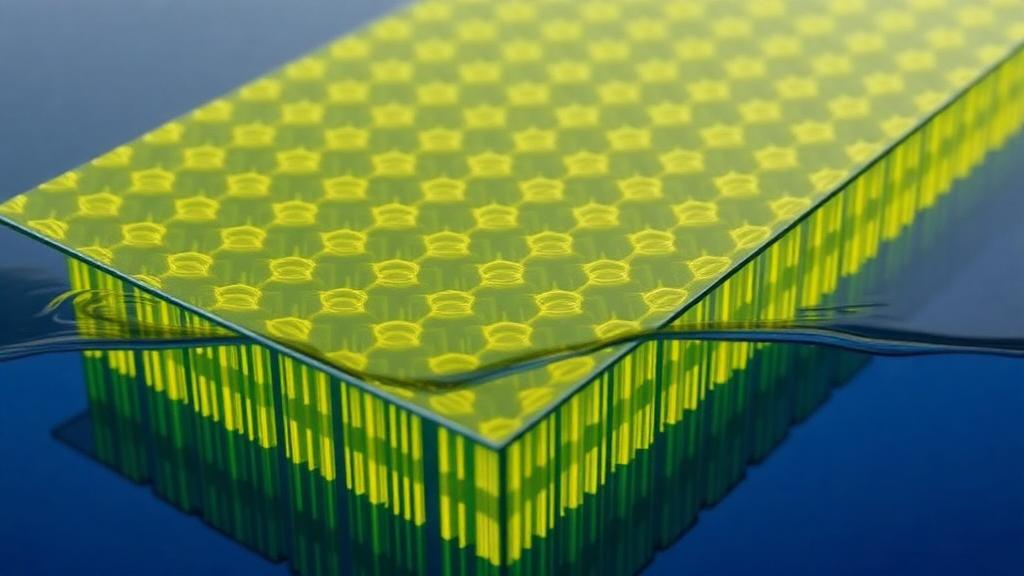
Petroleum refineries and oil fields discharge enormous volumes of wastewater laden with free oil, heavy metals, aromatic hydrocarbons, phenols, sulfides, and a host of organic and inorganic micropollutants. Conventional physical membrane separation can strip these contaminants from water, but it concentrates the toxic residue and demands frequent cleaning. A promising alternative is the membrane bioreactor, which couples biological oxidation with membrane filtration to degrade pollutants and reclaim clean water. Yet membrane fouling, the gradual clogging of pores by suspended biological matter, oil droplets, and microbial films, remains the Achilles heel of long-term operation. Now, a research team at King Fahd University of Petroleum and Minerals has engineered a new antifouling membrane that tackles this problem at the nanoscale, using a cleverly designed interlayer of two-dimensional materials sandwiched beneath a conductive polymer skin.
The team, led by Lukka Thuyavan Yogarathinam, Nadeem Baig, and Alexis Nzila of the Interdisciplinary Research Center for Membranes and Water Security, reports in Results in Engineering a polypyrrole membrane reinforced with a hybrid interlayer of titania nanosheets and graphitic carbon nitride. Their choice of materials was deliberate. Titanium dioxide is famed for its super-hydrophilicity, photocatalytic activity, and antibacterial character, but it suffers from weak visible-light response and tends to agglomerate and leach when blended into polymers. Graphitic carbon nitride, a metal-free two-dimensional photocatalyst, complements titania with visible-light activity and nitrogen-rich surface chemistry, but it too aggregates and disperses poorly in polymer matrices. Coupling the two into a single hybrid nanosheet, the researchers reasoned, could combine their strengths while creating continuous water-transport pathways through the membrane.
Getting the nanosheets to stay put was the central technical challenge. Blending nanomaterials into a polymer buries them inside the matrix where they cannot interact with foulants, while layer-by-layer deposition often produces dense coatings that throttle water flow. The researchers instead turned to coordination chemistry inspired by plant biology. Tannic acid, a naturally occurring polyphenol, forms a stable self-assembled network with ferric iron, and its catechol and galloyl groups anchor titania nanosheets through metal-phenolic coordination while binding graphitic carbon nitride through pi-pi interactions. This tannic acid-iron scaffold, deposited on a hydrolyzed polyacrylonitrile support, holds the nanosheets in place and simultaneously regulates how pyrrole monomers adsorb and polymerize into the overlying polypyrrole active layer.
The synthesis itself showcases precise control. Graphitic carbon nitride was produced by heating melamine at 550 degrees Celsius for four hours, yielding yellow nanosheets with the characteristic heptazine framework. The titania nanosheets required a more exotic route: an air-gap-assisted solvothermal process in which titanium isopropoxide in dimethylformamide was heated at 150 degrees Celsius for 48 hours in a reactor with a controlled headspace, producing ultrafine, wrinkled, nanocrystalline sheets. Combining the two materials in the same solvothermal reaction produced a compact, interconnected hybrid nanosheet whose diffraction pattern and infrared spectrum revealed strong interfacial interactions, including hydrogen bonding between the hydroxyl-rich titania and the nitrogen-containing carbon nitride.
Characterization confirmed that the interlayer fundamentally reshaped the membrane. Electron microscopy showed a thin, continuous polypyrrole selective layer resting on the nanosheet-modified support, while atomic force microscopy revealed a dramatic increase in surface roughness, from 24.76 nanometers for a plain polypyrrole membrane to 131.5 nanometers for the hybrid version. That roughness, far from being a defect, creates a hierarchical ridge-and-valley topology with enhanced surface area. Contact angle measurements told an equally compelling story: the water contact angle dropped to 32 degrees, the lowest of all tested membranes, while the underwater oil contact angle climbed to 128.98 degrees. The surface had become simultaneously water-loving and oil-repelling, the ideal combination for oil-water separation.
The performance gains were striking. Pure-water flux rose from 67.81 liters per square meter per hour for the pristine polypyrrole membrane to 106.85 for the hybrid version, an increase of more than half, driven by higher water uptake, larger effective pore radii, and the hydrophilic pathways carved by the nanosheet interlayer. In oil-water emulsion separation at 400 kilopascals, the hybrid membrane sustained a steady-state flux of 19.17 liters per square meter per hour, compared with just 12.33 for the unmodified membrane, while rejecting 95.88 percent of the oil as measured by total organic carbon. Flux reduction, a key fouling metric, fell from 36.36 percent to 23.08 percent.
The real test came with fouling by biological matter. When the membranes filtered a simulated biologically treated oily wastewater containing bovine serum albumin and sodium alginate, the pristine polypyrrole membrane collapsed to a flux of 3.31 liters per square meter per hour with a devastating 64.91 percent flux reduction. The hybrid membrane held a flux of 13.47 and limited flux loss to 29.66 percent. The mechanism is twofold: the hydroxyl-rich titania and nitrogen-rich carbon nitride groups sustain a stable hydration layer that physically blocks hydrophobic attachments of proteins and oil droplets, while the negatively charged, nitrogen-functionalized surface electrostatically repels foulants such as alginate.
Biofouling by living microorganisms posed an even stiffer challenge. Filtration of Pseudomonas aeruginosa cultures showed that the pristine membrane lost nearly 92 percent of its flux at high cell concentrations, as bacteria adhered to hydrophobic domains and built exopolysaccharide biofilms. The hybrid membrane maintained a flux of 39.04 liters per square meter per hour, rejected up to 99.56 percent of cells at lower microbial loads, and kept flux reduction to 27.66 percent. In continuous cycling with SDS washing, flux recovered to near-initial values across repeated runs, and when the team filtered actual aerobically treated crude oil wastewater, the hybrid membrane delivered 25.68 liters per square meter per hour against 10.79 for the control, with turbidity rejection above 99 percent and flux reduction cut to 28.85 percent.
Stability concerns were addressed directly. Sixteen hours of continuous filtration showed negligible iron leaching, peaking at just 0.70 milligrams per liter and attributable only to weakly coordinated surface species, while titanium release was confined to an initial compaction stage before dropping to negligible levels. A statistical feature-engineering analysis of 80 filtration observations reinforced the design logic: membrane type, interlayer incorporation, and surface roughness correlated positively with a combined performance index, whereas contact angle, surface charge magnitude, and filtration time correlated negatively, confirming that hydrophilic, negatively charged, nanostructured surfaces are the winning formula.
Compared against nanocomposite membranes reported in the literature for biologically treated oily effluents, the new membrane stands out for combining high hydrophilicity, favorable permeability of 5.94 times ten to the minus eight meters per second per kilopascal, near-complete turbidity rejection, and minimal metal leaching in a single platform. The work demonstrates that interlayer engineering, using nothing more exotic than plant-derived tannic acid, iron coordination, and two abundant nanomaterials, can transform a conductive polymer membrane into a durable, fouling-resistant workhorse. For an industry under pressure to reclaim every drop of water it uses, that is a result worth watching closely.
Subject of Research: Interlayer-engineered antifouling polypyrrole membranes for oily wastewater filtration
Article Title: Titania nanosheet-graphitic carbon nitride interlayer engineering of antifouling polypyrrole membranes for effective filtration of aerobically treated oily wastewater
Article References: Titania nanosheet-graphitic carbon nitride interlayer engineering of antifouling polypyrrole membranes for effective filtration of aerobically treated oily wastewater. (n.d.). https://doi.org/10.1016/j.rineng.2026.113380
Image Credits: AI Generated
DOI: 10.1016/j.rineng.2026.113380
Keywords: antifouling membrane, polypyrrole, titania nanosheets, graphitic carbon nitride, tannic acid, oily wastewater, membrane bioreactor, oil-water separation, biofouling, nanocomposite, water treatment, hydration layer
Cite Scienmag News
Neil Sanderson. (October 12, 2026). Nanosheet Interlayers Turn Conductive Membranes Into Oily Wastewater Filters. Scienmag. https://scienmag.com/nanosheet-interlayers-turn-conductive-membranes-into-oily-wastewater-filters/
Neil Sanderson. "Nanosheet Interlayers Turn Conductive Membranes Into Oily Wastewater Filters." Scienmag, 12 October 2026, https://scienmag.com/nanosheet-interlayers-turn-conductive-membranes-into-oily-wastewater-filters/. Accessed 12 October 2026.
Neil Sanderson. "Nanosheet Interlayers Turn Conductive Membranes Into Oily Wastewater Filters." Scienmag. October 12, 2026. https://scienmag.com/nanosheet-interlayers-turn-conductive-membranes-into-oily-wastewater-filters/


