


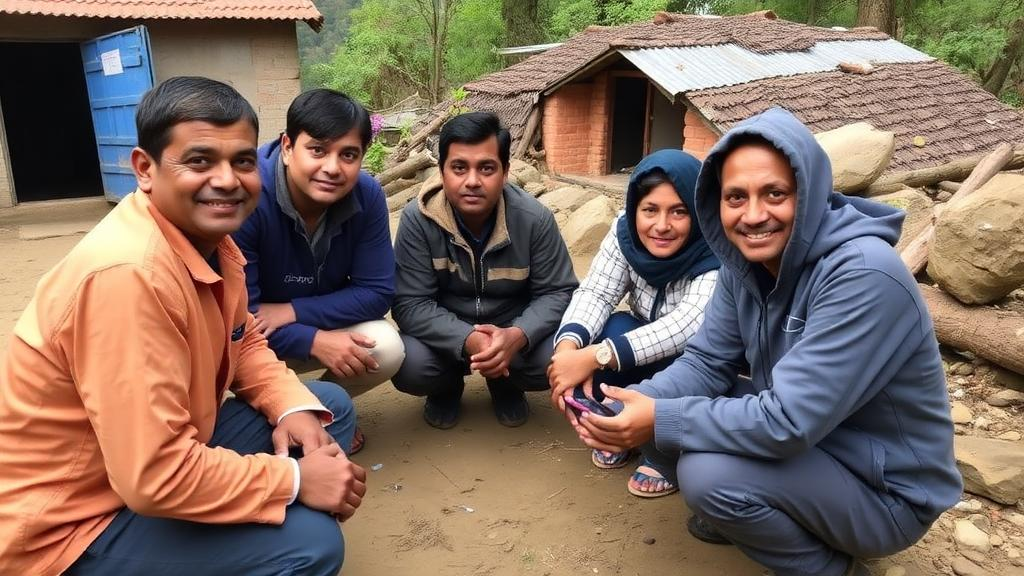
In the remote hills of rural Nepal, when someone is injured in a road crash, a fall, or a farm accident, the first person to arrive is rarely a paramedic. More often it is a teacher, an ambulance driver, or a community health worker who happens to be nearby. A new study published in BMC Health Services Research offers a detailed look at what happens when those everyday responders are given formal trauma training, and the findings carry weight for millions of people living far from any emergency medical system.
Researchers from Brown University’s Warren Alpert Medical School and Bayalpata Hospital in Nepal assessed a pilot pre-hospital trauma training program delivered to community health responders, or CHRs, in a rural Nepali municipality. The two-day course, piloted in April 2023, was adapted from the World Health Organization’s Basic Emergency Care Course, a curriculum designed to teach systematic assessment and stabilization of acutely ill and injured patients even in settings with minimal equipment. Because Nepal has no systematic pre-hospital trauma care infrastructure, community members effectively function as the country’s de facto emergency medical services, making them a critical but historically untrained link in the chain of survival.
The assessment took a qualitative approach, which is particularly well suited to understanding how a novel program is actually received in the field. Three months after the initial training, the team conducted semi-structured interviews with fourteen of the thirty-five trained participants, interviewing them in Nepali and translating the transcripts into English. The interviewees represented the full diversity of the CHR model: teachers, ambulance drivers, community health workers, and health post workers. The researchers then analyzed the data using the immersion-crystallization method, a technique in which analysts repeatedly read the transcripts until thematic categories and patterns emerge and consolidate into a final interpretation.
The picture that emerged was broadly encouraging. Participants reported that the training had a positive impact on their ability to provide patient care before reaching a health facility. They described enhanced knowledge and skills, and, perhaps most importantly, a new sense of confidence in their ability to act when injury strikes. In emergency medicine, that confidence matters: hesitation and fear of doing harm are well-documented reasons bystanders fail to intervene, and systematic training frameworks like the WHO’s ABCDE approach give lay providers a clear sequence to follow even under stress.
The course itself adapted an internationally recognized curriculum to local realities. The WHO Basic Emergency Care Course was developed precisely for settings where formal emergency medicine systems are thin, teaching a standardized primary assessment covering airway, breathing, circulation, disability, and exposure, along with focused interventions that can be performed with limited supplies. Translating this into a two-day program for lay responders in Achham district, supported by the nonprofit Nyaya Health Nepal and Bayalpata Hospital, represents a deliberate strategy: rather than waiting for an ambulance system that may be decades away, equip the people who are already there.
Yet the interviews also surfaced barriers that any expansion of the program will need to confront. Transportation to the training site was difficult for some participants, a familiar obstacle in rural districts where travel itself can be hazardous and time-consuming. Language and pedagogy posed a second challenge: some trainees reported limited understanding of certain medical terminology, suggesting that curricula built for clinicians require careful translation and simplification for community audiences. The third and arguably most consequential barrier was logistics after the course ended: reliable access to pre-hospital care supplies. Skills learned in a classroom have limited value if bandages, splints, or basic airway adjuncts are not available when a responder actually reaches a patient.
Participants themselves proposed solutions, requesting refresher trainings and an improved training handbook to support ongoing education and skill retention. This feedback aligns with a robust body of literature on skill decay, which shows that procedural skills learned in short courses erode without reinforcement, particularly among providers who encounter emergencies infrequently. The researchers concluded that ongoing education and enhancements to training materials are necessary to empower diverse community members to be effective first responders, especially given the resource-constrained environments in which they work.
The study’s design carries some inherent limits worth noting. It captured the perspectives of a subset of trainees from a single municipality, and it measured impressions rather than clinical outcomes. Self-reported confidence does not automatically translate into improved survival, and the authors are explicit that these findings represent feasibility testing intended to guide a broader implementation study. Still, qualitative assessments of this kind are an essential early step in implementation science, identifying friction points in program delivery before expensive and large-scale trials are attempted.
The broader implications extend well beyond Nepal. Low- and middle-income countries account for the overwhelming majority of trauma deaths worldwide, and in many of them formal emergency medical services remain sparse or absent. Lay responder models, in which teachers, drivers, and health post staff are trained to deliver basic life-saving care, are increasingly seen as a pragmatic bridge. The Nepali experience suggests such models can be well received and practical, provided designers plan for refresher training, plain-language materials, and supply chains from the outset.
For a district where a seriously injured patient may face hours of travel over mountain roads before reaching a hospital, the difference between a trained and an untrained bystander can be measured in lives. This pilot study does not prove that outcome, but it demonstrates that community health responders are willing learners, that an adapted WHO curriculum can be delivered to them, and that the path forward requires sustained investment in their education and equipment. As the research team moves toward broader implementation across rural Nepal, the voices of the fourteen interviewed responders will shape how the next generation of first responders is trained.
Subject of Research: Pre-hospital trauma training for community health responders in rural Nepal
Article Title: Qualitative assessment of a pilot trauma training program for community health responders in rural Nepal
Article References: Junkin, J. R., Pathak, M., Chand, S. B., Paudel, R., Goldman, R. E., Mello, M. J., & Kharel, R. (2026). Qualitative assessment of a pilot trauma training program for community health responders in rural Nepal. BMC Health Services Research. https://doi.org/10.1186/s12913-026-15724-3
Image Credits: AI Generated
DOI: 10.1186/s12913-026-15724-3
Keywords: pre-hospital care, community health responders, trauma training, rural Nepal, emergency medical services, WHO Basic Emergency Care, qualitative research, global health, low- and middle-income countries, health services research, first responders, skill retention
Cite Scienmag News
Ophelia Keating. (October 12, 2026). Lay Responders in Rural Nepal Gain Confidence After Two-Day Trauma Course. Scienmag. https://scienmag.com/lay-responders-in-rural-nepal-gain-confidence-after-two-day-trauma-course/
Ophelia Keating. "Lay Responders in Rural Nepal Gain Confidence After Two-Day Trauma Course." Scienmag, 12 October 2026, https://scienmag.com/lay-responders-in-rural-nepal-gain-confidence-after-two-day-trauma-course/. Accessed 12 October 2026.
Ophelia Keating. "Lay Responders in Rural Nepal Gain Confidence After Two-Day Trauma Course." Scienmag. October 12, 2026. https://scienmag.com/lay-responders-in-rural-nepal-gain-confidence-after-two-day-trauma-course/


