


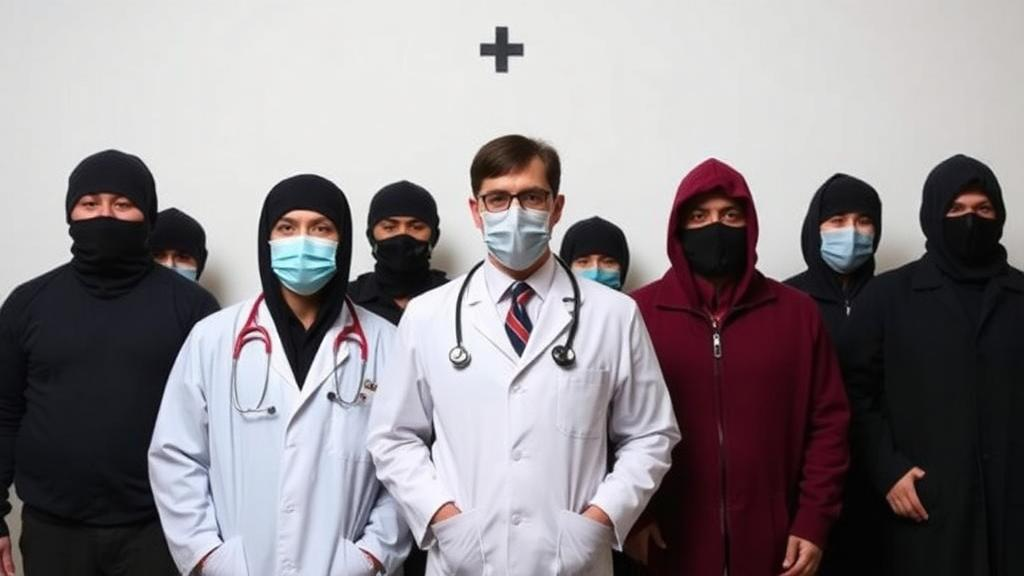
A small minority of doctors who commit serious crimes against patients are being protected not by their own cunning alone, but by the institutions that employ them, according to two experienced general practitioners who have examined some of the most disturbing cases in modern medical history. Baroness Clare Gerada and Zaid Al-Najjar, authors of the new book Doctors and Their Crimes: Hiding Behind the White Coat, published by Routledge, argue that fear of litigation, reputational damage and career consequences builds a protective shield around practitioners who should have been stopped years, and in some cases decades, earlier. Their analysis draws on high-profile cases of malpractice, fraud, manslaughter, sexual misconduct and murder from around the world, and it identifies a common thread running through them all: systemic failure.
The scale of the problem is statistically small but devastating in its consequences. Less than half of one percent of doctors in the United Kingdom have criminal convictions, compared with roughly sixteen percent of the general population. Medicine, in other words, attracts and retains overwhelmingly law-abiding professionals. Yet when a medical professional does cross the line into criminal behaviour, the authors explain, the impact is magnified by the perpetrator’s unique position of trust and access. Patients undress in front of doctors, surrender intimate information to them, consent to being touched, sedated and treated, and often have no independent means of verifying what is actually being done to them. That asymmetry of power is precisely what makes medical crime so difficult to detect and so shattering when it is finally exposed.
The numbers behind the most extreme cases are stark. Between 1970 and 2006, ninety healthcare workers across twenty countries were prosecuted as serial killers, linked to a total of 2,113 suspicious deaths. Many of these individuals evaded suspicion for years or even decades, moving between wards, hospitals and health systems while colleagues and managers failed to connect the dots. The sheer persistence of these failures has prompted an uncomfortable question that Gerada and Al-Najjar place at the centre of their book: why did institutions repeatedly fail to stop practitioners whose patterns of harm were, in hindsight, often visible for a long time?
One of the most troubling mechanisms the authors document is the way problematic doctors are passed along rather than confronted. The book reveals a recurring pattern of doctors moving between hospitals, regions and even countries to escape accumulating suspicion. In many cases, the authors note, these medics depart with glowing references from employers who are eager to see them go. The result is a system that does not resolve risk but simply exports it, handing the problem to the next institution and the next cohort of patients. Each fresh employer, unaware of the history, extends the perpetrator’s freedom to operate, while the originating organisation quietly closes an embarrassing chapter.
The warning signs, the authors argue, were frequently there to be seen. Patterns of complaints, unusual behaviour and poor clinical results were routinely ignored or minimised by those best placed to act. Part of the explanation, they suggest, lies in the sheer implausibility of the crime: the very notion that a doctor might deliberately harm patients was unthinkable to many colleagues, allowing perpetrators to continue unchecked. This cognitive blind spot is compounded by structural deference. Medicine remains a hierarchical and paternalistic profession, and challenging a senior colleague can feel like career suicide to a junior doctor or nurse. Silence, whether driven by fear, misplaced loyalty or learned helplessness, can sustain harm over many years. When whistleblowers are nurses rather than doctors, the authors add, they are often ignored altogether, with gender imbalance in the profession deepening the disparity in whose concerns are taken seriously.
Research cited in the book quantifies just how deep that silence runs. Only two-thirds of doctors with direct knowledge of an impaired or incompetent colleague reported their concerns, meaning a substantial minority of those who knew said nothing. Among the reasons given, nearly twelve percent cited fear of retaliation or the belief that nothing would happen as a result of reporting. Those figures describe a profession in which the practical incentives for speaking up are weak and the perceived risks are strong. The authors’ conclusion is blunt: fear is the weapon most effectively wielded by the practitioners they discuss, and it is the culture of fear within healthcare itself that must be dismantled if dangerous doctors are to be detected earlier.
The case studies the book examines illustrate how these vulnerabilities play out in practice. Harold Shipman, Britain’s most prolific serial killer, murdered an estimated 215 patients while practising as a trusted family doctor. Michael Swango poisoned patients and colleagues across multiple American hospitals, repeatedly securing new positions despite mounting suspicion. Gerada and Al-Najjar argue that both men exploited the same systemic weaknesses: institutional deference to medical authority, a reluctance to investigate senior colleagues, and a culture that prioritised the reputation of the profession over the safety of patients. They also point to psychological traits that can drive criminal behaviour, including hero complexes and narcissism, which may be amplified in medical settings where authority is high and scrutiny is often low. The institutions themselves, the authors are careful to note, do not create these traits, but looser oversight allows them to go unexposed for longer than they otherwise would.
There is, however, evidence that reform is possible and, in places, already underway. Following the Shipman case, the United Kingdom overhauled the monitoring of controlled drugs and the investigation of deaths, and the shift to electronic records has created audit trails that are far more difficult to falsify than paper notes. Most modern clinical systems now allow medicines to be tracked, making it easier to detect unusual prescribing patterns than in previous decades. Regulators, the authors observe, act more promptly than they once did, and data sharing between agencies and across international borders has improved. Whistleblowing policies and the establishment of the Freedom to Speak Up Guardian role in England reflect a growing official recognition that silence enables harm. These are meaningful advances, but the authors caution that they are not a finished solution.
New vulnerabilities continue to emerge as fast as old ones are closed. Telemedicine, accelerated dramatically by the pandemic, has broadened patient access to care but also introduced fresh risks of inappropriate prescribing and exploitation, precisely because remote consultation weakens the informal oversight that physical workplaces once provided. Globalised healthcare makes it easier for rogue doctors to move between jurisdictions, carrying unresolved allegations across borders where regulators have no easy access to their history. The authors describe a persistent structural lag: the rate of medical innovation continually surpasses the capacity of regulatory systems to keep pace with it. Every new technology that expands what doctors can do also expands what a small number of them could abuse.
Ultimately, Gerada and Al-Najjar argue that preventing medical crime requires more than perfecting control measures, because determined offenders will almost always find ways to bypass technical safeguards. What is needed instead, they suggest, is a culture of accountability, transparency and courage, one in which patients are genuinely listened to, empowered with knowledge of warning signs, and given the confidence to raise concerns with someone who will act. There is a painful paradox at the heart of their analysis: the very qualities that make medicine a noble profession, its intimacy, its authority and its promise of healing, can under certain circumstances become the conditions that cause harm. The challenge they set for health systems worldwide is to preserve the trust and clinical autonomy that good medicine depends on, while building safeguards robust enough to catch the rare practitioners who would exploit both.
Subject of Research: Institutional culture of fear in healthcare enabling criminal doctors and silencing whistleblowers
Article Title: Culture of fear in healthcare enables killer practitioners while silencing whistleblowers, experts warn
Article References: Culture of fear in healthcare enables killer practitioners while silencing whistleblowers, experts warn. (n.d.). Original publication
Image Credits: AI Generated
DOI: Not provided
Keywords: healthcare, patient safety, whistleblowing, medical misconduct, Harold Shipman, hospital culture, medical regulation, serial killers, telemedicine, accountability, doctors, Routledge
Cite Scienmag News
Ophelia Keating. (October 12, 2026). How a Culture of Fear in Medicine Shields Criminal Doctors From Justice. Scienmag. https://scienmag.com/how-a-culture-of-fear-in-medicine-shields-criminal-doctors-from-justice/
Ophelia Keating. "How a Culture of Fear in Medicine Shields Criminal Doctors From Justice." Scienmag, 12 October 2026, https://scienmag.com/how-a-culture-of-fear-in-medicine-shields-criminal-doctors-from-justice/. Accessed 12 October 2026.
Ophelia Keating. "How a Culture of Fear in Medicine Shields Criminal Doctors From Justice." Scienmag. October 12, 2026. https://scienmag.com/how-a-culture-of-fear-in-medicine-shields-criminal-doctors-from-justice/


