


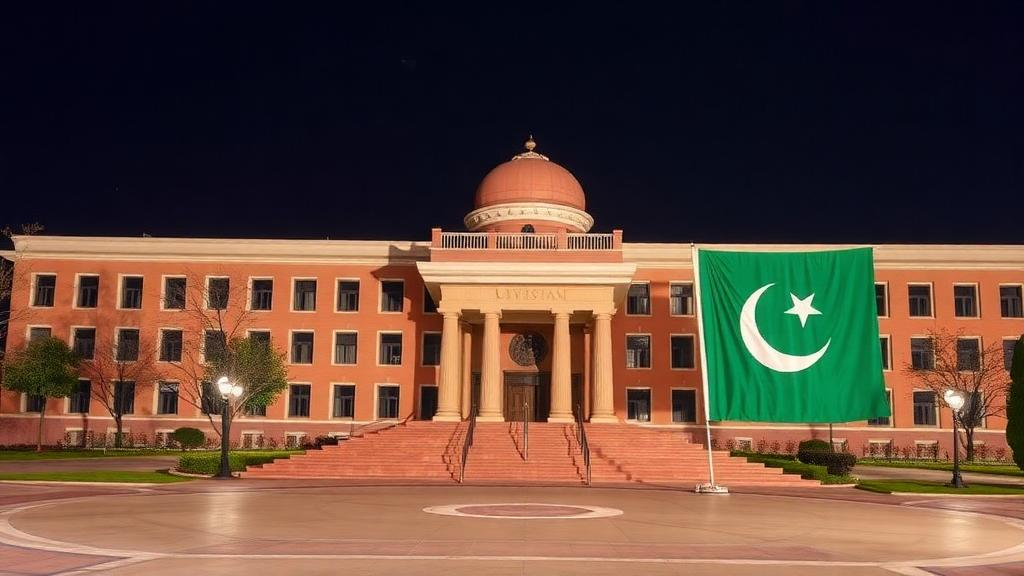
Social media has quietly become the front door of the modern university. Long before a prospective student visits a campus, reads a prospectus, or speaks to an admissions officer, that student has likely scrolled through the institution’s posts, absorbed its imagery, and formed an impression of who the university claims to be. A new study published in Humanities and Social Sciences Communications examines exactly how that impression is manufactured, focusing on how two of Pakistan’s leading universities use X, the platform formerly known as Twitter, to project institutional identities that are simultaneously global in ambition and unmistakably local in character. The research introduces a conceptual approach the authors call multimodal glocalisation, and it offers one of the most detailed pictures to date of how universities in a non-Western context negotiate the tension between international visibility and cultural rootedness.
The study, conducted by Fareeha Aazam, Pei Soo Ang, and Noor Aqsa Nabila Mat Isa of the Faculty of Languages and Linguistics at Universiti Malaya, with Aazam also affiliated with the Department of English at the University of Wah in Pakistan, analyses an entire year of activity on X: 2,861 posts drawn from the accounts of the National University of Sciences and Technology (NUST), a government institution, and the Lahore University of Management Sciences (LUMS), a private university. These two institutions were chosen as leading representatives of Pakistan’s higher education landscape, and their contrasting ownership structures, public versus private, provided a natural comparison for the branding strategies each employs. Rather than treating posts as isolated bits of text, the researchers read them as coordinated bundles of words, images, and interactional moves that together perform an institutional identity.
The core theoretical contribution of the paper is the multimodal glocalisation approach itself. Glocalisation, a term long used in social science to describe the adaptation of global forms to local conditions, has often been studied in economics or media content. Here the authors integrate it with discourse-semiotic principles, which hold that meaning is made not only through what is said but through how it is said, what is shown alongside it, and how audiences are invited to respond. They then connect this to theories of glocal identity performance, the idea that institutions do not simply possess an identity but actively enact one, moment by moment, through their communicative choices. The result is a framework that asks a deceptively simple question of every post: how does this message align the communicative norms expected of a globally oriented university with cultural meanings grounded in Pakistani society?
Answering that question required a deliberately multi-method design, and the technical architecture of the study is one of its strengths. Content analysis provided a systematic census of what the two universities posted about, allowing the researchers to quantify the themes that dominate each account. Corpus-assisted discourse analysis then examined patterns of language across the full body of posts, identifying recurring vocabulary and framing choices that individual close reading might miss. Multimodal visual analysis extended the scrutiny to photographs, graphics, and other visual resources, asking how imagery contributes to the branding work that text alone cannot accomplish. Crucially, the researchers did not stop at the messages themselves. Questionnaires and interviews captured how audiences actually perceived these branding efforts, adding a reception dimension that much social media analysis lacks. The study received ethics approval from the Universiti Malaya Research Ethics Committee, and all participants gave informed consent before data collection, which took place between March and May 2024.
The findings reveal two sharply differentiated branding philosophies. NUST, the government institution, builds its identity around national development and research legitimacy. Its posts foreground the university’s contribution to the country’s scientific and technological advancement, presenting it as an engine of progress whose credibility rests on demonstrable research output. This is branding aimed at legitimacy: the message is that NUST matters because Pakistan’s future depends on institutions like it. The rhetorical and visual resources deployed in service of this narrative emphasize achievement, institutional authority, and alignment with national priorities, positioning the university as a trusted instrument of state-level ambition.
LUMS, by contrast, constructs its identity around the texture of student life. The private university’s posts foreground student experience, social advocacy, and community networks, portraying the institution as a vibrant, engaged, and socially conscious environment. Where NUST’s branding speaks in the register of national progress, LUMS speaks in the register of belonging and impact: the campus as a community, the student as a change-maker, the university as a node in networks of advocacy and civic engagement. Neither strategy is inherently superior, the study suggests; each is calibrated to the institution’s history, funding model, and the audiences it most needs to persuade, from prospective students and their families to international academic partners and policymakers.
The most striking result, however, is what the two universities share. Despite their different orientations, both institutions consistently embed Islamic and nationalistic cues in their messaging, anchoring globally oriented content within the Pakistani socio-cultural context. A post about an international research collaboration, a global ranking, or an English-language achievement is rarely allowed to float free of its local moorings. Instead, it is accompanied by visual and verbal markers, religious and patriotic, that remind the audience of where the university stands and whom it ultimately serves. This is glocalisation in action: the global vocabulary of higher education, with its emphasis on rankings, research, innovation, and international engagement, is deliberately interwoven with local symbols that guarantee cultural resonance at home.
The theoretical significance of this pattern is considerable. Much of the existing literature on university branding has been built on Western institutions operating in contexts where the global and the local align relatively comfortably. The Pakistani case demonstrates that in other settings the negotiation is far more delicate. A university that projected a purely cosmopolitan identity might risk appearing detached from the values of its society, while one that leaned entirely on local tradition might forfeit the international credibility it needs for partnerships, rankings, and global student recruitment. The multimodal glocalisation approach names and formalizes this balancing act, showing that it is accomplished not in grand strategic documents but in the cumulative, post-by-post coordination of language, imagery, and interaction. Each post is a small performance, and the institutional identity emerges from the pattern of thousands of such performances over time.
The methodological contribution is equally important for researchers. By combining corpus-assisted discourse analysis with multimodal visual analysis and audience research, the study offers a replicable template for anyone seeking to understand institutional branding on social media. The approach scales to other platforms and other countries, and it resists the common pitfall of analyzing text in isolation from visuals and reception. For practitioners, the implications are direct. University communications teams, particularly those in non-Western contexts, gain a vocabulary for thinking about how their global aspirations and local obligations can reinforce rather than undermine one another. The study suggests that the most effective branding does not choose between the global and the local but choreographs them, using each post to perform a hybrid identity that is culturally resonant at home and recognizably excellent abroad.
As universities everywhere compete for attention in crowded digital feeds, the lessons from Pakistan’s leading institutions travel well beyond their borders. The study’s authors present their framework as a step toward understanding how organizations of any kind craft identities that must satisfy multiple audiences at once, and the year of X posts they analyzed provides concrete evidence that the craft is both systematic and subtle. In an era when a university’s brand may be built one 280-character message at a time, the finding that identity is performed, coordinated, and glocalised in every post is a reminder that the smallest communicative choices can carry the largest institutional stakes.
Subject of Research: Multimodal glocalisation in university branding strategies on social media
Article Title: Multimodal glocalisation approach for analysing university branding strategies: the case of pakistan on X
Article References: Multimodal glocalisation approach for analysing university branding strategies: the case of pakistan on X. (n.d.). https://doi.org/10.1038/s41599-026-09382-3
Image Credits: AI Generated
DOI: 10.1038/s41599-026-09382-3
Keywords: university branding, glocalisation, multimodality, social media, X platform, Pakistan, NUST, LUMS, discourse analysis, higher education, digital communication, identity performance
Cite Scienmag News
Courtney Benton. (October 11, 2026). Pakistani Universities Blend Global Ambition with Local Identity on X, Study Finds. Scienmag. https://scienmag.com/pakistani-universities-blend-global-ambition-with-local-identity-on-x-study-finds/
Courtney Benton. "Pakistani Universities Blend Global Ambition with Local Identity on X, Study Finds." Scienmag, 11 October 2026, https://scienmag.com/pakistani-universities-blend-global-ambition-with-local-identity-on-x-study-finds/. Accessed 11 October 2026.
Courtney Benton. "Pakistani Universities Blend Global Ambition with Local Identity on X, Study Finds." Scienmag. October 11, 2026. https://scienmag.com/pakistani-universities-blend-global-ambition-with-local-identity-on-x-study-finds/


