


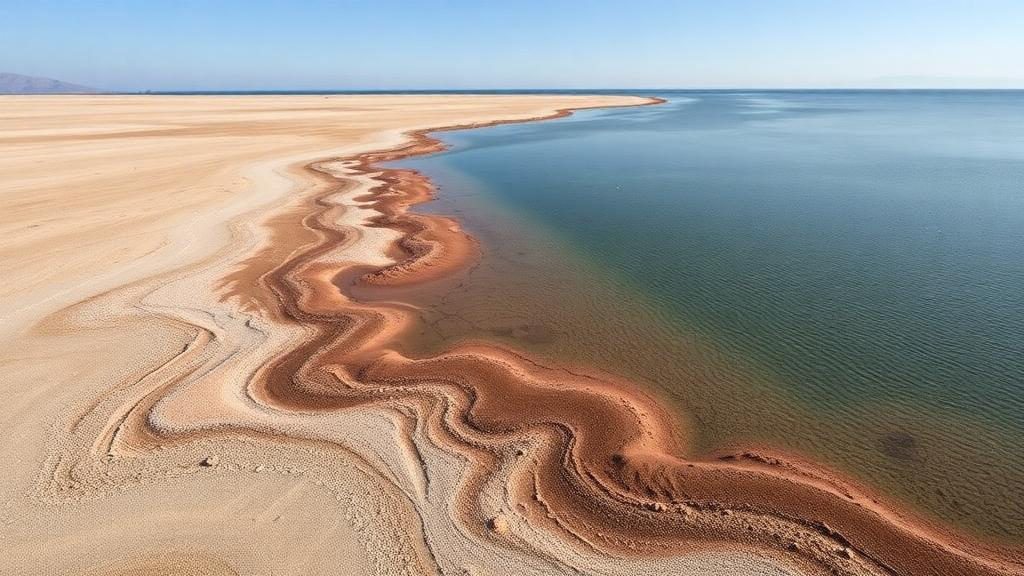
On the eastern shore of Lake Baikal, in a windswept stretch of dunes and marshes known as Bezymyannaya Bay, something remarkable is happening beneath the surface. Loose, quartz-rich sands that were blown inland from the beach are being cemented into hard, dark ferromanganese sandstones on a timescale that geologists would normally associate with millions of years, not decades. A new open-access study published in Discover Geoscience by Nikolay Akulov of the Institute of the Earth’s Crust in Irkutsk and colleagues documents this rapid transformation in unprecedented detail, and in doing so reveals a self-organizing geochemical barrier that quietly scrubs dissolved metals from groundwater before the water reaches one of the world’s most pristine lakes.
The story begins underground. Metal-rich, oxygen-depleted groundwater migrates through permeable coastal sand massifs after picking up dissolved iron and manganese from the weathering of crystalline basement rocks. According to the team’s hydrochemical surveys, the swamp waters feeding the system carry ferrous iron concentrations of up to 1.30 milligrams per liter and dissolved manganese of up to 0.25 milligrams per liter. When this reducing water meets the oxygenated environment near the shoreline, those concentrations collapse to 0.25 and 0.013 milligrams per liter respectively. The metals precipitate out of solution exactly at that redox interface, and the precipitates act as a cement that glues sand grains together into rock.
Field trenching at the Bezymyannoye occurrence exposed two sub-parallel ore bodies running along the shoreline, each up to 3.2 meters wide, roughly 43 meters long, and reaching an exposed thickness of 2.0 meters. At depth the two horizons converge into a single continuous ore massif, and in elevated areas the mineralization breaks the surface as a distinctive iron-rich crust resembling a lacustrine gossan, or iron hat. In the center of the massif the sandstones are black, massive, and well lithified; toward the margins they fade into weakly cemented, variegated yellow-red-brown sands, a gradient that records the progressive advance of the mineralizing front.
To decipher how the cement forms, the researchers deployed a multi-analytical arsenal. Bulk chemistry came from wavelength-dispersive X-ray fluorescence on a Bruker S8 TIGER spectrometer, which quantified ten major oxides and 25 trace elements in each sample. Micro-scale textures and compositions were resolved with a TESCAN MIRA 3 LMH field-emission scanning electron microscope equipped with an Oxford Instruments AztecLive Advanced Ultim Max 40 system, operating at 20 kilovolts with a focused beam of about 100 nanometers. Electron probe microanalysis then pinned down the stoichiometry of individual authigenic minerals, and Q-mode and R-mode cluster analyses organized the resulting geochemical data into genetically meaningful groups.
The microscopy revealed a striking architecture. White, dripstone-like colloform crusts and reniform, kidney-shaped precipitates of ore minerals coat the surfaces of terrigenous grains and fill the pore spaces between them, penetrating deep into the grains along micro-fractures. The crusts reach thicknesses of about 6 micrometers, and most precipitates measure no more than 20 micrometers across. At individual analytical points the manganese oxide content of the cement soars to 89.7 weight percent, a figure that stands in stark contrast to the deep-water ferromanganese nodules of Lake Baikal, where manganese oxide rarely exceeds 2.6 percent while iron oxide can reach 25 percent. The coastal ores are, chemically speaking, a different beast entirely.
The mineral assemblage identified in the cement includes todorokite, manganite, hydromanganite, rhodochrosite, hematite, goethite, and hydrogoethite. Todorokite carries 52.87 to 56.48 weight percent manganese, and barium emerges as the dominant isomorphous admixture, reaching 10.53 to 11.45 weight percent in manganite and todorokite, where it substitutes for calcium, iron, magnesium, sodium, and potassium. X-ray diffraction confirmed manganite as the most abundant phase in the barrier zone. The presence of rhodochrosite, an authigenic manganese carbonate, hints at bacterial degradation of organic matter in the adjacent bog waters, an early clue that biology may be entangled in the ore-forming machinery.
Cluster analysis sharpened the picture. The R-mode statistics split the major oxides into two negatively correlated super-clusters: one representing the inert terrigenous framework of the sand, the other the ore-forming pair of manganese oxide with loss on ignition, and total iron oxide with phosphorus pentoxide. Trace elements sorted along the same lines, with manganese, barium, copper, and molybdenum forming one genetic group and iron, fluorine, chlorine, phosphorus, sulfur, arsenic, and lanthanum another. The manganese-bearing sandstones stood apart as a chemically distinct cluster enriched in barium, copper, and molybdenum, while iron-stained sands remained geochemically close to their unmineralized hosts. These patterns, the authors argue, are the statistical fingerprint of an actively self-organizing geochemical system.
What makes the spatial separation of iron and manganese so sharp is a matter of kinetics. Iron, far more sensitive to oxidation, precipitates almost immediately as amorphous oxyhydroxides when the reducing groundwater meets atmospheric oxygen, building the initial framework of the cement. Manganese stays mobile longer and migrates farther toward the periphery of the mineralizing zone before being captured through autocatalytic oxidation, quite possibly with the help of manganese-oxidizing bacteria such as Leptothrix or Gallionella. Because dissolved Mn2+ oxidizes sluggishly at pH values below 8, microbial catalysis is likely essential to overcome that kinetic barrier, even though the biological role has not yet been quantified in this study.
Genetically, the deposits plot squarely in the hydrogenetic field on standard ternary discrimination diagrams, with manganese-to-iron ratios between 0.06 and 2.42, far below the 19.78 to 45.7 range typical of hydrothermal systems. Yet unlike the slow-growing nodules of Baikal’s deep basins, this terrestrial mineralization unfolds on what the authors call an engineering timescale, offering a rare real-time analogue for hydrogenetic ore genesis and echoing the accelerated shallow-water ferromanganese formation documented in the Baltic Sea. The coastal sand matrix is not a passive substrate but the framework of a living geochemical filter.
That filter has consequences for the lake itself. By sequestering barium, zinc, copper, and other trace metals before groundwater discharges into Baikal, the ferromanganese sandstones function as a natural geoecological shield for an ecosystem famous for its endemic biodiversity and its sensitivity to pollution. But the shield is not invulnerable. Fluctuations in the lake’s water level driven by hydroelectric regulation, or chemical loading from tourism-related runoff, could shift the pH-Eh balance of the discharge zones. The authors warn that even slight acidification of the groundwater could remobilize the stored heavy metals, converting the barrier from a sink into a secondary source of contamination. Monitoring the growth and stability of these coastal ores, they conclude, offers a cost-effective early-warning baseline for the biogeochemical health of the entire Baikal coastal zone, and future work combining metagenomics with long-term observation should finally pin down how much of this remarkable natural water-purification engine is powered by microbes.
Subject of Research: Rapid authigenic ferromanganese sandstone formation and natural groundwater purification at the coastal zone of Lake Baikal
Article Title: Natural water purification and ferromanganese sandstone formation in the coastal zone of Lake Baikal
Article References: Akulov, N. I., Akulova, V. V., Belozerova, O. Y., Chubarov, V. M., Rubtsova, M. N., & Shtelmakh, S. I. (2026). Natural water purification and ferromanganese sandstone formation in the coastal zone of Lake Baikal. Discover Geoscience, 4(1), Article 290. https://doi.org/10.1007/s44288-026-00598-z
Image Credits: AI Generated
DOI: 10.1007/s44288-026-00598-z
Keywords: Lake Baikal, ferromanganese sandstone, geochemical barrier, groundwater discharge, aeolian sand, manganese oxidation, todorokite, manganite, hydrogenetic mineralization, heavy metal sequestration, biogeochemistry, ore genesis
Cite Scienmag News
Violet Maxwell. (October 11, 2026). Lake Baikal’s Shores Host a Fast-Working Natural Filter That Turns Sand Into Ore. Scienmag. https://scienmag.com/lake-baikals-shores-host-a-fast-working-natural-filter-that-turns-sand-into-ore/
Violet Maxwell. "Lake Baikal’s Shores Host a Fast-Working Natural Filter That Turns Sand Into Ore." Scienmag, 11 October 2026, https://scienmag.com/lake-baikals-shores-host-a-fast-working-natural-filter-that-turns-sand-into-ore/. Accessed 11 October 2026.
Violet Maxwell. "Lake Baikal’s Shores Host a Fast-Working Natural Filter That Turns Sand Into Ore." Scienmag. October 11, 2026. https://scienmag.com/lake-baikals-shores-host-a-fast-working-natural-filter-that-turns-sand-into-ore/


