


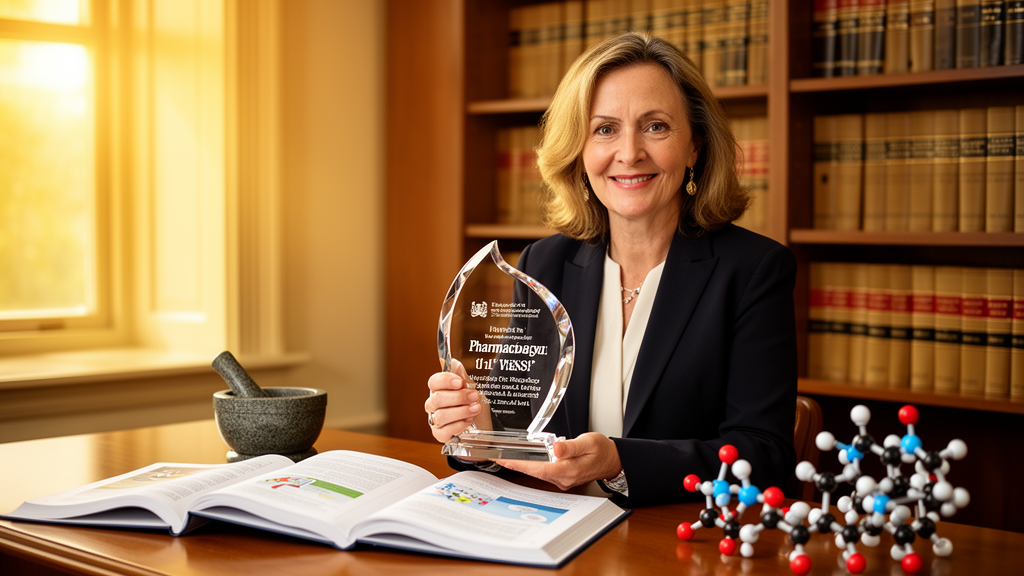
Springer Nature has announced the recipients of its Editor of Distinction Awards for 2026, an annual programme that recognises the editors whose behind-the-scenes work keeps scientific publishing accurate, fair and efficient. Among the journals celebrating this year’s honourees is BMC Pharmacology and Toxicology, part of the BMC series published by Springer Nature, which highlighted the contributions of editors working across its editorial board. The awards are structured around two principal categories this cycle: the Springer Nature Editorial Contribution Award and the Springer Nature Author Service Award. Each category captures a different dimension of what editors actually do, from the forensic scrutiny of submitted manuscripts to the day-to-day stewardship of authors navigating peer review for the first time.
The Editorial Contribution Award is given for meticulous assessment of submissions and rigorous management of the peer review process, with the explicit aim of safeguarding the scientific accuracy of the published record. In practical terms, this means evaluating whether the experimental design supports the conclusions, whether the statistical treatment of data is appropriate, and whether the manuscript sits within the scope and ethical standards of the journal. Editors who receive this distinction are described as having demonstrated exactly that kind of diligence. The 2026 list of Editorial Contribution Award recipients includes Abdelwahab Omri, Anshuman Chandra, Catherine Sherwin, Giovanni Tarantino, Hualin Cai, Imran Khan, Jeffrey Raj, Josef Yayan, Koushik Debnath, Marcelo Arbo, Md Jakaria, Zhengwei Huang and Zhenwei Yu.
The second distinction, the Springer Nature Author Service Award, recognises exceptional service in improving the author experience and ensuring that the peer review process is efficient, constructive and fair. This dimension of editorial work is often invisible to readers but decisive for researchers: clear decision letters, timely handling of manuscripts, and reviewer guidance that helps authors strengthen their papers rather than simply rejecting them. The 2026 Author Service Award honourees named by the journal are Anindya Bose, Josef Yayan, Simone Brogi, Zhenwei Yu. Notably, Josef Yayan and Zhenwei Yu appear in both categories, indicating that their contributions spanned both the technical rigour of manuscript assessment and the quality of service delivered to authors.
In its announcement, the journal framed the awards as a celebration of editors’ dedication to their journals and research communities. The description of editorial work offered by the publisher is unusually candid about how much labour the role involves. Editors are credited with developing networks for authors and peer reviewers, helping authors improve their papers, and advocating for their journal communities. The publisher states plainly that editorial teams work tirelessly to help advance discovery, and that this outstanding contribution is what the annual Editor of Distinction Awards are designed to recognise. For a field like pharmacology and toxicology, where published findings feed directly into drug development, safety assessment and regulatory science, the accuracy of the peer-reviewed record carries particularly high stakes.
Peer review in pharmacology and toxicology journals demands a specific technical toolkit. Manuscripts in this field routinely involve dose-response modelling, pharmacokinetic and pharmacodynamic analyses, toxicological threshold determination, and in vivo studies whose ethical and methodological standards must be verified before publication. An editor managing this pipeline must identify reviewers with the right sub-speciality expertise, reconcile conflicting reviewer reports, and press authors on reproducibility issues such as reagent validation, blinding, and the statistical power of animal studies. The Editorial Contribution Award’s emphasis on meticulous assessment and rigorous process management reflects precisely this reality: the difference between a sound publication and a flawed one often turns on the quality of the editorial judgement applied before a paper ever reaches readers.
The Author Service Award, by contrast, points to a growing recognition across scholarly publishing that the experience of submitting authors matters to the health of the research ecosystem. Early-career researchers in particular depend on constructive peer review to learn the norms of scientific writing and argumentation. An editor who ensures that review is efficient, constructive and fair reduces the time from submission to publication, limits the frustration of repetitive revision cycles, and helps ensure that decisions rest on the science rather than on opaque or inconsistent criteria. In pharmacology and toxicology, where authors may be racing to publish safety data or novel therapeutic mechanisms, the efficiency of editorial handling can have tangible consequences for how quickly findings enter the wider scientific conversation.
The dual recognition of editors such as Josef Yayan and Zhenwei Yu illustrates how these two functions reinforce one another. Rigorous scrutiny of submissions and a constructive author experience are not competing priorities; the most effective editors deliver both, holding manuscripts to a high evidentiary bar while communicating decisions in ways that help authors respond productively. Similarly, the breadth of the Editorial Contribution Award list, spanning thirteen named editors, suggests that the journal’s editorial board distributes the workload of peer review across a wide international network of subject specialists, each responsible for a slice of the field’s sub-disciplines, from molecular pharmacology to toxicological pathology.
Programmes like the Editor of Distinction Awards also serve a broader structural purpose in contemporary science publishing. Academic editing is largely unpaid or modestly compensated labour performed by working scientists on top of their research, teaching and clinical obligations. Public recognition is one of the few currencies the system offers in return. By naming individual editors and specifying what their contributions consisted of, Springer Nature’s awards make visible a layer of the scientific enterprise that usually operates without public acknowledgement. The publisher’s own framing, that editors develop reviewer networks, improve papers and advocate for their communities, reads as a deliberate effort to describe editorial work as an active scientific contribution rather than an administrative filter.
For the research communities served by BMC Pharmacology and Toxicology, the 2026 awards carry a practical message as well as a ceremonial one. Authors submitting to the journal can infer that editorial attention to fairness, constructiveness and efficiency is being actively measured and rewarded. Reviewers can infer that the editors mediating their reports are being held to standards of rigour and timeliness. And readers, the ultimate beneficiaries, can place somewhat greater confidence in a published record whose gatekeepers are recognised specifically for safeguarding scientific accuracy. In a publishing landscape frequently criticised for variability in review quality, the explicit celebration of meticulous editorial practice is a small but meaningful signal about the values a journal chooses to enforce.
The full list of this year’s honourees reflects the international character of modern editorial boards. Names on the Editorial Contribution and Author Service rosters correspond to researchers based across multiple continents and working in diverse areas of pharmacology, toxicology and adjacent biomedical sciences, consistent with the global reviewer networks that open-access BMC journals rely upon. Springer Nature’s announcement closes with congratulations to the recipients, and the journal’s editorial team presents the awards as an annual fixture rather than a one-off gesture, indicating that the recognition of editorial excellence will continue to be tracked and celebrated in future cycles. For now, the 2026 cohort stands as the journal’s formal acknowledgement that the integrity of the pharmacological and toxicological literature depends on the sustained, largely invisible effort of the editors who read, question and refine its papers before the world sees them.
Subject of Research: Recognition of editorial excellence in peer review and author service at BMC Pharmacology and Toxicology through the Springer Nature Editor of Distinction Awards 2026
Article Title: Springer Nature Editor of Distinction Awards 2026
Article References: Springer Nature Editor of Distinction Awards 2026. (n.d.). Original publication
Image Credits: AI Generated
DOI: Not provided
Keywords: Springer Nature, Editor of Distinction Awards, BMC Pharmacology and Toxicology, peer review, editorial excellence, scholarly publishing, pharmacology, toxicology, author service, scientific integrity, editorial boards, open access
Cite Scienmag News
Louis Brooks. (October 11, 2026). Springer Nature Honours Standout Editors Shaping Pharmacology Research in 2026. Scienmag. https://scienmag.com/springer-nature-honours-standout-editors-shaping-pharmacology-research-in-2026-2/
Louis Brooks. "Springer Nature Honours Standout Editors Shaping Pharmacology Research in 2026." Scienmag, 11 October 2026, https://scienmag.com/springer-nature-honours-standout-editors-shaping-pharmacology-research-in-2026-2/. Accessed 11 October 2026.
Louis Brooks. "Springer Nature Honours Standout Editors Shaping Pharmacology Research in 2026." Scienmag. October 11, 2026. https://scienmag.com/springer-nature-honours-standout-editors-shaping-pharmacology-research-in-2026-2/


