


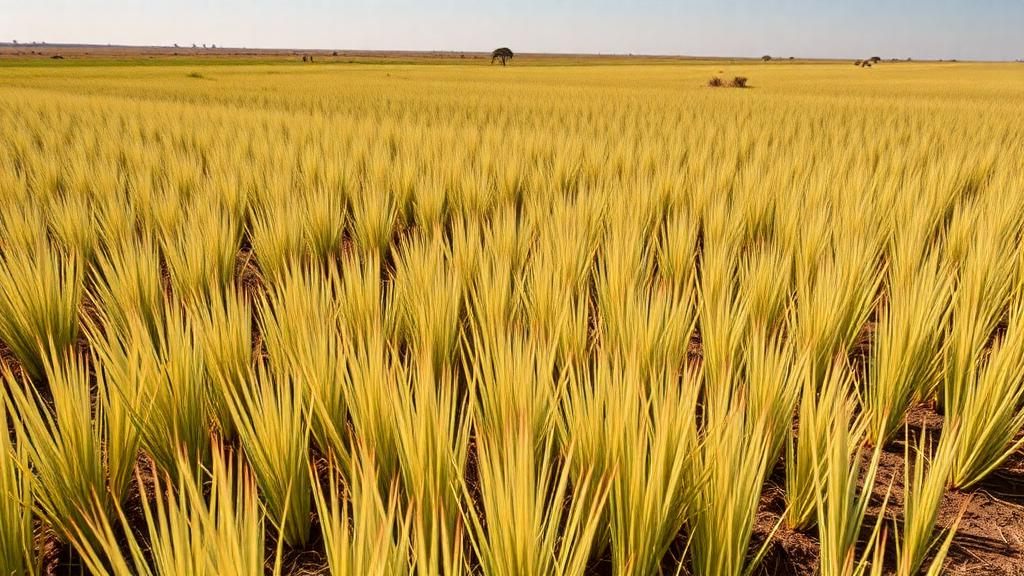
Grasslands cover roughly a quarter of the planet’s ice-free land surface, feed billions of livestock, and store vast amounts of carbon in their soils. Now a global meta-analysis published in Environmental Management has identified a sharp climatic tipping point that fundamentally changes how these ecosystems work. Aboveground net primary productivity, or ANPP, the annual amount of plant biomass a grassland produces, does not respond smoothly to drying conditions. Instead, the study finds that productivity climbs steeply with water availability up to a critical aridity index of approximately 0.51, and then the relationship abruptly weakens. Beyond that threshold, the very plant traits that govern productivity also change their roles, in some cases reversing their effects entirely.
The research team, led by Yongping Tie of Qinghai University and colleagues, synthesized data from grassland studies spanning the global aridity gradient, from humid meadows to desert steppes. The aridity index they used is a standard measure calculated as the ratio of precipitation to potential evapotranspiration, so lower values indicate drier conditions. By fitting nonlinear models to the compiled dataset, the researchers detected the threshold at AI ≈ 0.51, a value that separates water-limited grasslands where every additional increment of moisture translates into substantial productivity gains from more mesic systems where other factors, such as nutrients or light, become limiting.
What makes the finding particularly striking is not the nonlinear productivity curve itself, but what happens to the underlying biological machinery on either side of the threshold. Below the aridity threshold, ANPP was strongly and positively associated with leaf carbon-to-nitrogen ratio (LCN) and specific leaf area (SLA), two traits central to the well-known leaf economics spectrum. SLA reflects how much photosynthetic surface a plant builds per unit of leaf mass, while leaf nitrogen content governs the capacity of the photosynthetic apparatus. In drier grasslands, communities dominated by acquisitive, fast-growing species with high SLA and favorable leaf chemistry convert water into biomass efficiently, so these traits act as reliable predictors of productivity.
Above the threshold, that predictive architecture collapses. The influence of LCN diminished, and specific root length (SRL), a belowground trait describing the length of fine roots produced per unit of root biomass, showed reduced or even reversed effects on productivity. This suggests a reorganization of functional controls: once water is no longer the dominant constraint, the traits that once signaled rapid resource acquisition lose their leverage, and the coupling between plant economics and ecosystem output shifts to a different configuration. The authors interpret this as evidence that the functional regulation of grassland productivity is not a fixed relationship that can be extrapolated across climates, but one that is contingent on where a site sits relative to the aridity threshold.
To disentangle the direct and indirect pathways linking climate to productivity, the team employed structural equation modeling, a statistical framework that allows researchers to test networks of hypothesized causal relationships simultaneously. The models revealed that the relative importance of direct climatic effects versus trait-mediated pathways differed markedly before and after the threshold. In the dry regime, climate influences productivity both directly and indirectly through its filtering effect on community traits, meaning that aridity shapes which species and which trait values persist, and those traits in turn drive biomass production. In the wetter regime, the trait-mediated channel weakens, and the direct climatic pathway dominates, indicating that above the threshold the community composition matters less for predicting how productivity responds to further changes in water availability.
The concept of thresholds is increasingly central to ecology and Earth system science. Previous work has documented critical soil moisture thresholds at which plant water stress accelerates globally, and recent experiments have shown that drought intensity and duration can interact to magnify losses in primary productivity in nonlinear ways. The new study adds a crucial piece to this puzzle by demonstrating that a single, globally consistent aridity threshold governs not only the magnitude of productivity responses but also the mechanisms producing them. That dual significance matters because most Earth system models and dynamic global vegetation models assume smooth, continuous relationships between climate drivers and ecosystem processes, an assumption this study directly challenges.
The implications for climate change adaptation are concrete. As global warming intensifies evaporative demand, many grassland regions are expected to cross from the humid side of the AI ≈ 0.51 threshold into the arid side. When that happens, the study suggests, managers and modelers should expect a double transition: productivity will become far more sensitive to each unit of moisture change, and the plant communities best suited to sustaining production will shift from acquisitive, high-SLA species toward strategies emphasizing resource conservation and drought tolerance. Rangeland stocking rates, restoration seed mixes, and carbon accounting frameworks calibrated on humid-grassland trait relationships may therefore misfire once a region passes the threshold.
The meta-analytic approach also carries methodological weight. Rather than relying on a handful of long-term experimental sites, the authors aggregated response patterns across geographically distributed studies, which is visible in the global map of study sites accompanying the paper. This breadth is what allowed the detection of a threshold that no single-site study could establish, and it aligns with a growing body of synthesis work showing that plant functional traits affect biomass responses to global change in context-dependent ways. The trade-off is that meta-analyses inherit the heterogeneity of their source studies, and the authors note that the underlying data are available from the corresponding authors upon reasonable request, enabling future reanalyses as more trait observations accumulate.
For the broader scientific conversation, the study reinforces an emerging view that ecosystems do not merely decline gradually under drying climates; they reorganize. The shift from LCN- and SLA-dominated regulation to a regime where SRL and other traits behave differently hints at a coordinated change in how aboveground and belowground economies are coupled. Fine roots govern water and nutrient uptake, and the nonlinearity of root trait relationships documented in recent work suggests that belowground adjustments may be a key part of how grasslands restructure themselves as aridity crosses critical levels. Understanding that coupling will be essential for predicting whether grasslands remain productive carbon sinks or transition into sources under continued warming.
The study, published in Environmental Management with support from the National Natural Science Foundation of China and Qinghai University’s talent programs, ultimately delivers a clear message: the future of the world’s grasslands cannot be forecast with straight lines. Predictive frameworks that incorporate nonlinear climatic responses and the shifting, threshold-dependent role of plant functional traits will be far better equipped to anticipate where productivity will prove resilient and where it will unravel. As aridity intensifies across the globe’s rangelands, the invisible line at AI ≈ 0.51 may become one of the most consequential numbers in ecology, marking the point at which the rules of grassland life are quietly rewritten.
Subject of Research: Aridity thresholds and plant functional trait control of grassland aboveground net primary productivity
Article Title: Aridity Threshold Alters Trait-mediated Regulation of Grassland Productivity at a Global Scale
Article References: Tie, Y., Cao, Q., Liu, W., Yang, X., Dong, Q., & Liu, Y. (2026). Aridity Threshold Alters Trait-mediated Regulation of Grassland Productivity at a Global Scale. Environmental Management, 76(10), Article 339. https://doi.org/10.1007/s00267-026-02639-2
Image Credits: AI Generated
DOI: 10.1007/s00267-026-02639-2
Keywords: grasslands, aridity threshold, net primary productivity, plant functional traits, meta-analysis, climate change, leaf economics spectrum, specific leaf area, specific root length, structural equation modeling, drylands, ecosystem modeling
Cite Scienmag News
Sloane Callahan. (October 11, 2026). Global Grasslands Hit a Hidden Aridity Tipping Point That Rewires How Plants Drive Productivity. Scienmag. https://scienmag.com/global-grasslands-hit-a-hidden-aridity-tipping-point-that-rewires-how-plants-drive-productivity/
Sloane Callahan. "Global Grasslands Hit a Hidden Aridity Tipping Point That Rewires How Plants Drive Productivity." Scienmag, 11 October 2026, https://scienmag.com/global-grasslands-hit-a-hidden-aridity-tipping-point-that-rewires-how-plants-drive-productivity/. Accessed 11 October 2026.
Sloane Callahan. "Global Grasslands Hit a Hidden Aridity Tipping Point That Rewires How Plants Drive Productivity." Scienmag. October 11, 2026. https://scienmag.com/global-grasslands-hit-a-hidden-aridity-tipping-point-that-rewires-how-plants-drive-productivity/


