


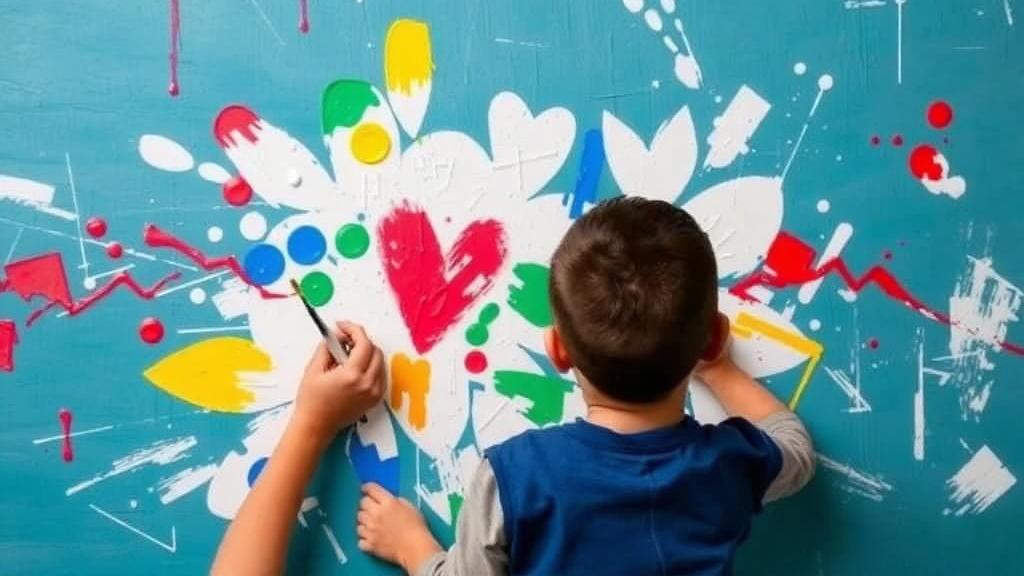
How do you ask a seven-year-old what death means? Words fail young children precisely when they need them most, which is why one of the most sensitive territories in education—life and death—has long been handled with euphemism, silence, or avoidance. A new study published in Humanities and Social Sciences Communications argues that the way out of this impasse may not be verbal at all. Zhi Chie Low of National Sun Yat-sen University in Kaohsiung, Taiwan, has designed and tested a series of expressive arts activities that let children explore life-related themes through color, line, form, and multisensory experience, offering one of the most systematic accounts yet of how symbolic creation can carry meanings that spoken language cannot.
The research, published open access on 11 October 2026, tackles a persistent gap in early childhood pedagogy. Life education—the umbrella term for teaching that helps children understand existence, loss, mortality, and the value of living—is widely recognized as important, yet classroom practice often stalls because adults lack the tools to open the conversation. Direct questioning about death can frighten children or invite rehearsed, adult-shaped answers. Low’s approach inverts the dynamic: instead of asking children to translate their inner world into adult language, the method asks adults to learn to read the symbolic languages children already use.
Expressive arts, as deployed in this study, differ from conventional art instruction in a crucial way. The goal is not technical skill or aesthetic product but the externalization of subjective experience. Children engage in sensory exploration with diverse artistic media, and the resulting works—paintings, constructions, tactile pieces—are treated as evidence of meaning-making rather than as objects to be graded. This distinction matters because the psychological literature has long suggested that pre-verbal and symbolic processing dominates early childhood cognition. A child who cannot define mortality in a sentence may nonetheless represent it vividly in a darkened color field, a broken line, or an empty shape.
To investigate this, Low designed and implemented a structured series of expressive arts-based life education activities and then analyzed them through two interrelated dimensions. The first dimension concerned the children themselves: their subjective interpretations and emotional expressions around life and death as these surfaced in artistic creation, with particular attention to the symbolic meanings embedded in color, line, form, and multisensory experiences. The second dimension concerned the adults and the environment: how teachers’ pedagogical actions, the design of materials, and the configuration of learning spaces shaped children’s participation, the depth of their expression, and their processes of constructing meaning.
The data collection was deliberately triangulated across three streams. Low maintained reflective journals throughout the implementation, capturing the researcher’s own observations and decisions as the activities unfolded. Interviews were conducted with collaborating teachers, providing an external professional perspective on how children responded and how the sessions could be adjusted. Finally, the children’s artistic works and the documentation of their creative processes formed the third evidentiary base, allowing the analysis to track not only what children produced but how their symbols evolved over time. A systematic thematic analysis was then applied to this combined corpus, extracting recurring patterns rather than relying on anecdote.
From this analysis, the study synthesizes two major strands of findings. The first strand identifies interpretive dimensions through which children express life-related meanings in expressive arts creation. In practical terms, this means the research offers a framework for reading children’s work: color choices, gestural qualities of line, formal structures, and the integration of sensory experience are treated as interpretable channels of communication about existence, loss, and continuity. The second strand is prescriptive. Low distills the implementation experience into three key principles for running expressive arts-based life education activities: teacher facilitation, openness of materials, and a process-oriented pedagogical approach.
Each of the three principles carries technical weight. Teacher facilitation refers to the adult’s role as an enabler rather than an instructor—a figure who scaffolds the creative environment, responds to children’s emerging symbols without imposing interpretations, and holds the emotional space steady when difficult themes surface. Openness of materials means that art supplies and sensory resources are presented without predetermined outcomes, so that a lump of clay or a palette of paint can become whatever the child’s inner processing requires rather than what a lesson plan dictates. Process orientation, the third principle, shifts the evaluative center of gravity from finished artwork to the act of creation itself, recognizing that the therapeutic and educational value lies in the externalization and exploration, not in the artifact.
The study’s ethical architecture reflects the delicacy of its subject. The research was approved by the Human Research Ethics Committee of National Cheng Kung University under approval number NCKU HREC-E-114-0587-2, and it was conducted in accordance with the Declaration of Helsinki, Taiwan’s Human Subjects Research Act, and the institutional requirements of National Cheng Kung University. Written informed consent was obtained from the parents or legal guardians of all minor participants. Children themselves were informed about the purpose and procedures of the study, and their participation was voluntary and explicitly decoupled from academic performance or evaluation. Participants retained the right to withdraw at any time without penalty, confidentiality was protected throughout, and support arrangements were available in case any child experienced discomfort—a protocol that models the kind of care the pedagogy itself advocates.
Why does this matter beyond the classroom? Death education remains one of the most contested areas of childhood curriculum worldwide, with many school systems deferring it entirely or reducing it to biology lessons. Yet children encounter loss—of pets, of relatives, of stability—long before any curriculum addresses it. Research of this kind suggests that the developmental window for helping children process these experiences symbolically is not only open but actively demanding of attention. By demonstrating that expressive arts can serve as a non-verbal and symbolic pathway through which children explore and articulate their experiences, the study gives educators a defensible, evidence-based alternative to silence.
The findings also carry implications for how teachers are trained. If the interpretive dimensions identified in the study are to be used in real classrooms, educators need to develop a literacy in children’s symbolic expression—learning, for instance, that a recurring visual motif may signal an ongoing process of meaning-making rather than mere decoration. Low’s dual focus on children’s interpretations and on teachers’ pedagogical actions acknowledges that the two are inseparable: the depth of a child’s expression depends substantially on whether the surrounding adults and materials permit it. The study is candid about practical considerations and limitations in applying expressive arts within educational settings, and it positions its three principles as a starting framework rather than a finished prescription. As expressive arts gain traction in wellbeing-focused education globally, this research offers both a theoretical map of what children’s symbols may mean and a grounded set of implementation principles for bringing life education out of the realm of the unsayable and into the realm of the creatable.
Subject of Research: Expressive arts as a symbolic, non-verbal method for children's life education on life and death
Article Title: Beyond words: symbolic interpretation and implementation principles of expressive arts in children’s life education
Article References: Beyond words: symbolic interpretation and implementation principles of expressive arts in children’s life education. (n.d.). https://doi.org/10.1038/s41599-026-09169-6
Image Credits: AI Generated
DOI: 10.1038/s41599-026-09169-6
Keywords: expressive arts, life education, children, death education, symbolic interpretation, early childhood education, art therapy, meaning-making, teacher facilitation, pedagogy, multisensory learning, qualitative research
Cite Scienmag News
Courtney Benton. (October 11, 2026). Children Paint What They Cannot Say: Arts Unlock Life-and-Death Learning. Scienmag. https://scienmag.com/children-paint-what-they-cannot-say-arts-unlock-life-and-death-learning/
Courtney Benton. "Children Paint What They Cannot Say: Arts Unlock Life-and-Death Learning." Scienmag, 11 October 2026, https://scienmag.com/children-paint-what-they-cannot-say-arts-unlock-life-and-death-learning/. Accessed 11 October 2026.
Courtney Benton. "Children Paint What They Cannot Say: Arts Unlock Life-and-Death Learning." Scienmag. October 11, 2026. https://scienmag.com/children-paint-what-they-cannot-say-arts-unlock-life-and-death-learning/


