


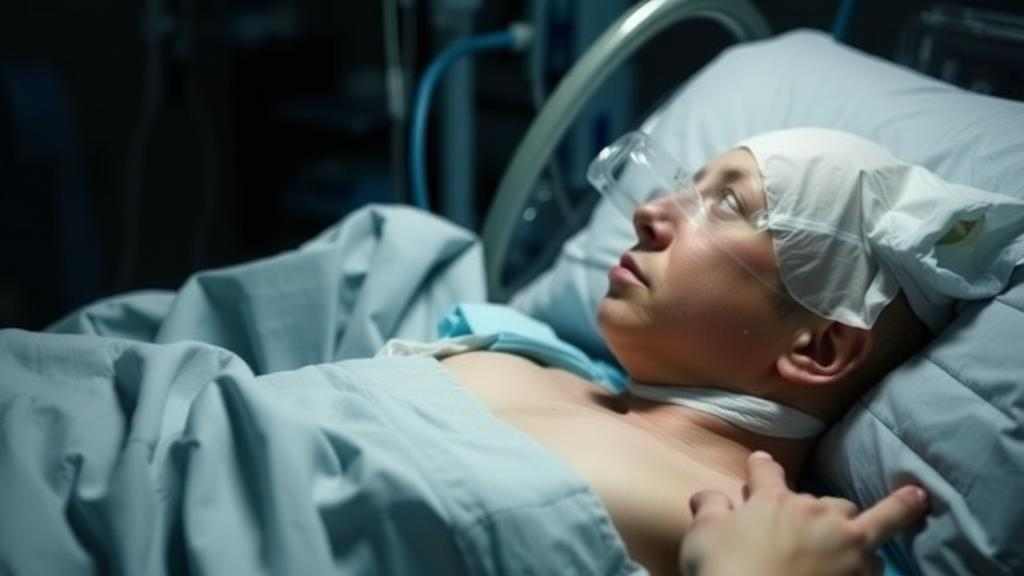
For most people, thirst is a minor inconvenience solved by a glass of water. For patients on mechanical ventilation in an intensive care unit, it can become an all-consuming ordeal that dominates memory, thought, and emotion long after the breathing tube is removed. A new qualitative study from Tehran, published in the journal Nursing Open, has documented in striking detail how intubated patients experience thirst during mechanical ventilation, revealing a symptom that is at once physical, psychological, spiritual, and, in many cases, invisible to the clinicians charged with their care.
Researchers at Tehran University of Medical Sciences interviewed 20 patients roughly five hours after they were extubated across three teaching-hospital intensive care units. All participants had been mechanically ventilated, were alert, scored between −1 and +1 on the Richmond Agitation-Sedation Scale, and showed no delirium on the CAM-ICU screening tool. Using a conventional content analysis approach, in which codes and categories emerge inductively from participants’ narratives rather than from a pre-existing theory, the team extracted 501 open codes from the interviews and distilled them into six subcategories grouped under three overarching themes: Unrelieved Thirst, Seeking Relief, and Emotional Collapse and Withdrawal.
The choice of timing was deliberate. Interviewing patients about five hours after extubation allowed them to recall the intubation period while memories remained fresh, theoretically reducing recall bias, while ensuring they had recovered from the immediate physiological effects of the tube. Interviews lasted 40 to 60 minutes, including breaks, and continued until data saturation was reached: most initial codes emerged from the first 12 interviews, the next five refined the categories, and the final three produced no new codes. Participants were recruited through maximum variation purposive sampling, deliberately spanning diagnoses from sepsis and pneumonia to cancer, liver failure, myasthenia gravis, and postoperative conditions, so that shared patterns of the thirst experience could be distinguished from diagnosis-specific effects.
The first theme, Unrelieved Thirst, captured a state of endless waiting punctuated by intrusive, repetitive thoughts about water. One participant described the sensation as a mind stuck in a loop: every second was spent imagining a glass of cold water, with no escape from the fixation. Others reported fearing they might die of thirst, being afraid even to sleep, and feeling a suffocating urgency with no visible endpoint. Yet within this distress, patients actively constructed hope, telling themselves that the deprivation was temporary, that someone would eventually understand and bring water, or that the thirst might even be part of their treatment. The researchers identified this last maneuver as cognitive reframing, a deliberate psychological strategy in which patients recast their suffering as therapeutically necessary in order to preserve meaning and resilience rather than sink into passive despair.
The second theme, Seeking Relief, revealed two distinct coping pathways. The first was spiritual: many Muslim participants turned to prayer and to religious narratives for strength, most notably the story of Imam Hussein at Karbala, a figure whose suffering from thirst holds deep resonance in Shia culture. Participants described praying nightly, asking for patience, and feeling spiritually closer to the divine precisely through their own thirst. The researchers interpret this as a meaning-making process that transformed a physical distress into a spiritually significant experience, though they caution that this finding is culturally embedded and may not transfer directly to non-Muslim or non-Shia communities.
The second relief pathway was more desperate and more practical. Unable to speak, patients begged for water with their bodies: tapping bed rails, gesturing toward their mouths, making sustained eye contact, and moving their hands in an effort to signal need. Participants described these as acts of desperation rather than casual communication, and their success depended entirely on the attentiveness of the healthcare team. Many reported that their gestures were misunderstood or simply missed. One participant recalled begging with eyebrows and eyes for even a drop of water, while another said that sometimes staff understood and sometimes they did not, leaving the patient trapped in a body that could not voice its most basic need.
When these efforts repeatedly failed, patients moved into the third theme: Emotional Collapse and Withdrawal. After cycles of hope and disappointment, many simply gave up, stopping their gestures and their attempts to attract attention, closing their eyes, and waiting for the ordeal to end. The researchers emphasize that this resignation was not acceptance or peace but profound hopelessness; some participants explicitly described wanting the nightmare to end. Alongside this withdrawal came deep emotional isolation. Participants described crying alone in a room full of people, feeling that no one truly saw them, and perceiving that their suffering was noticed only when it registered on a monitor. One participant recounted that when his heart rate rose and he began to sweat, staff rushed to administer medication, while his own clear identification of thirst as the cause went unaddressed.
That last account points to one of the study’s most clinically significant observations. Participants perceived that thirst-related distress was frequently misread as anxiety, agitation, or physiological instability, prompting pharmacological responses while the underlying unmet need was overlooked. The authors are careful to note that their qualitative data cannot establish a causal link between thirst and signs such as tachycardia, and that this interpretation rests on patient perception requiring further quantitative confirmation. Nevertheless, the pattern suggests a systematic blind spot: when a voiceless patient’s distress is medicalized, the root cause can be concealed rather than relieved, and the failure is not only clinical but relational, a missed moment of human connection.
The findings align with the Theory of Unpleasant Symptoms, which frames symptoms as multidimensional products of physiological, psychological, and situational factors. In this framework, fluid restriction, endotracheal intubation, diuretics, anxiety, impaired communication, and the disorienting ICU environment converged to produce an unusually intense symptom experience. The study also echoes earlier work showing that waiting distorts time perception in the ICU, and that ventilated patients associate thirst with helplessness, anxiety, and hopelessness. What this study adds is a sequential arc, from hope through cognitive burden and help-seeking to emotional collapse, that traces how an unrelieved basic need can erode a patient’s sense of self and agency.
The authors propose several directions for practice, framed as hypothesis-generating rather than evidence-based recommendations. These include routine visual assessment of thirst in intubated patients, training nurses to recognize subtle non-verbal cues, supporting spiritual coping resources where appropriate, and considering thirst as a possible underlying cause when patients show agitation or physiological instability. Even when oral intake is impossible, they suggest, acknowledging the request and offering timely comfort-focused mouth care might ease the helplessness, shame, and isolation participants described. The study has limitations, including its reliance on retrospective recall, the exclusion of delirious or less communicative patients, and its setting within Tehran’s Shia cultural context. Still, its central message is hard to ignore: thirst in the ventilated ICU patient is not a trivial complaint but a multidimensional crisis, and because intubation renders it invisible, care systems that wait for patients to ask may be waiting forever.
Subject of Research: Post-extubation recall of thirst during mechanical ventilation among intensive care unit patients
Article Title: Post‐Extubation Recall of Thirst During Mechanical Ventilation Among Intensive Care Unit Patients: A Conventional Content Analysis
Article References: Sadeghi, A., Nazari, A. M., Jackson, A. C., Khedmati, E., & Bahramnezhad, F. (2026). Post‐Extubation Recall of Thirst During Mechanical Ventilation Among Intensive Care Unit Patients: A Conventional Content Analysis. Nursing Open, 13(10), Article e70912. https://doi.org/10.1002/nop2.70912
Image Credits: AI Generated
DOI: 10.1002/nop2.70912
Keywords: thirst, mechanical ventilation, intensive care unit, extubation, qualitative research, content analysis, nursing, patient experience, non-verbal communication, spiritual coping, endotracheal intubation, Theory of Unpleasant Symptoms
Cite Scienmag News
Ophelia Keating. (October 11, 2026). Thirst Leaves Lasting Scars on ICU Patients Who Cannot Speak, Study Finds. Scienmag. https://scienmag.com/thirst-leaves-lasting-scars-on-icu-patients-who-cannot-speak-study-finds/
Ophelia Keating. "Thirst Leaves Lasting Scars on ICU Patients Who Cannot Speak, Study Finds." Scienmag, 11 October 2026, https://scienmag.com/thirst-leaves-lasting-scars-on-icu-patients-who-cannot-speak-study-finds/. Accessed 11 October 2026.
Ophelia Keating. "Thirst Leaves Lasting Scars on ICU Patients Who Cannot Speak, Study Finds." Scienmag. October 11, 2026. https://scienmag.com/thirst-leaves-lasting-scars-on-icu-patients-who-cannot-speak-study-finds/


