


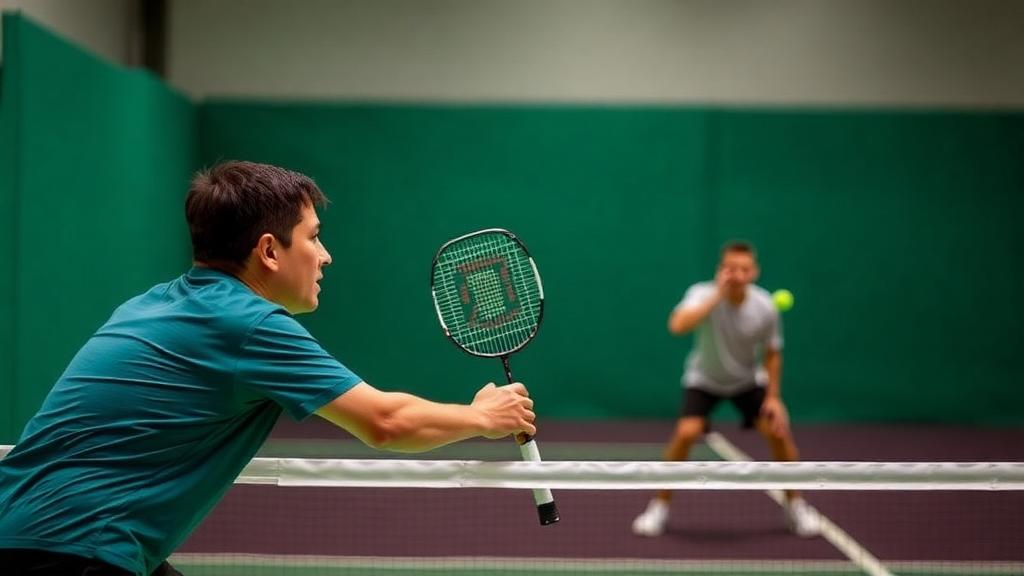
Badminton is the fastest racket sport on Earth, with shuttlecocks recorded at speeds of up to 565 kilometers per hour. Behind the explosive smashes and lightning-quick lunges, however, lies a quieter problem that has long troubled the sport’s high-performance systems: injuries cluster dramatically in the years when teenage talents become professional athletes. A new qualitative study published in Sports Medicine – Open now offers an unusually candid look at how the people who actually run elite badminton, from national coaches to team doctors, judge which young players are about to break down, and their answers reveal a world of intuition, subtle behavioral reading, and experience-driven judgment that no spreadsheet currently captures.
The research team, led by Brid Stepper and Anne Hecksteden of the University of Innsbruck together with colleagues at the German Sport University Cologne and the University of Basel, interviewed twenty national-level stakeholders in German competitive badminton between October 2023 and July 2024. The group included nine badminton coaches working at youth training centers, five current or former top-level players, two association doctors, two physiotherapists, and two strength and conditioning coaches. Each participant had at least five years of experience with athletes of transitional age at the highest German level, and the semi-structured interviews averaged 54.4 minutes, ranging from roughly 30 to nearly 79 minutes. Using the six-phase thematic analysis model of Braun and Clarke, the researchers coded the transcripts with MAXQDA software and distilled the conversations into broader themes and observable indicators.
The study focused on a well-documented danger zone: the transition from junior to elite badminton, roughly between the ages of 16 and 20. Injury incidence in competitive badminton generally falls between one and four injuries per 1,000 hours of play, with some studies reporting rates as high as seven per 1,000 hours, and the injury profile is dominated by overuse problems in the ankles, knees, shoulder, and back. The interviewees unanimously confirmed that this transitional window is the most perilous. Their explanation is mechanically straightforward: as skill grows with age, the mechanical strain of playing intensifies, and at the same moment many players leave home to join national training centers, where training volume and intensity spike within a short time frame, leaving almost no opportunity for the body to adapt.
From the interviews, four higher-order themes emerged as stakeholder-perceived contributors to injury vulnerability: excessive pressure, recovery deficits, an unprofessional attitude, and disruptions in training continuity. Excessive pressure came in two flavors. Intrinsic pressure drove athletes to train beyond what was reasonable, a behavior coaches described with the vivid German image of trying to force progress with a crowbar. External pressure flowed down from coaches and associations, and the make-it-or-break-it atmosphere of the transition years pushed players to hide weaknesses rather than report them. Recovery deficits accumulated when consecutive tournaments and intense training weeks stacked up, a pattern the researchers labeled the boom-and-bust cycle: after a break caused by injury, illness, or school obligations, athletes tried to catch up on lost time too quickly, peaked their load, and injured themselves again.
Beyond these underlying themes, the researchers distinguished six families of cues that stakeholders actually use when assessing whether an individual player is at elevated risk. The first family is signs of over-motivation, most visibly when players sneak in additional unsupervised training sessions before an upcoming tournament because they fear losing their feel for the court and racket. The second is an unprofessional attitude, summarized as not being a real athlete, which manifests as irregular strength and mobility work, too little sleep, and poor diet. The third family is the most intriguing: the coaches’ eye, an intuitive sense that something is different about an athlete. This includes visible rapid changes to the body, deviations from a player’s habitual movement quality on court, and psychosocial departures from the individual normal state, such as a normally quiet player suddenly shouting in training, or a usually loud player falling silent, each signaling a different underlying problem.
The remaining cue families are more concrete. Upheavals in private life, such as moving away from home or transitioning from school to university, were repeatedly flagged as raising injury risk through lost focus and poor recovery. Exposure cues covered unfamiliar training content, like newly introduced jump rope sessions or jump-focused programs, and sudden load spikes when volume or intensity ramped up abruptly. Finally, signs of wear, meaning mild overuse complaints that athletes ignore because they do not yet count as injuries, were seen as precursors that can quietly develop into serious problems. Notably, the experts often did not estimate absolute injury probabilities at all. Instead, they judged risk relative to a familiar baseline, reasoning in ratios: this player currently appears twice as vulnerable as usual, or clearly more fragile than teammates.
One of the study’s most striking findings is what the stakeholders downplayed. Injury history, a factor heavily emphasized in the scientific literature as a predictor of future injury, was rarely mentioned proactively by the interviewees, and biomechanical markers such as leg alignment were largely ignored by those without formal scientific training. The authors suggest two possible explanations: practical settings often lack systematic documentation of long-term medical histories, and athletes who successfully return from injury are simply more visible in a coach’s perception than those who quietly exit the sport. Similarly, while the literature identifies gender differences in injury patterns, most interviewees saw no clear difference between male and female players, though a few noted that men seemed more prone to muscular injuries and women to ligament and joint problems.
The different professional roles also produced different blind spots. Physiotherapists and doctors, who see athletes mainly after a problem has occurred, reasoned retrospectively about causes. Badminton coaches, embedded in daily training, were the ones who picked up on psychological and interpersonal cues such as over-motivation, behavioral deviations, and private upheavals. Strength and conditioning coaches focused on athletic deficiencies and load spikes, consistent with their role. The athletes themselves confirmed the coaches’ suspicion that dishonest communication is widespread: young players hide minor complaints out of ambition and fear of being pulled from training or appearing weak. This convergence between what coaches suspect and what players admit lends the experiential cues a degree of internal validity that pure epidemiology cannot easily provide.
The authors argue that these intuitive heuristics, while valuable, are difficult to standardize or automate, particularly when they concern dynamic psychological states like pressure, fatigue, and motivation. Their proposed solution is a hybrid approach: rather than replacing human judgment with rigid thresholds derived from small datasets, interpretable machine learning systems could be enriched with expert input, and qualitative cues could be logged within existing athlete monitoring frameworks. Structured coach observations and periodic athlete self-reports covering perceived fatigue, communication shifts, and contextual stressors could serve as complementary flags that trigger closer interdisciplinary review when combined with quantitative load data. The researchers are careful to stress that this study does not yet prove such integration improves prediction; prospective validation remains an open task.
The study has limitations worth noting. The strict inclusion criteria, demanding years of experience at the highest national level, limited the sample to twenty participants, and only a small number of women could be included because few hold coaching or supervisory positions in German badminton. Psychologists and nutritionists were not systematically included, and only one interviewed athlete was within the actual target age range, meaning the findings rest on retrospective reflections that may be subject to recall bias. Nevertheless, the high level of agreement among interviewees strengthens confidence in the identified themes. What the study ultimately delivers is a rare, systematic map of the tacit knowledge that guards young athletes’ bodies every day, and a challenge to sports science: if the coaches’ eye can be made explicit, the transition from junior ace to elite professional might finally become less of a gamble.
Subject of Research: Stakeholder perspectives on injury risk assessment during the junior-to-elite transition in competitive badminton
Article Title: From young aces to injury cases: a qualitative study of stakeholder perspectives on injury risk in junior to elite badminton
Article References: Stepper, B., Donath, L., Stagge, H., Faude, O., & Hecksteden, A. (2026). From young aces to injury cases: a qualitative study of stakeholder perspectives on injury risk in junior to elite badminton. Sports Medicine – Open, 12(1), Article 151. https://doi.org/10.1186/s40798-026-01107-9
Image Credits: AI Generated
DOI: 10.1186/s40798-026-01107-9
Keywords: badminton, injury risk, junior-to-elite transition, coaches' eye, qualitative research, thematic analysis, overuse injuries, sports medicine, athlete monitoring, expert heuristics, training load, youth athletes
Cite Scienmag News
Ophelia Keating. (October 11, 2026). Coaches’ Intuition Outperforms Data in Spotting Badminton Injury Risk. Scienmag. https://scienmag.com/coaches-intuition-outperforms-data-in-spotting-badminton-injury-risk/
Ophelia Keating. "Coaches’ Intuition Outperforms Data in Spotting Badminton Injury Risk." Scienmag, 11 October 2026, https://scienmag.com/coaches-intuition-outperforms-data-in-spotting-badminton-injury-risk/. Accessed 11 October 2026.
Ophelia Keating. "Coaches’ Intuition Outperforms Data in Spotting Badminton Injury Risk." Scienmag. October 11, 2026. https://scienmag.com/coaches-intuition-outperforms-data-in-spotting-badminton-injury-risk/


