


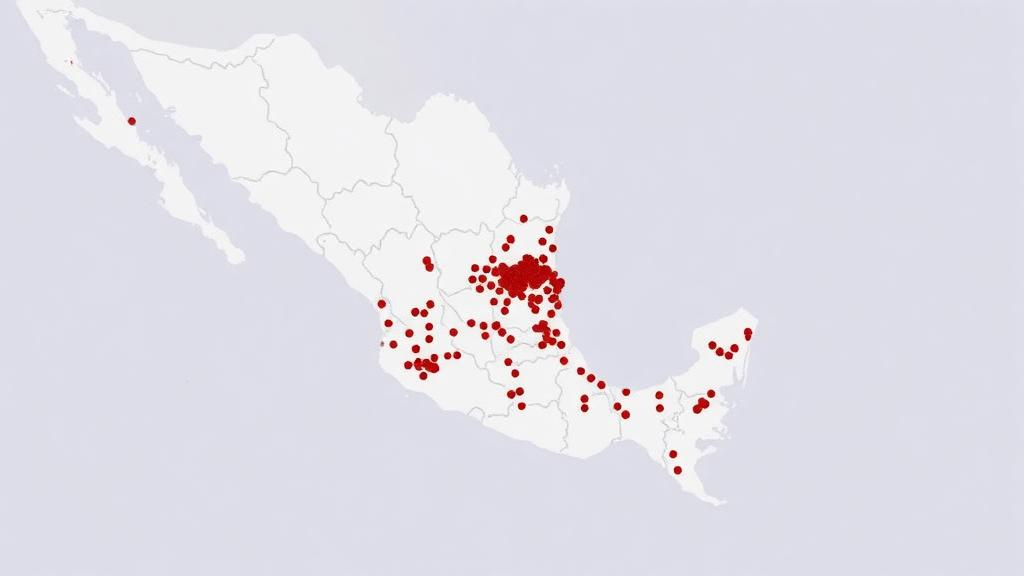
Dengue remains one of the most formidable mosquito-borne viral diseases in the Americas, and Mexico has stood at the front line of its recent resurgence. A new modelling study published in PLOS Medicine has now provided the most detailed picture to date of how intensely dengue virus has circulated across Mexico between 2016 and 2023, both overall and separately for each of the virus’s four serotypes. By analysing more than 833,000 probable or confirmed dengue cases reported to the country’s National Epidemiological Surveillance System, known as SINAVE, the research team quantified the force of infection, a measure of the rate at which susceptible individuals acquire infection, across 27 Mexican states. The results reveal striking spatial, temporal and serotype-specific heterogeneities that have important implications for how the country, and the wider region, plans vaccination strategies, vector control campaigns and outbreak preparedness.
The study, led by Oliver S. Simmons and Ilaria Dorigatti together with colleagues at Mexican research institutions, set out to fill two important gaps in the understanding of dengue epidemiology. First, while earlier work had mapped long-term average spatial patterns of dengue risk in Mexico, nobody had systematically characterised how transmission intensity shifts from year to year across the country. Second, the relative transmissibility of the four dengue virus serotypes, DENV-1, DENV-2, DENV-3 and DENV-4, remains poorly characterised both in Mexico and globally, despite the fact that these serotypes differ genetically and can dominate outbreaks at different times and places. Understanding these differences matters because infection with one serotype confers long-lasting immunity only against that serotype, while secondary infection with a different serotype is a well-established risk factor for severe disease.
To address these questions, the researchers employed catalytic models, a class of mathematical models originally developed to describe age patterns of infection for vaccine-preventable diseases. These models use the age distribution of cases, combined with case counts over time, to estimate the force of infection without requiring population-wide serological surveys. Crucially, the team developed a new serotype-specific extension of these established models, allowing them to estimate how intensely each of the four serotypes was transmitting in each state and year. This methodological advance means that routinely collected case-notification data, which health ministries already gather as part of standard surveillance, can be repurposed to yield insights that would otherwise require expensive and logistically demanding seroprevalence studies.
The analysis confirmed that dengue transmission in Mexico is far from uniform. Large spatial heterogeneities emerged, with some states experiencing consistently higher force of infection than others, reflecting differences in climate, urbanisation, mosquito abundance, human mobility and surveillance capacity. Equally notable were the temporal patterns: transmission intensity fluctuated considerably from year to year, underscoring that a single snapshot of average risk can be misleading for planning purposes. In years of intense transmission, a state’s population may experience a rapid accumulation of immunity, only for that same population to remain relatively untouched in subsequent years. This year-to-year volatility means that cumulative estimates of infection burden can conceal periods of both quiescence and explosive epidemic growth.
The serotype-specific findings are among the most significant contributions of the study. DENV-1 and DENV-2, according to the model estimates, have historically circulated at high levels across Mexico, making them the dominant drivers of the country’s dengue burden during the study period. In contrast, DENV-4 exhibited low transmission intensity throughout the eight years analysed. Perhaps most concerning for public health planners was the evidence of increasing DENV-3 transmission intensity in several states in recent years, a trend that coincided with large outbreaks. Because many younger Mexicans may never have been exposed to DENV-3, its re-emergence creates a large susceptible population at risk of primary infection, while older cohorts previously exposed to this serotype decades ago face the possibility of secondary infection with a now-circulating different serotype, a scenario associated with elevated risk of severe dengue.
The mechanistic underpinnings of these serotype-specific patterns are complex. Dengue virus transmission depends on the Aedes aegypti mosquito vector, whose abundance and susceptibility to infection can vary, as can the intrinsic fitness of each viral serotype. Differences in the force of infection between serotypes may reflect a combination of viral characteristics, such as replication efficiency in the mosquito and human host, and herd immunity dynamics, whereby a serotype that circulated widely in the past leaves fewer susceptible individuals available for future transmission. The modelling framework cannot fully disentangle these mechanisms on its own, but by generating comparable, state-level estimates of serotype-specific transmission intensity, it provides the empirical foundation upon which such mechanistic questions can be addressed in future work.
The study also highlights the crucial role of diagnostics in making serotype-specific inference possible. Extensive reverse transcription polymerase chain reaction, or RT-PCR, testing during the study period allowed many cases to be attributed to a specific infecting serotype, and the authors emphasise that newly available rapid diagnostic tests capable of discerning the infecting serotype could further improve this picture. As these tests become more widely deployed, surveillance systems in Mexico and elsewhere will be better positioned to track which serotypes are circulating in near real time, information that is directly relevant to decisions about when and where to deploy interventions. The timing is particularly significant given that Mexico has introduced dengue vaccination programmes, and vaccine effectiveness and deployment strategy can depend on the local transmission intensity and the serotype composition of circulating viruses.
The authors are careful to note an important limitation: the serotype-specific estimates may be affected by heterogeneities in how cases are reported across states and over time. Surveillance intensity, health-seeking behaviour, access to healthcare and diagnostic practices all vary geographically and can shift between years, and disentangling genuine changes in transmission from artefacts of the reporting system remains a task for future validation studies. Nevertheless, the scale of the dataset, spanning 833,629 cases across 27 states and eight years, lends considerable weight to the broad patterns identified, and the consistency of the findings with known epidemiological events, such as the DENV-3 resurgence coinciding with large outbreaks, supports their plausibility.
The wider context makes this work especially timely. Mexico and the Americas region as a whole have experienced rising dengue incidence in recent years, and there are widespread concerns that changing climatic conditions, including warmer temperatures and shifting rainfall patterns, may expand the geographic range and seasonal window of Aedes mosquito activity, thereby enhancing transmission in the future. In this environment, accurate estimates of who remains susceptible to which serotype, and where and when transmission is most intense, become essential inputs for targeting vaccination, vector control and clinical preparedness. The methods developed in this study contribute to a better understanding of the past and current burden of dengue infection and can help refine assessments of the potential impact of existing and new interventions, from next-generation vaccines to Wolbachia-based biocontrol strategies.
Ultimately, the study demonstrates the power of mining routinely collected surveillance data with appropriately sophisticated models. Rather than relying solely on costly serological surveys, public health authorities can extract detailed, serotype-resolved pictures of transmission intensity from the case notifications they already gather, provided that diagnostic testing is sufficiently extensive and that reporting heterogeneities are acknowledged and, where possible, corrected for. As dengue continues to expand its footprint across the Americas under the combined pressures of urbanisation, connectivity and climate change, approaches of this kind offer a practical route toward the granular, timely evidence base that controlling this evolving threat will demand.
Subject of Research: Serotype-specific dengue virus transmission intensity across Mexican states estimated from case-notification data using catalytic models
Article Title: Overall and serotype-specific dengue virus transmission intensity in Mexico, 2016–2023: A modelling study of case-notification data
Article References: Simmons, O. S., Vicco, A., Martínez-Vega, R. A., Ramos-Castañeda, J., & Dorigatti, I. (2026). Overall and serotype-specific dengue virus transmission intensity in Mexico, 2016–2023: A modelling study of case-notification data. PLOS Medicine, 23(9), e1004874. https://doi.org/10.1371/journal.pmed.1004874
Image Credits: AI Generated
DOI: 10.1371/journal.pmed.1004874
Keywords: dengue, DENV-1, DENV-2, DENV-3, DENV-4, force of infection, catalytic models, Mexico, serotypes, surveillance, PLOS Medicine, epidemiology
Cite Scienmag News
Kristina Jarvis. (October 10, 2026). Dengue Transmission in Mexico Varies Sharply by Place, Year and Virus Serotype, Modelling Study Finds. Scienmag. https://scienmag.com/dengue-transmission-in-mexico-varies-sharply-by-place-year-and-virus-serotype-modelling-study-finds/
Kristina Jarvis. "Dengue Transmission in Mexico Varies Sharply by Place, Year and Virus Serotype, Modelling Study Finds." Scienmag, 10 October 2026, https://scienmag.com/dengue-transmission-in-mexico-varies-sharply-by-place-year-and-virus-serotype-modelling-study-finds/. Accessed 10 October 2026.
Kristina Jarvis. "Dengue Transmission in Mexico Varies Sharply by Place, Year and Virus Serotype, Modelling Study Finds." Scienmag. October 10, 2026. https://scienmag.com/dengue-transmission-in-mexico-varies-sharply-by-place-year-and-virus-serotype-modelling-study-finds/


