


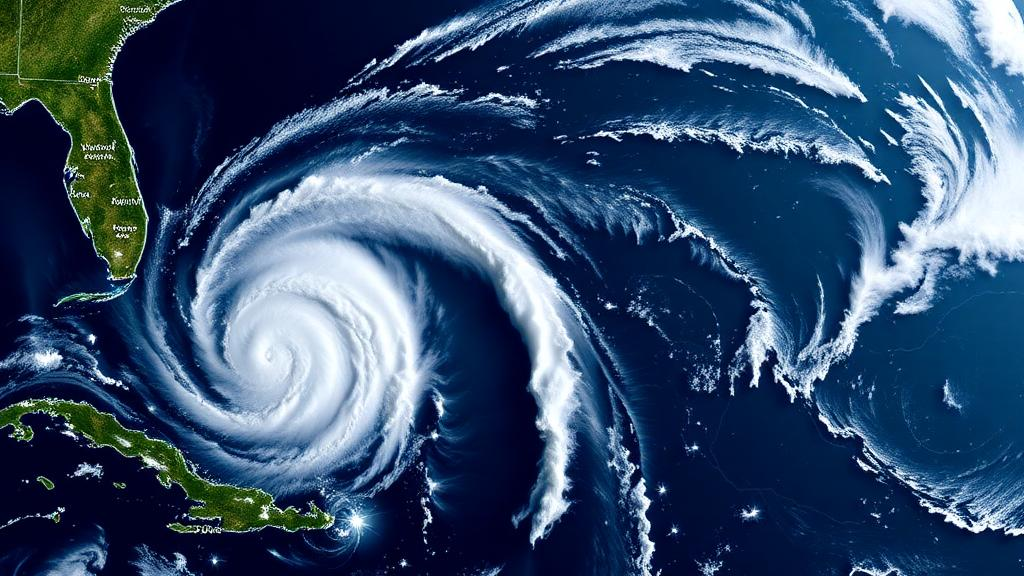
When a hurricane slams into a coastline, the danger does not end at the beach. For communities hundreds of kilometers inland, the critical question has always been how quickly the storm will lose its punch over land. For decades, forecasters and emergency planners have treated that decay process as essentially uniform: whatever the environment is doing, it should affect all landfalling storms in roughly the same way. A new study published in Nature Communications dismantles that assumption, revealing that strong and weak tropical cyclones are now following sharply divergent trajectories after they come ashore, with profound implications for who faces the greatest risk in a warming world.
The research, led by Chenxi Hu of the University of Texas at Austin together with Xinxin Sui of the National Science Foundation National Center for Atmospheric Research, Dev Niyogi, Clint N. Dawson, and Zong-Liang Yang, analyzed 885 observed tropical cyclone landfall events spanning the years 1979 through 2024. That forty-five-year record allowed the team to compute how the rate of post-landfall weakening has changed over time for storms of different intensities. The results were striking. Strong storms, defined in the study as those with maximum sustained winds of at least 29 meters per second, now weaken 18.6 percent faster after landfall than they did in the earlier part of the record. Weak storms, by contrast, persist 14.5 percent longer once they move inland, holding onto their circulation and their rainfall-producing capacity well beyond where past storms of similar strength would have fizzled.
This split behavior matters because the two trends create opposite hazard profiles. A strong hurricane that decays rapidly after landfall concentrates its destructive winds and coastal surge near the shore, intensifying the already devastating impacts on coastal communities. A weak storm that lingers, however, becomes a slow-moving rain engine, pushing flooding rainfall and inland wind damage into regions that may have little experience preparing for tropical systems. The study’s authors describe the result as a dual-threat landscape: coastal impacts from faster-dying strong storms on one side, and expanding inland risks from increasingly persistent weak systems on the other.
What makes the divergence particularly interesting from a physical standpoint is that the two storm classes respond to fundamentally different aspects of the changing environment. The researchers found that weak storms are governed primarily by thermodynamic factors. Warmer sea surfaces pump more energy into storms before landfall, an enhanced atmospheric moisture supply keeps their circulations fueled after they leave the coast, and increased oceanic influence along storm tracks means that even over land, weak systems can draw on wetter conditions that slow their decline. All three of these thermodynamic trends favor prolonged inland persistence, and weak storms, it turns out, are exquisitely sensitive to them.
Strong storms tell a different story. Their post-landfall behavior is more tightly coupled to dynamic and land-surface conditions rather than to heat and moisture alone. Over the study period, storms have been translating faster, and a faster-moving cyclone spends less time over any given stretch of terrain, but it also experiences more rapid changes in the forces acting on it. At the same time, atmospheric stability has been increasing, which suppresses the deep convective activity that a strong cyclone needs to maintain its inner core once its oceanic energy supply is cut off. Drier soils compound the problem, reducing the evaporation and latent heat fluxes from the land surface that can partially sustain a storm’s circulation. Together, these dynamic disruptions promote faster decay in strong systems, which the study shows are more vulnerable to such disruption than their weaker counterparts.
To move beyond correlation and probe the underlying mechanisms, the team conducted numerical experiments that isolated the different environmental influences. Those simulations confirmed the observational picture: weaker storms respond more strongly to thermodynamic enhancement, gaining longevity when moisture and surface heating conditions improve, whereas stronger storms are disproportionately damaged by dynamic disruption. In other words, the same changing climate is pushing the two ends of the tropical cyclone intensity spectrum in opposite directions after landfall, not because the environment is inconsistent, but because the storms themselves have different sensitivities depending on how powerful they are.
The implications for risk assessment are immediate. Most existing hazard models and building codes implicitly assume that environmental change affects storms of all intensities uniformly, so a trend identified for the average landfalling cyclone is applied across the board. The new findings show that this uniform-response assumption can misallocate protective resources in both directions. Coastal defenses and evacuation planning may need to account for strong storms that deliver their worst impacts in a compressed window near the shore, while inland flood management, dam operations, and emergency response networks in regions far from the coast face a growing burden from weak but persistent tropical systems that historically would have decayed before reaching them.
The geographic dimension of the problem is equally consequential. Regions that have historically been spared the worst of tropical cyclone impacts, precisely because weak storms tended to die quickly after landfall, may now find themselves in the path of systems that survive longer over land. These vulnerable and often unprepared areas may lack the drainage infrastructure, floodplain zoning, and public awareness campaigns that coastal populations have developed over generations of exposure. The study’s authors urge refined hazard assessment and adaptation strategies that explicitly account for intensity-dependent behavior rather than relying on aggregate storm statistics that blend strong and weak systems into a single, misleading average.
The methodological foundation of the work rests on a careful observational record. By assembling nearly nine hundred landfall events across four and a half decades and stratifying them by intensity, the researchers could separate long-term trends in decay behavior from the considerable natural variability that characterizes individual storm seasons. The combination of global observations with targeted numerical experiments gives the findings a robustness that purely statistical studies often lack, and the open-access publication ensures that the underlying analysis can be scrutinized and extended by other research groups. The work was supported by the U.S. Department of Energy’s Advanced Scientific Computing Research Program, with additional support from the National Science Foundation’s National Center for Atmospheric Research.
As the climate continues to warm, the divergence documented in this study is likely to become more pronounced rather than less. Continued sea-surface warming and a moister atmosphere will keep strengthening the thermodynamic lifeline that sustains weak storms over land, while trends toward faster storm motion, greater stability, and drier soils in many landfall regions will continue to erode the resilience of strong systems once they leave the ocean. For forecasters, the message is that intensity must become a first-order variable in post-landfall prediction, not an afterthought. For the public, the message is subtler but no less important: the storms that linger quietly over the interior, stripped of their category ratings but not of their rainfall, may pose the fastest-growing tropical cyclone threat to the largest number of people.
Subject of Research: Intensity-dependent trends in the post-landfall decay of tropical cyclones
Article Title: Divergent trends in post-landfall decay of strong and weak tropical cyclones
Article References: Hu, C., Sui, X., Niyogi, D., Dawson, C. N., & Yang, Z.-L. (2026). Divergent trends in post-landfall decay of strong and weak tropical cyclones. Nature Communications. https://doi.org/10.1038/s41467-026-77958-3
Image Credits: AI Generated
DOI: 10.1038/s41467-026-77958-3
Keywords: tropical cyclones, landfall, post-landfall decay, hurricanes, climate change, inland flooding, storm intensity, thermodynamics, atmospheric moisture, land surface, hazard assessment, Nature Communications
Cite Scienmag News
Violet Maxwell. (October 10, 2026). Strong hurricanes now die faster inland while weak ones linger, study finds. Scienmag. https://scienmag.com/strong-hurricanes-now-die-faster-inland-while-weak-ones-linger-study-finds/
Violet Maxwell. "Strong hurricanes now die faster inland while weak ones linger, study finds." Scienmag, 10 October 2026, https://scienmag.com/strong-hurricanes-now-die-faster-inland-while-weak-ones-linger-study-finds/. Accessed 10 October 2026.
Violet Maxwell. "Strong hurricanes now die faster inland while weak ones linger, study finds." Scienmag. October 10, 2026. https://scienmag.com/strong-hurricanes-now-die-faster-inland-while-weak-ones-linger-study-finds/


