


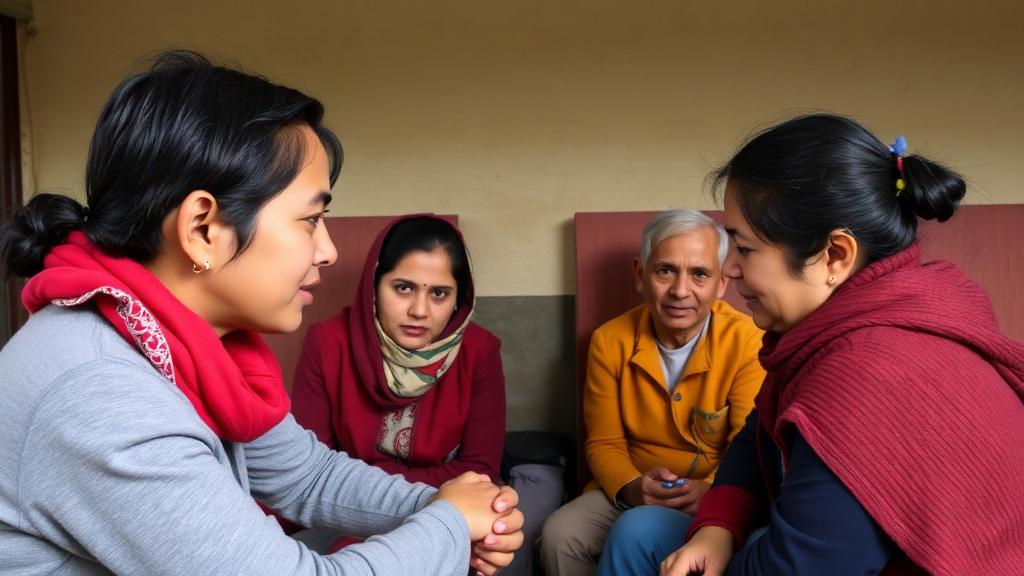
Mental health-related stigma remains one of the most stubborn barriers standing between people with psychological conditions and the care they need. In Nepal, where mental health services are scarce and misconceptions about conditions such as depression, psychosis, and epilepsy are widespread, stigma operates at every level of the health system, from the village volunteer who first encounters a distressed resident to the psychiatrist working in a national hospital. A new mixed-methods pilot study published in PLOS Mental Health suggests that a carefully structured, multi-level anti-stigma intervention, built around the involvement of people with lived experience of mental health conditions, can measurably improve the knowledge, attitudes, and behavior of health workers across this entire chain of care.
The study, conducted as part of the international Study of Discrimination and Stigma Outcomes, known as INDIGO, adapted and pilot-tested contact-based anti-stigma interventions at three distinct levels of Nepal’s health system. The research team, led by Bhawana Subedi and colleagues including Kalpana Bhattarai, Brandon A. Kohrt, Claire Henderson, Graham Thornicroft, and Petra C. Gronholm, designed the pilot to answer a deceptively simple question: can a single anti-stigma program be tailored to work simultaneously for female community health volunteers, primary healthcare workers, and specialist psychiatric staff, and can its effects be sustained over time? The answer emerging from the data is a cautious but encouraging yes, with important caveats about the structural constraints that training alone cannot overcome.
The intervention targeted three groups of health workers in sequence. Nineteen female community health volunteers took part in the component known as INDIGO Local. Nine primary healthcare workers participated in the INDIGO Primary component. Nine psychiatrists and psychiatric nurses formed the INDIGO READ-MH group. In each case, the training package integrated social contact with people with lived experience, a technique with strong evidence behind it in stigma research. Rather than lecturing health workers about the wrongness of discriminatory attitudes, the program brought them into direct, structured interaction with individuals who have personally navigated mental health conditions and the health system, allowing stereotypes to be challenged through personal encounter rather than abstract instruction.
The researchers measured outcomes using validated instruments administered before training, immediately after training, and at follow-up points of three and six months. Among the community health volunteers in INDIGO Local, the mean knowledge score rose from 20.43 at pre-training, with a 95 percent confidence interval of 20.0 to 20.9, to 25.11 at six months, with a confidence interval of 23.83 to 26.17. That a knowledge gain of this magnitude persisted half a year after the training ended is one of the most striking findings of the pilot, since anti-stigma effects are often reported to fade quickly once the immediate enthusiasm of a workshop dissipates.
The results among primary healthcare workers were equally notable, particularly on measures of intended behavior and self-stigma. In the INDIGO Primary group, the intended behavior score increased from 16.67 at pre-training, with a confidence interval of 14.73 to 19.27, to 18.88 at post-training, with a confidence interval of 17.69 to 20.31. Perhaps more dramatically, the mean score on the Social Distance Scale, a widely used measure of the desire to keep distance from people with mental health conditions, fell from 39.26 to 20.62. A reduction of this size indicates a substantial softening of the avoidance instincts that often cause primary care workers to refer mental health patients elsewhere rather than engage with them directly. The study also recorded that the primary care personnel’s helpful behavior increased while harmful behavior decreased, a paired shift that speaks directly to the quality of care patients actually receive.
Among the specialist psychiatric staff in INDIGO READ-MH, the knowledge and Objective Structured Clinical Examination scores both improved. The knowledge mean score rose from 12.67 at baseline, with a confidence interval of 10.36 to 14.97, to 14.67 at post-training, with a confidence interval of 13.28 to 16.05. The OSRE mean score, which assesses clinical competency through simulated patient encounters, climbed from 2 at pre-training, with a confidence interval of 1.62 to 2.38, to 9 at post-training, with a confidence interval of 7.56 to 10.44. This leap in competency scores suggests that the training did more than adjust attitudes; it equipped clinicians with practical skills for communicating with and treating people experiencing mental health crises, skills that were demonstrably lacking before the intervention.
The study was not without its more complicated results. On the Anti-Stigma Toolkit for Assessment of Discrimination, or ASTAD, subscales, most domains increased at the three-month follow-up, but two subscales, motivation and work satisfaction, decreased at post-training. The researchers do not gloss over this pattern. It may reflect a sobering recalibration among specialist staff, who, having become more attuned to the realities of stigma and the gaps in their health system, found their sense of efficacy and job satisfaction tested. Alternatively, the immediate post-training period may simply capture a moment of fatigue after intensive coursework. Either way, the finding is a reminder that anti-stigma interventions do not operate in a vacuum and that emotional responses to training deserve attention in future iterations.
The qualitative strand of the study, drawing on interviews with 43 participants across all three levels of the health system, added depth and texture to the quantitative findings. Participants consistently described a positive attitudinal shift following the interventions, and the involvement of people with lived experience emerged as the single most emphasized element of the training. Health workers reported that hearing directly from individuals who had experienced mental health conditions dismantled assumptions in a way that no lecture or written module could. This aligns with a growing international consensus in stigma research that social contact is among the most powerful mechanisms for changing discriminatory attitudes, and it demonstrates that this mechanism can be successfully embedded in training packages adapted to the specific cultural and institutional context of Nepal.
Crucially, the providers themselves judged the training to be feasible and appropriate within the structure of Nepal’s health system. This assessment matters because interventions that look effective on paper often fail in practice when they demand resources, time, or institutional arrangements that a health system cannot supply. The multi-level design, reaching from community volunteers to specialist clinicians, reflects an understanding that stigma is not confined to any single professional group. A community volunteer who fears a person with psychosis will not refer them for care; a primary care worker who avoids mental health presentations will not provide first-line support; a psychiatrist who holds subtle discriminatory attitudes will not deliver person-centered treatment. Addressing all three levels simultaneously multiplies the potential impact of each individual training.
At the same time, the study is candid about the limits of what attitude change can achieve. Even as providers reported more positive perceptions of people with mental health conditions, they identified persistent structural barriers to effective mental health care, including insufficient availability of medicines, limited human resources, and the absence of separate counseling rooms where confidential conversations could take place. These findings underscore a central tension in global mental health work: changing hearts and minds is necessary but not sufficient if the material infrastructure of care remains inadequate. A health worker who now wants to help a patient with depression may still be unable to prescribe an essential medication or find a private space for a counseling session. The researchers’ mixed-methods approach captures this tension precisely, pairing statistical evidence of improvement with qualitative testimony about the conditions under which that improvement must be translated into patient care.
As a pilot feasibility study, the INDIGO Nepal work does not claim to demonstrate population-level impact, and the modest sample sizes at each level mean the confidence intervals around some estimates are wide. But the pilot achieves what a well-designed feasibility study should: it shows that the intervention can be delivered, that participants find it acceptable, that outcome measures move in the expected direction, and that effects on knowledge at least can persist for months. The involvement of people with lived experience, the element participants valued most highly, stands out as both an ethical imperative and a practical engine of change. If subsequent controlled trials confirm these findings at scale, the model developed in Nepal could offer a template for other low- and middle-income countries grappling with the same entanglement of stigma, scarce resources, and unmet mental health need, demonstrating that the people who have lived through mental health conditions are not merely beneficiaries of reform but its most persuasive advocates.
Subject of Research: Multi-level mental health stigma reduction interventions in Nepal's healthcare system involving people with lived experience
Article Title: Multi-level mental health-related stigma interventions in healthcare systems through the involvement of people with lived experiences: Mixed-methods pilot findings from international study of discrimination and stigma outcomes (INDIGO) study in Nepal
Article References: Subedi, B., Bhattarai, K., Kohrt, B. A., Henderson, C., Brohan, E., Thornicroft, G., Bakolis, I., Semrau, M., Votruba, N., Gronholm, P. C., Ouali, U., & Gurung, D. (2026). Multi-level mental health-related stigma interventions in healthcare systems through the involvement of people with lived experiences: Mixed-methods pilot findings from international study of discrimination and stigma outcomes (INDIGO) study in Nepal. PLOS Mental Health, 3(9), e0000638. https://doi.org/10.1371/journal.pmen.0000638
Image Credits: AI Generated
DOI: 10.1371/journal.pmen.0000638
Keywords: mental health stigma, Nepal, INDIGO study, contact-based intervention, lived experience, community health volunteers, primary healthcare workers, psychiatrists, PLOS Mental Health, stigma reduction, health system, mixed methods
Cite Scienmag News
Glenn Wilkins. (October 10, 2026). People With Lived Experience Help Dismantle Mental Health Stigma in Nepal’s Health System. Scienmag. https://scienmag.com/people-with-lived-experience-help-dismantle-mental-health-stigma-in-nepals-health-system/
Glenn Wilkins. "People With Lived Experience Help Dismantle Mental Health Stigma in Nepal’s Health System." Scienmag, 10 October 2026, https://scienmag.com/people-with-lived-experience-help-dismantle-mental-health-stigma-in-nepals-health-system/. Accessed 10 October 2026.
Glenn Wilkins. "People With Lived Experience Help Dismantle Mental Health Stigma in Nepal’s Health System." Scienmag. October 10, 2026. https://scienmag.com/people-with-lived-experience-help-dismantle-mental-health-stigma-in-nepals-health-system/


