


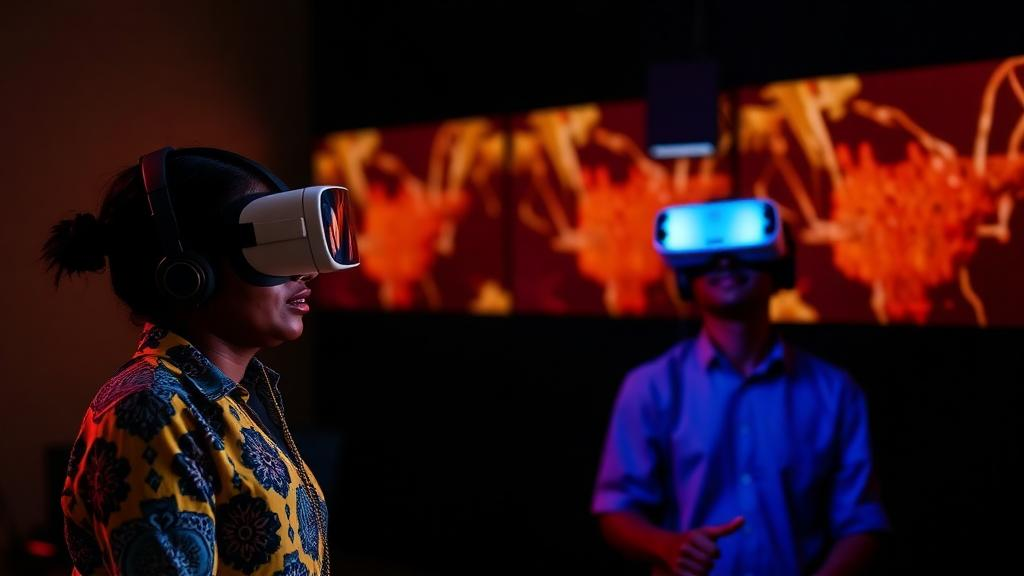
Stroke remains one of the world’s most devastating neurological events, and its aftermath is felt most acutely in low- and middle-income countries, where rehabilitation resources are scarce and long-term disability is common. Among the many consequences of stroke, impairment of the upper limb stands out as particularly disabling, robbing survivors of the ability to dress themselves, prepare food, write, or perform the countless hand-centered tasks that underpin independent living. A new study from Ethiopia, published in PLOS One, suggests that an immersive virtual reality system called AdaptRehab VR may offer a practical, engaging, and safe way to rebuild these lost functions, even in settings where advanced rehabilitation technology has traditionally been out of reach.
The research, led by Chala Diriba Kenea and Teklu Gemechu Abessa of Jimma University together with Dheeraj Lamba and Bruno Bonnechère, was designed as a mixed-methods feasibility study rather than a definitive trial. The team wanted to know whether an immersive virtual reality rehabilitation program could actually be delivered in an Ethiopian hospital, whether stroke survivors would find it acceptable and motivating, and whether there were early signals of functional improvement that would justify a larger randomized controlled trial. To that end, the investigators enrolled twenty adults aged eighteen or older who were in the subacute or chronic phase after stroke, recruiting them through Jimma University Teaching Hospital.
Eighteen of the twenty participants completed the full program, which consisted of nine AdaptRehab VR sessions delivered over three weeks. That adherence rate of 93 percent is remarkable for any rehabilitation intervention, and particularly notable in a field where dropout and poor engagement are persistent problems. Conventional upper limb therapy is often repetitive and monotonous, and patients frequently struggle to maintain motivation across weeks of exercises that may produce slow, incremental gains. Immersive virtual reality addresses this by placing patients inside interactive virtual environments where therapeutic movements become goal-directed tasks, with immediate visual feedback that rewards effort and progress in ways that conventional drills cannot match.
The technical evaluation of the system focused on three complementary dimensions: usability, user experience, and cybersickness. Usability was measured with the widely used System Usability Scale, a ten-item questionnaire that yields a score from zero to one hundred. AdaptRehab VR achieved a mean score of 76.2 with a standard deviation of 12.1, a result that falls squarely within the range conventionally interpreted as good usability. For a technology deployed in a hospital setting with patients who had never encountered head-mounted displays before, this suggests that the interface, the session structure, and the physical setup were intuitive enough for stroke survivors with compromised motor control to operate with confidence.
User experience was assessed with the User Experience Questionnaire, a validated instrument that captures both pragmatic qualities, such as efficiency and dependability, and hedonic qualities, such as stimulation and novelty. Participants rated the system positively across all measured dimensions, with a mean attractiveness score of 1.92, pragmatic quality of 1.78, and hedonic quality of 1.84, each on a scale where positive values indicate favorable evaluations. These numbers matter because hedonic appeal, the sheer enjoyment of using a system, is often what sustains patient engagement over repeated sessions. The qualitative arm of the study reinforced this picture: eighteen participants took part in individual interviews and six physiotherapists contributed to a focus group discussion, and both groups reported high acceptability, strong motivation to continue, and perceived functional gains that patients themselves could feel in daily life.
Safety, always a central concern with head-mounted immersive systems, also fared well. Cybersickness, the nausea, disorientation, and ocular discomfort that can arise when virtual motion conflicts with vestibular signals, was minimal in this cohort. Only six participants reported mild, transient sweating, and three experienced mild fatigue or headache, with symptoms resolving without intervention. This favorable safety profile is encouraging for broader deployment, since cybersickness has been a recurring barrier to clinical adoption of virtual reality, particularly among older patients and those with neurological injury. Careful calibration of session duration, movement design, and headset ergonomics appears to have kept these effects to a tolerable minimum in the Ethiopian cohort.
The most striking results, however, were the preliminary efficacy signals on standardized measures of upper limb function. On the Action Research Arm Test, a 37-item measure of the ability to handle objects of varying size and weight, participants improved from a mean of 33.0 at baseline to 48.6 after the three-week program, a difference that was highly statistically significant with a p-value below 0.001. The Box and Block Test, which counts how many one-inch cubes a patient can transfer from one compartment to another in a minute, showed median scores rising from 21.5 to 29 over the same period, also significant at p below 0.001. Both instruments are sensitive, well-validated indicators of real-world arm and hand capacity, and improvements of this magnitude over just nine sessions suggest that the immersive, adaptive training environment was genuinely driving motor practice and learning rather than merely entertaining patients.
Several features of the AdaptRehab VR approach likely explain these gains. The system is adaptive, meaning that the difficulty of virtual tasks adjusts to the patient’s current capacity, keeping each session in the productive zone where movements are challenging but achievable. This principle mirrors the motor learning literature, which emphasizes that practice must be intensive, repetitive, task-specific, and progressively graded to drive neuroplastic reorganization after stroke. Immersive virtual reality is well suited to delivering all of these ingredients simultaneously: it can generate hundreds of movement repetitions per session, embed them in meaningful virtual contexts, provide instant feedback, and scale difficulty automatically as the patient improves. The physiotherapists involved in the focus group discussion were able to supervise this process directly, positioning the technology as an amplifier of clinical expertise rather than a replacement for it.
The Ethiopian context gives these findings particular weight. Low- and middle-income countries bear a disproportionate share of the global stroke burden, yet they often have few rehabilitation specialists, limited equipment, and long waiting lists for therapy. A system that is inexpensive to operate relative to conventional intensive therapy, requires modest space, and can be run by physiotherapists after brief training could dramatically expand access to high-dose upper limb rehabilitation. The fact that the study followed CONSORT guidelines for pilot and feasibility studies, and that the trial is registered with ClinicalTrials.gov under identifier NCT07412899, reflects a methodological rigor that strengthens confidence in the reported outcomes and lays a clean foundation for the next phase of research.
The authors are appropriately measured in their conclusions. As a single-arm feasibility study without a control group, the trial cannot isolate the effect of AdaptRehab VR from natural recovery, attention, or the therapeutic contact itself, and the small sample of twenty participants limits generalizability. But the combination of excellent adherence, good usability, positive user experience, minimal adverse effects, and large significant improvements on two independent functional measures constitutes exactly the kind of preliminary evidence that feasibility studies are meant to generate. The clear message is that a fully powered randomized controlled trial is warranted and feasible. If that trial confirms these early signals, immersive virtual reality could become a transformative tool for stroke rehabilitation, bringing intensive, engaging, and effective upper limb therapy to millions of survivors in Ethiopia and across the wider world of resource-constrained health systems.
Subject of Research: Feasibility and preliminary efficacy of immersive virtual reality for upper limb stroke rehabilitation in Ethiopia
Article Title: Feasibility, acceptability, and preliminary efficacy of AdaptRehab VR, an immersive virtual reality system for upper limb stroke rehabilitation: A mixed-methods study in Ethiopia
Article References: Kenea, C. D., Abessa, T. G., Lamba, D., & Bonnechère, B. (2026). Feasibility, acceptability, and preliminary efficacy of AdaptRehab VR, an immersive virtual reality system for upper limb stroke rehabilitation: A mixed-methods study in Ethiopia. PLOS One, 21(10), e0360216. https://doi.org/10.1371/journal.pone.0360216
Image Credits: AI Generated
DOI: 10.1371/journal.pone.0360216
Keywords: stroke rehabilitation, virtual reality, upper limb, Ethiopia, immersive technology, physiotherapy, neurorehabilitation, cybersickness, motor recovery, low- and middle-income countries, feasibility study, PLOS One
Cite Scienmag News
Cassandra Pierce. (October 10, 2026). Immersive Virtual Reality Shows Promise for Stroke Rehabilitation in Ethiopia. Scienmag. https://scienmag.com/immersive-virtual-reality-shows-promise-for-stroke-rehabilitation-in-ethiopia/
Cassandra Pierce. "Immersive Virtual Reality Shows Promise for Stroke Rehabilitation in Ethiopia." Scienmag, 10 October 2026, https://scienmag.com/immersive-virtual-reality-shows-promise-for-stroke-rehabilitation-in-ethiopia/. Accessed 10 October 2026.
Cassandra Pierce. "Immersive Virtual Reality Shows Promise for Stroke Rehabilitation in Ethiopia." Scienmag. October 10, 2026. https://scienmag.com/immersive-virtual-reality-shows-promise-for-stroke-rehabilitation-in-ethiopia/


