


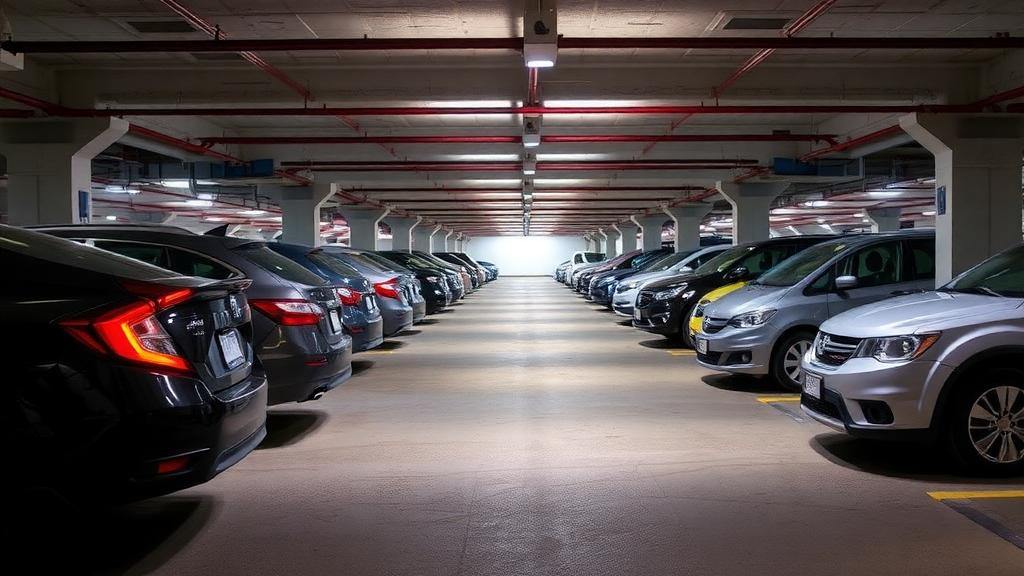
On a June morning in Tucson, Arizona, six identical gasoline-powered cars sat idling side by side beneath the concrete canopy of a covered parking garage at the University of Arizona. To anyone walking past, nothing remarkable was happening. But a few feet away, sensitive instruments were recording something that urban heat researchers have long suspected and rarely measured directly: the invisible plume of waste heat rising from vehicle engines was measurably warming the air around them, raising both ambient temperature and a composite heat-stress index that tracks how hot the human body actually feels. The result, published in PLOS Climate, offers one of the first controlled estimates of how much vehicular waste heat contributes to personal heat exposure in the microclimates where people walk, wait, and cycle every day.
The study, led by Ashley Avila with Nicole Iroz-Elardo, Kristina M. Currans, and Ladd Keith, set out to answer a deceptively simple question: when a vehicle idles, how much heat does it add to the immediate surroundings of a person standing nearby? Most urban heat research focuses on large-scale phenomena such as the urban heat island, in which cities run several degrees warmer than surrounding rural areas because of asphalt, concrete, and reduced vegetation. But the heat that matters most to human health is often experienced at the scale of a single street corner or bus stop, where a pedestrian may stand within a few meters of a running engine. These fine-grained microclimates, the authors argue, are where heat risk is actually lived.
To isolate the effect of vehicle exhaust heat from the many other factors that warm a city street, the team designed an experiment that stripped away as much background noise as possible. The measurements took place in a covered parking garage, a setting chosen deliberately because its roof blocked direct solar radiation, one of the dominant drivers of daytime heat, and its enclosed structure reduced wind, which otherwise mixes and dilutes warm air. By controlling for sunshine and airflow, the researchers could treat the garage as a kind of natural laboratory in which the only meaningful variable was whether the vehicles were running. The measurements were conducted in June 2022, at the height of the Sonoran Desert summer, when background temperatures in Tucson are already among the highest in the United States.
The vehicles themselves were a fleet of six identical gasoline-powered cars, a choice that eliminated variability in engine size, fuel type, and exhaust behavior. The researchers positioned measurement points 1.5 to 3.0 meters, roughly five to ten feet, from the idling vehicles, a distance chosen to approximate how closely a pedestrian, cyclist, or person waiting at a transit stop typically passes or stands near a running car. At each measurement location, the team deployed Kestrel 5400 handheld weather meters, instruments capable of logging ambient air temperature, wind velocity, and wet bulb globe temperature, the metric most widely used to quantify heat stress on the human body.
Wet bulb globe temperature, or WBGT, deserves particular attention because it captures more than air temperature alone. The index combines readings of temperature, humidity, radiant heat, and wind into a single value that reflects the physiological burden heat places on a person, especially one who is walking or working outdoors. Public health agencies and athletic organizations use WBGT thresholds to trigger warnings about heat illness, because the human body’s ability to cool itself through sweating depends heavily on humidity and airflow, not just on what a thermometer reads. By measuring WBGT alongside plain air temperature, the Tucson team could assess not only whether idling cars warm the air but whether they meaningfully increase the heat stress experienced by nearby people.
The experimental design compared three conditions: periods when the vehicles were present and idling, periods when the vehicles were present but engines were off, and a control condition without vehicles. When the researchers compared the idling periods against both the control and the engine-off periods, they found a strong correlation between vehicle presence and elevated readings of both ambient air temperature and wet bulb globe temperature. In other words, the warming was not an artifact of the time of day or of the cars simply sitting in the garage; it appeared specifically when the engines were running and disappeared when they were not.
To quantify the effect more rigorously, the team applied ordinary least-squares regression, a standard statistical technique for estimating the relationship between a predictor and an outcome while accounting for other trends in the data. The models revealed a striking pattern. When the vehicles were on and idling, ambient air temperature rose by an additional 0.006 degrees Celsius per minute, an increase the authors characterize as a 25 percent rise relative to the background warming. By contrast, once the vehicle effect was removed, the remaining temperature increase, about 0.024 degrees Celsius per minute, reflected the expected natural climb of morning temperatures as the day warmed. The comparison makes clear that the idling fleet was adding a distinct layer of warming on top of the desert morning’s already substantial heat load.
While a rate of 0.006 degrees Celsius per minute may sound small in isolation, the cumulative effect over time is far from trivial. A vehicle that idles for thirty minutes, a common scenario in drive-through lines, loading zones, and congested intersections, contributes warming that compounds minute by minute, and a row of vehicles multiplies the effect. For pedestrians and cyclists who pass through such environments repeatedly during a summer day, these incremental exposures accumulate alongside the broader burden of urban heat. Heat is already the deadliest weather hazard in the United States, and researchers increasingly recognize that total personal heat exposure, the sum of every hot microclimate a person moves through, matters more for health outcomes than any single reading from a distant weather station.
The findings arrive at a moment when cities across the American Southwest and other semi-arid regions are grappling with longer, hotter summers and rising rates of heat-related illness. The authors emphasize that their results have immediate practical relevance for transportation professionals who design streets, manage traffic, and schedule transit service. Until the vehicle fleet transitions fully to electric power, which eliminates tailpipe waste heat at the point of use, and until alternative modes of transportation such as walking, cycling, and public transit become more widespread, the heat emitted by combustion engines will remain a feature of the streetscape. Understanding its magnitude allows engineers and planners to respond with targeted measures, from improving ventilation and shade at transit stops and pick-up zones to managing idling in queues and designing intersections that reduce the time vehicles spend running near pedestrian routes.
As a pilot study, the research has clear boundaries that the authors themselves acknowledge. It was conducted at a single site, in a covered garage, with a small fleet of identical gasoline vehicles, and during one summer month, conditions chosen to maximize experimental control rather than to mirror every real-world street. Solar radiation, wind, vehicle mix, and traffic volume all vary enormously across actual urban environments, and future work will need to test how the garage findings translate to open roadways, bus stops, and bike lanes. Even so, the study’s core contribution stands: it provides direct, instrumented evidence that idling vehicles measurably raise both air temperature and heat stress within the very zones where people on foot are most exposed. In a warming world where every fraction of a degree of exposure counts, that invisible plume of engine heat is no longer invisible to science.
Subject of Research: The effect of vehicular waste heat from idling cars on personal heat exposure in semi-arid urban microclimates
Article Title: A pilot study exploring the effect of vehicular waste heat on personal heat exposure in a semi-arid environment
Article References: A pilot study exploring the effect of vehicular waste heat on personal heat exposure in a semi-arid environment. (n.d.). https://doi.org/10.1371/journal.pclm.0000824
Image Credits: AI Generated
DOI: 10.1371/journal.pclm.0000824
Keywords: vehicular waste heat, personal heat exposure, wet bulb globe temperature, urban heat island, microclimate, idling vehicles, heat stress, semi-arid climate, pedestrian health, transportation planning, Tucson Arizona, pilot study
Cite Scienmag News
Sloane Callahan. (October 10, 2026). Idling Cars Quietly Turn Parking Garages into Heat Traps, Pilot Study Finds. Scienmag. https://scienmag.com/idling-cars-quietly-turn-parking-garages-into-heat-traps-pilot-study-finds/
Sloane Callahan. "Idling Cars Quietly Turn Parking Garages into Heat Traps, Pilot Study Finds." Scienmag, 10 October 2026, https://scienmag.com/idling-cars-quietly-turn-parking-garages-into-heat-traps-pilot-study-finds/. Accessed 10 October 2026.
Sloane Callahan. "Idling Cars Quietly Turn Parking Garages into Heat Traps, Pilot Study Finds." Scienmag. October 10, 2026. https://scienmag.com/idling-cars-quietly-turn-parking-garages-into-heat-traps-pilot-study-finds/


