


Deep in the Peruvian Andes, at an elevation of nearly 5,000 meters, a mine that first opened in 1591 has yielded a mineral never before seen by science. A team of European mineralogists has identified and formally described argentotennantite-(Fe), a new member of the tetrahedrite group, from the San Genaro mine in the Castrovirreyna Province of Huancavelica, Peru. The International Mineralogical Association’s Commission on New Minerals, Nomenclature and Classification approved the species under proposal number IMA 2023-126, and the full description, including its crystal structure, has now been published in the European Journal of Mineralogy by Jiří Sejkora of the National Museum in Prague, Dalibor Velebil, Cristian Biagioni of the University of Pisa, Zdeněk Dolníček, and Jaroslav Hyršl.
The new mineral carries the ideal chemical formula Ag6(Cu4Fe2)As4S13, a composition that places it squarely within one of the most chemically versatile families of minerals known. Tetrahedrite-group minerals are sulfosalts, complex chalcogenide compounds in which metals are bound to semimetal atoms such as arsenic and antimony through sulfur. They are the most common sulfosalts in many hydrothermal ore deposits worldwide, and they are among the principal carriers of silver in those ores. The group’s general structural formula allows a remarkable range of substitutions: copper or silver can occupy multiple distinct sites, while zinc, iron, mercury, cadmium, nickel, manganese, and other elements can fill the divalent positions, and antimony, arsenic, bismuth, or tellurium define the semimetal sites. This chemical plasticity makes tetrahedrite-group minerals a bridge between mineralogy and ore geochemistry, and their compositions have long been used to reconstruct the conditions of ore formation.
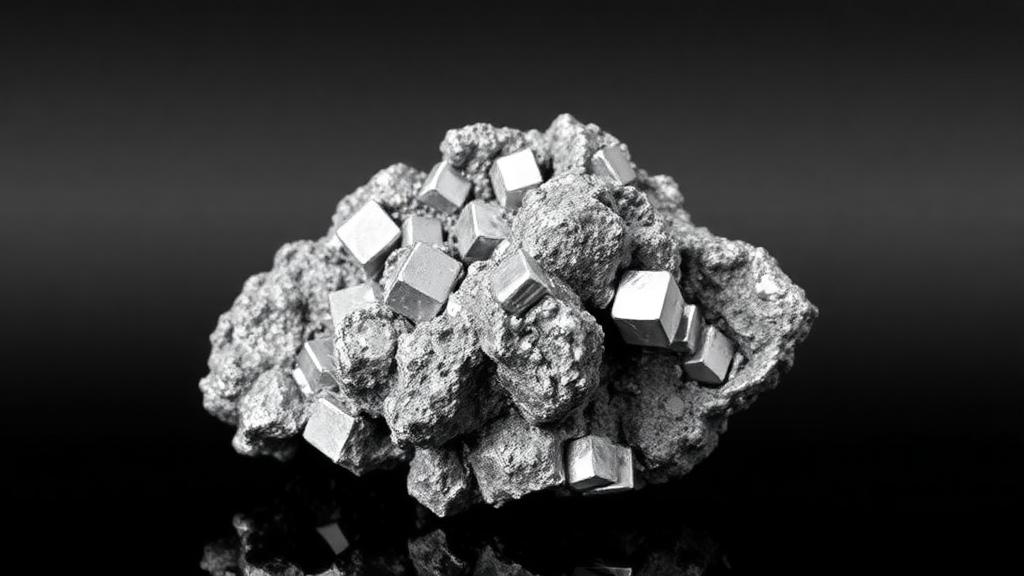
The holotype specimen of argentotennantite-(Fe) is a piece of quartz gangue studded with dark-red pyrargyrite crystals up to 3 millimeters long and dark-gray, many-faced crystals of tetrahedrite-group minerals up to 2 millimeters across, accompanied by minor galena, acanthite, light-pink siderite, and white tabular baryte. Within this assemblage, the new mineral appears as anhedral grains reaching up to 100 micrometers in size. More commonly, it forms micrometer-sized rims around crystals of argentotetrahedrite-(Zn), or it replaces that mineral along cavities and fissures, together with a silver-rich variety of tennantite-(Fe). These delicate overgrowths record a late stage of mineralization in which silver and arsenic-rich fluids modified the earlier, antimony-dominated crystals.
In hand specimen and under the microscope, argentotennantite-(Fe) presents as an opaque, dark-gray mineral with a metallic luster and a black streak. In reflected light it is isotropic and pale gray with a brownish shade. Its measured reflectance values at the four standard wavelengths recommended by the IMA’s Commission on Ore Mineralogy are 29.9 percent at 470 nanometers, 30.1 percent at 546 nanometers, 29.8 percent at 589 nanometers, and 28.9 percent at 650 nanometers. The mineral is brittle, with an indistinct cleavage and conchoidal fracture, and its Mohs hardness is likely close to 4, consistent with other tetrahedrite-group members. Because so little material was available, the density could not be measured directly; calculated from the empirical formula and the refined unit cell, it comes to 4.922 grams per cubic centimeter.
The chemical work behind the discovery was performed with a Cameca SX100 electron microprobe at the National Museum in Prague, operating in wavelength-dispersive mode at 25 kilovolts with a beam current of 20 nanoamperes and a beam diameter of just 0.7 micrometers. In total, 386 spot analyses of the described tetrahedrite-group minerals were collected. For the grain selected for structural study, recalculated on the basis of 16 metal atoms per formula unit, the composition came out as (Ag3.36Cu2.70)(Cu4.05Fe1.88Zn0.07)(As2.29Sb1.66)S12.82. Silver contents across the new mineral range from 3.00 to 3.68 atoms per formula unit, iron is clearly dominant among the divalent elements, and arsenic is partly replaced by antimony. The researchers chose to normalize on the metal sum because their data showed only very minor vacancies, if any, at the key structural sites.
The decisive evidence came from single-crystal X-ray diffraction. A tiny crystal, measuring only 0.035 by 0.030 by 0.025 millimeters, was extracted from the rim of an aggregate and studied on a Bruker D8 Venture diffractometer with microfocus molybdenum radiation at the University of Pisa. The structure was refined starting from the atomic coordinates of a 1985 study of an arsenic-bearing argentian tetrahedrite, and the model had to be inverted to account for racemic twinning. The final refinement converged to an R1 value of 0.0384 based on 246 unique reflections and just 20 refined parameters, confirming that argentotennantite-(Fe) is cubic, crystallizing in space group I-43m with a unit-cell edge of 10.4365 angstroms and a volume of 1136.75 cubic angstroms, with two formula units per cell. It is isotypic with all other members of the tetrahedrite group, meaning it shares the same underlying architecture.
That architecture is a collapsed sodalite-like framework built from corner-sharing tetrahedra, forming cages that host sulfur-centered octahedra surrounded by trigonal pyramids of arsenic and antimony. The refinement revealed a planar triangular M(2) site occupied by a nearly equal mixture of silver and copper, with a high displacement parameter suggesting that this site, like in other silver-rich members of the group, is probably split into sub-positions preferentially occupied by copper and silver respectively. The tetrahedral M(1) site holds copper and iron in roughly a two-to-one ratio, while the X(3) site is a mixed arsenic-antimony position whose measured bond distances match the microprobe-derived occupancy almost perfectly. Both sulfur sites are overbonded, chiefly because the silver-sulfur distances come out physically too short, a feature observed in every other known silver member of the tetrahedrite group and attributed to positional disorder affecting the central sulfur and the M(2) site.
Perhaps the most scientifically interesting aspect of the discovery is what it says about the long-debated relationship between silver and arsenic in these minerals. Earlier workers proposed an antipathetic relationship, noting that the two elements rarely coexist in high concentrations in tetrahedrite-group structures, because the stability field of arsenic sulfide lies at conditions incompatible with silver. Yet argentotennantite-(Fe) demonstrably hosts both. The authors point to a resolution: the significant antimony content, with arsenic-to-total-semimetal ratios around 0.53 to 0.58 in the new mineral and similar values in related species, appears to reduce the structural strain that would otherwise destabilize silver- and arsenic-rich compositions. Substituting the larger antimony atom for arsenic relieves the distortion of the framework, allowing these otherwise improbable minerals to exist. This explains the observed negative correlation between silver content and the arsenic proportion in the San Genaro material, and it suggests that the true formula of the mineral is better written with a mixed (As,Sb) site even though the end-member definition is pure arsenic.
The new species also fills a gap in the arsenofreibergite series, the arsenic analogues of the silver-rich freibergite minerals first described from Freiberg, Germany, in the nineteenth century. Before this work, the series was represented by only two formally approved species, argentotennantite-(Zn) and kenoargentotennantite-(Fe), and no crystallographic data existed for the zinc-dominant type material. Compositions matching argentotennantite-(Fe) had been glimpsed before, in zoned rims from the Kremnica gold-silver deposit in Slovakia, tiny grains in fluorite from Grube Clara in Germany, and material from Jáchymov in the Czech Republic, but never confirmed structurally. With the description of argentotennantite-(Fe) and its keno counterpart, mineralogists now have the first solid crystal-chemical picture of this rare series, further evidence of the extraordinary plasticity of the tetrahedrite structure, which can record even the subtlest shifts in ore chemistry. Holotype material is preserved at the National Museum in Prague, and the crystal used for the structural study resides in the natural history museum of the University of Pisa, ensuring that this tiny but telling product of Andean silver mineralization will remain available to science for generations.
Subject of Research: Crystal structure and occurrence of the new tetrahedrite-group mineral argentotennantite-(Fe) from the San Genaro mine, Peru
Article Title: Argentotennantite-(Fe), Ag6(Cu4Fe2)As4S13, a new member of the tetrahedrite group from the San Genaro mine, Peru: occurrence and crystal structure
Article References: Sejkora, J., Velebil, D., Biagioni, C., Dolníček, Z., & Hyršl, J. (2026). Argentotennantite-(Fe), Ag 6 (Cu 4 Fe 2 )As 4 S 13 , a new member of the tetrahedrite group from the San Genaro mine, Peru: occurrence and crystal structure. European Journal of Mineralogy, 38(3), 325-336. https://doi.org/10.5194/ejm-38-325-2026
Image Credits: AI Generated
Keywords: argentotennantite-(Fe), tetrahedrite group, new mineral species, San Genaro mine, Peru, sulfosalts, crystal structure, X-ray diffraction, silver mineralogy, IMA approval, hydrothermal ore deposits, arsenofreibergite series
Cite Scienmag News
Bethany Barker. (October 10, 2026). New Silver Mineral Argentotennantite-(Fe) Unearthed in Peru’s Andes. Scienmag. https://scienmag.com/new-silver-mineral-argentotennantite-fe-unearthed-in-perus-andes/
Bethany Barker. "New Silver Mineral Argentotennantite-(Fe) Unearthed in Peru’s Andes." Scienmag, 10 October 2026, https://scienmag.com/new-silver-mineral-argentotennantite-fe-unearthed-in-perus-andes/. Accessed 10 October 2026.
Bethany Barker. "New Silver Mineral Argentotennantite-(Fe) Unearthed in Peru’s Andes." Scienmag. October 10, 2026. https://scienmag.com/new-silver-mineral-argentotennantite-fe-unearthed-in-perus-andes/


