


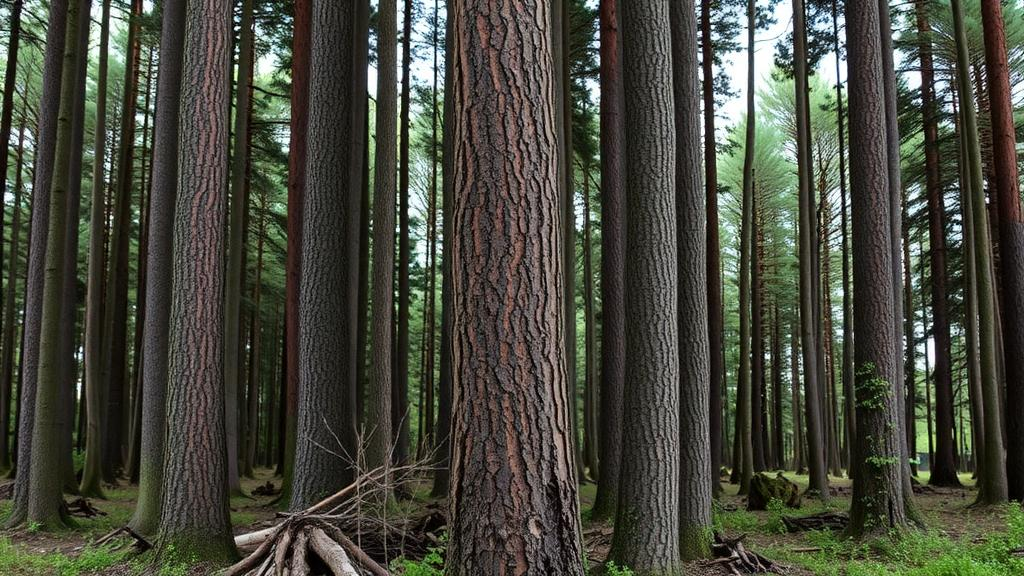
Walk into a sunlit forest and your eyes go straight to the leaves. They are the green solar panels that power photosynthesis, and for decades they have been almost the only thing climate and microclimate models cared about when deciding where incoming sunlight gets absorbed. But the trunks and branches that hold those leaves aloft have been quietly ignored, treated as structural scaffolding with no energy budget of their own. A new study published in Geoscientific Model Development argues that this omission distorts our picture of forest microclimates, and it delivers a practical fix: a set of modifications to a widely used canopy radiation model that finally lets wood absorb its share of sunlight.
The research, led by Martin Béland of Laval University’s Digital Forest Lab together with Gordon Bonan of the NSF National Center for Atmospheric Research, Hideki Kobayashi of the Japan Agency for Marine-Earth Science and Technology, and Dennis Baldocchi of the University of California, Berkeley, tackles a stubborn blind spot in radiative transfer modeling. Computer models that simulate forest canopy microclimates, from the air temperature at the forest floor to the fluxes that link land surfaces to the global atmosphere, all begin with the same calculation: how much solar radiation does the canopy reflect, and where does the rest go? Classic one-dimensional schemes such as the Norman model from 1979 and the two-stream formulations of Dickinson and Sellers divide that absorbed energy among sunlit leaves, shaded leaves, and soil. Wood simply does not appear in the ledger.
Yet recent work has shown that woody structures absorb a significant fraction of incoming near-infrared radiation in dense forests and store it as heat. Because stems are massive, they warm slowly through the day and release that stored heat at night, shifting the diurnal rhythm of air temperature inside the canopy. That matters for the organisms living in the understory and on the forest floor, for the closure of energy budgets at eddy covariance flux towers, and for land surface models such as the Community Land Model, which currently lumps leaves and stems together into a single plant area index with weighted optical properties, never resolving their separate absorption.
The challenge is structural. Stems and branches are wildly heterogeneous in size, orientation, and density, and their exposure to sunlight depends on where they sit within the canopy. The team’s solution was to modify the radiative transfer component of the CanVeg2 multilayer canopy model, which uses the Norman scheme, so that wood is explicitly represented. The mathematics is elegant: the projected areas of leaves and stems are combined in the Beer-Lambert extinction equation, and each canopy layer’s intercepted radiation is partitioned between leaves and wood in proportion to their projected areas in that direction, with leaf area index and wood silhouette area index weighted by their respective projection factors and clumping indices. The full system is solved as a tridiagonal set of equations, keeping the model fast enough for routine microclimate simulation.
One subtlety the researchers had to confront is that stems, like leaves, are not randomly distributed in space, and this clumping affects how much radiation they intercept. With no modern data available, the team mined a remarkable historical dataset: light transmission measurements collected in the 1980s by a tram system shuttling PAR sensors back and forth through a temperate deciduous forest near Oak Ridge, Tennessee, during leaf-off conditions in January 1981. Inverting Beer’s law against those measurements, and correcting for the fact that bark scatters more light than leaves and thus inflates ground-level transmission, the team arrived at a wood clumping index of 0.75 for a temperate deciduous forest. Sensitivity tests showed this parameter matters: shifting it from 0.75 to 0.6 or 0.9 changed the radiation absorbed by stems by roughly 16 percent in both directions, even though canopy albedo barely moved.
Validating a one-dimensional model requires a trustworthy benchmark, and here the team turned to ground-based lidar and three-dimensional ray tracing. At four broadleaf deciduous sites spanning a structural gradient, Harvard Forest in Massachusetts, Morgan-Monroe State Forest in Indiana, the Smithsonian Environmental Research Center in Maryland, and the Pasoh Forest Reserve in Malaysia, each plot was scanned from 121 lidar positions to build dense 3D voxel grids, 30 centimeters on a side, that separately map leaf area density and wood silhouette area density. These voxel maps fed the FLiESvox ray tracing model, which tracks photons through the full three-dimensional canopy, including multiple scattering within clumped foliage using the recollision probability theory of Smolander and Stenberg. Running FLiESvox was computationally demanding: covering varying sun angles and diffuse fractions required 81 simulations in the PAR waveband and 81 in the near-infrared.
The agreement between the modified one-dimensional model and the 3D benchmark was strikingly good. Across all four sites, root mean square errors between vertically integrated absorbed fluxes came to about 12 watts per square meter in the PAR and about 8 watts per square meter in the near-infrared. Vertical profiles of absorption by sunlit leaves, shaded leaves, and wood agreed with mean errors per layer of a few tenths of a watt per square meter. A leaf-off test case, where only wood remains in the canopy, also showed strong agreement between the two models, suggesting the approach works year-round. The step-by-step model comparisons revealed why each modification mattered: adding foliage clumping lowered albedo and let light penetrate deeper, adding wood further reduced both albedo and the radiation reaching the soil, and adding multiple scattering within clumped layers significantly cut near-infrared albedo while boosting leaf absorption.
The team then compared modeled albedos against tower observations of reflected sunlight, the only component of the radiation budget routinely measured in the field. Both models overestimated broadband albedo by roughly 4 to 7 percent, but the modified Norman model came noticeably closer to the observations than its predecessor, thanks to stem absorption and the treatment of multiple scattering. The characteristic U-shaped diurnal pattern of albedo, higher when the sun sits low, was successfully reproduced. The residual overestimate could stem from uncertain optical properties of leaves, soil, or bark, which vary with moisture, or even from the metallic tower structure itself slightly biasing the measurements. The authors also note that the recollision probability theory was developed for needleleaf shoots, and its extension to broadleaf shoots, while supported by the results, deserves dedicated testing with models that represent every leaf as an explicit mesh.
The practical consequences ripple outward. Because stems absorb far more near-infrared than photosynthetically active radiation, including them will barely change carbon and latent heat fluxes, but it will strongly alter sensible heat fluxes and biomass heat storage, with implications for the persistent energy budget closure problem at flux towers. More dramatically, the simulations showed that omitting stems nearly doubles the radiation absorbed by the soil in both wavebands, a major distortion of the energy balance at the soil-air interface that may explain why land surface models have needed empirical corrections to under-canopy wind speeds. With the modified model, wood absorption is computed directly from canopy structure, resolved vertically, and free of ad-hoc partitioning, and the code and data are openly available on Zenodo for other modeling groups. Validation in needleleaf forests, savannas, and sparse canopies lies ahead, but for dense broadleaf forests, the trunks and branches that were once invisible to climate models can now finally be counted, and the forest’s hidden heat economy is coming into focus.
Subject of Research: Radiation absorption by woody stems in forest canopy microclimate modeling
Article Title: Consideration of radiation absorption by stems in forests for microclimate modeling
Article References: Béland, M., Bonan, G., Kobayashi, H., & Baldocchi, D. (2026). Consideration of radiation absorption by stems in forests for microclimate modeling. Geoscientific Model Development, 19(18), 9019-9033. https://doi.org/10.5194/gmd-19-9019-2026
Image Credits: AI Generated
Keywords: forest microclimate, radiative transfer, wood heat storage, ground lidar, canopy albedo, Norman model, near-infrared radiation, leaf clumping, eddy covariance, land surface modeling, 3D ray tracing, deciduous forests
Cite Scienmag News
Denise Maddox. (October 10, 2026). Tree Trunks Get Their Due: Stems Missing From Forest Climate Models Finally Counted. Scienmag. https://scienmag.com/tree-trunks-get-their-due-stems-missing-from-forest-climate-models-finally-counted/
Denise Maddox. "Tree Trunks Get Their Due: Stems Missing From Forest Climate Models Finally Counted." Scienmag, 10 October 2026, https://scienmag.com/tree-trunks-get-their-due-stems-missing-from-forest-climate-models-finally-counted/. Accessed 10 October 2026.
Denise Maddox. "Tree Trunks Get Their Due: Stems Missing From Forest Climate Models Finally Counted." Scienmag. October 10, 2026. https://scienmag.com/tree-trunks-get-their-due-stems-missing-from-forest-climate-models-finally-counted/


