


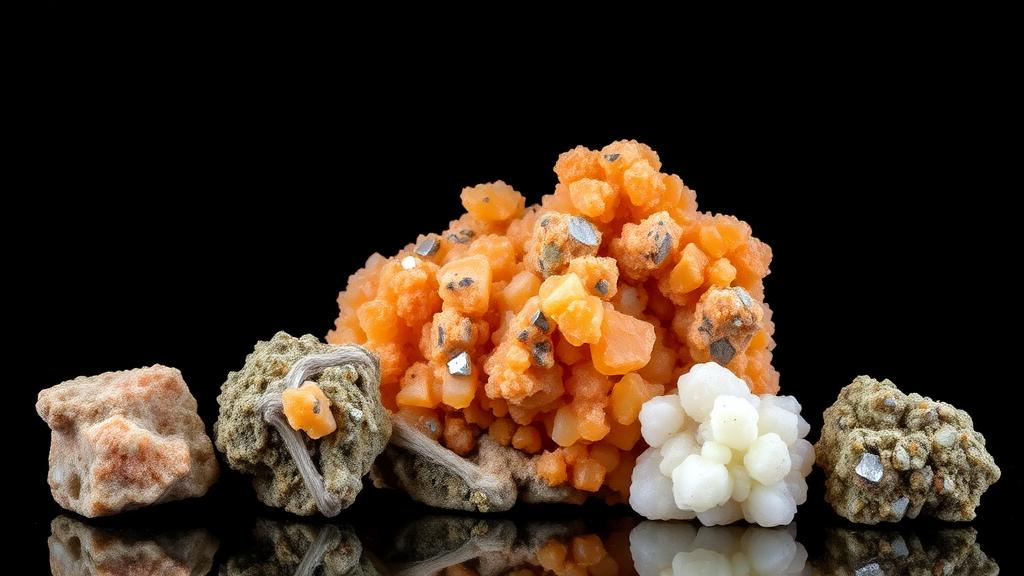
Every new mineral on Earth must pass through a single gate before it can officially exist: the Commission on New Minerals, Nomenclature and Classification of the International Mineralogical Association, known throughout the field as the IMA-CNMNC. In its latest bulletin, Newsletter 91, published in the European Journal of Mineralogy on 19 June 2026, the commission announced the approval of seven new mineral species along with a sweeping overhaul of the official IMA List of Minerals. The newsletter, compiled by commission chair Ferdinando Bosi of Sapienza University of Rome, vice-chairs Frédéric Hatert of the University of Liège and Marco Pasero of the University of Pisa, and secretary Stuart J. Mills, offers a rare public window into the meticulous bureaucratic machinery that underpins one of science’s oldest disciplines.
The April 2026 approvals open with piilonenite-(Nd), a hydrated sodium-neodymium carbonate with the ideal formula NaNd(CO3)2(H2O)3, discovered at the famous Poudrette (Demix) quarry on Mont Saint-Hilaire in Quebec, Canada. Proposed by Inna Lykova of the Canadian Museum of Nature and colleagues, the mineral represents an entirely new structure type, crystallizing in the orthorhombic space group P212121 with unit-cell parameters a = 6.791(1), b = 17.135(3) and c = 6.436(1) Å. Mont Saint-Hilaire has long been celebrated as one of the most mineralogically diverse localities on the planet, and the arrival of a new structure type from its alkaline rocks underscores why the quarry continues to fascinate collectors and crystallographers alike. The type specimen is deposited in the collections of the Canadian Museum of Nature in Ottawa under catalogue number CMNMC 93393.
The second April approval, kristekite, comes from a very different setting: the mine dump of shaft no. 11A near Bytíz in the Příbram ore district of Central Bohemia, Czech Republic. With the ideal formula Cu2(H2O)4(UO2)(SeO3)3 · 4H2O, kristekite is a hydrated copper uranyl selenite, chemically related to marthozite, and it crystallizes in the monoclinic space group P21/m. The proposal, led by Jakub Plášil of the Institute of Physics of the Czech Academy of Sciences together with Pavel Škácha, Jiří Sejkora, Radek Škoda and Radana Vrtišková, reflects the growing recognition of mine dumps as secondary-mineral laboratories, where the interaction of groundwater with ore and smelting residues generates exotic compounds that nature rarely produces elsewhere. The type material rests in the National Museum in Prague under catalogue number P1P 46/2025.
Perhaps the most eye-catching of the April approvals is magnesiochangesite-(Ce), with the ideal formula (Ca8Ce)□Mg(PO4)7, because its type locality is not on Earth at all. The mineral was found in lunar meteorite Pakepake005, discovered in the Taklamakan desert of Xinjiang, China. A member of the cerite supergroup, it is trigonal, space group R3c, with a = 10.3813(4) and c = 37.278(1) Å, and its structure has been fully determined. The large international team was coordinated by Yanjuan Wang of the China University of Geosciences and Fabrizio Nestola of the University of Padua, and the type specimen is held at the Geological Museum of China in Beijing under catalogue number GMCTM2025021. Minerals approved from meteorites carry particular scientific weight, because their compositions and structures preserve clues about the parent body’s geological history, and a cerite-supergroup phosphate in lunar material speaks to the complex chemistry of the Moon’s crust.
The May 2026 approvals begin with bernwoodite, Ca5TiAl2Si2O14, a member of the perovskite supergroup found as an inclusion inside a diamond from the Rio Sorriso placer in the Juina area of Mato Grosso, Brazil. Diamonds from Juina are renowned as messengers from the deep Earth, transporting fragments of the lower mantle and transition zone to the surface, and inclusions such as bernwoodite are among the few direct samples of those inaccessible depths. The mineral is monoclinic, space group C2/c, with a = 9.190(1), b = 5.2594(4) and c = 21.846(4) Å and β = 97.84(2)°. The proposal was led by Nester Korolev of the American Museum of Natural History, with co-authors including Ekaterina S. Kiseeva, Alena Aslandukova, George E. Harlow, Chi Ma, Yaakov Weiss, Alexander Kurnosov, Felix V. Kaminsky and Leonid Dubrovinsky. The type specimen is deposited at the American Museum of Natural History in New York under catalogue number AMNH#115649.
Two further May approvals came from Xiangping Gu and Hexiong Yang of the University of Arizona and their collaborators. Georgeliuite, Ca2Mn3(3+)O2(AsO4)3(H2O)2 · H2O, was found at the Jote mine in the Pampa Larga district of Tierra Amarilla, in Chile’s Atacama Region, and is the Mn3+ analogue of arseniosiderite; it is monoclinic, space group Cm, with type material split between the University of Arizona Alfie Norville Gem & Mineral Museum in Tucson, catalogue number 22747 (holotype), and the RRUFF Project, deposition number R250055 (cotype). Sombrereteite, NaCa3(Al7Si9)O32, was recovered from the Sombrerete iron meteorite, found in 1958 at Cerro del Sombreretillo in Zacatecas, Mexico, and is chemically the sodium analogue of wodegongjieite; it is monoclinic, space group C2/c, with its type specimen at the Geological Museum of China in Beijing, catalogue number GMCTM2025019. The pairing of a terrestrial mine and an extraterrestrial iron meteorite in a single month illustrates the breadth of environments from which new minerals now emerge.
The final new species, leishmanite, approved as IMA no. 2026-002, is a barium uranyl oxide hydroxide hydrate with the ideal formula Ba(H2O)4[(UO2)3O2(OH)3]2 · 3H2O, discovered on the northern slope of the Grand Alou valley south of the Dent de Nendaz in Valais, Switzerland. Proposed once again by Jakub Plášil, with Radek Škoda, Stefan Ansermet and Nicolas Meisser, leishmanite is closely related to billietite and crystallizes in the orthorhombic space group Pmn21, with a = 12.079(2), b = 15.096(3) and c = 7.155(2) Å. The type material is deposited at the Naturéum in Lausanne under catalogue number MGL101918. Uranyl minerals such as leishmanite and kristekite are of intense interest beyond pure mineralogy, because their layered structures and ion-exchange behavior inform models of uranium mobility in contaminated ground and the long-term behavior of nuclear waste.
Beyond the new species, Newsletter 91 records two significant nomenclature decisions approved in March 2026. Proposal 25-B formally redefines the stilpnomelane group, whose members share the general formula A4M48Si64Al8216 · nH2O, where A is potassium, sodium, calcium or barium and M is a mix of iron, manganese, magnesium, aluminum and zinc. Stilpnomelane itself is now defined by the end-member formula K4Fe2+48[Si64Al8]O164(OH)52 · nH2O, while lennilenapeite is redefined as its manganese analogue. As a consequence of the tightened definitions, two long-recognized names are discredited: ekmanite, which turns out to be a stilpnomelane with only minor manganese, and franklinphilite, which proves to be a mixture of lennilenapeite and nelenite rather than a distinct species. Discreditation is a routine but consequential act, removing names from textbooks and databases worldwide.
Proposal 26-A addresses a problem that occasionally afflicts historically important minerals: inadequate or missing original type material. Gadolinite-(Y), first described from the famous Ytterby locality in Sweden, the quarry that gave its name to four chemical elements, has now been assigned a neotype, a newly designated reference specimen that anchors the name for future generations. The neotype material, curated by Dan Holtstam, Alice Taddei, Hans-Jürgen Förster and Oona Appelt, is stored in the collections of the Swedish Museum of Natural History in Stockholm under catalogue number GEO-NRM LK6893, ensuring that the mineral whose discovery helped launch the chemistry of the rare earth elements rests on a firm modern footing.
The newsletter’s final section documents the second round of a systematic polish-up of the IMA List of Minerals, an executive decision by the commission following a similar exercise published years earlier in Newsletter 50. In most cases the changes are subtle but meaningful: subordinate constituents sharing parentheses with the dominant constituent are eliminated from ideal formulae, so that, for example, ankerite is now written CaFe2+(CO3)2 in direct parallel with dolomite, CaMg(CO3)2, and serpierite becomes CaCu4(SO4)2(OH)6(H2O)3, matching the pattern of devilline. Similar simplifications were applied to dozens of species, including aldridgeite, aluminocopiapite, azoproite, bannisterite, barquillite, borisenkoite, byrudite, chlorophoenicite, cyprine, eckhardite, fluorphvesuvianite, fritzscheite, gainesite, hloušekite, hydrombobomkulite, johnwalkite, laitakarite, lasnierite, lucabindiite, magnesioneptunite, magnesiorowlandite-(Y), mbobomkulite, mccrillisite, montroseite, murunskite, nordgauite, ohmilite, paraniite-(Y), the paratacamite series, plumboagardite, potassiccarpholite, putzite, thalcusite, thorutite, the yttrotungstites and zincobriartite. Questionable minerals and species belonging to supergroups covered by comprehensive subcommittee reports were deliberately excluded, since they require deeper reappraisal or have already been settled. The exercise may look like typographic housekeeping, but consistent ideal formulae are the backbone of mineral databases, thermodynamic modeling and automated crystallographic searches, and the commission’s routine publication of such updates in the European Journal of Mineralogy keeps the nomenclature of the roughly six thousand recognized mineral species transparent, verifiable and, in its own quiet way, remarkably viral among the collectors and researchers who follow each new name as it enters the official record.
Subject of Research: Approval of new mineral species and mineral nomenclature revisions by the IMA Commission on New Minerals, Nomenclature and Classification
Article Title: IMA Commission on New Minerals, Nomenclature and Classification (CNMNC) – Newsletter 91
Article References: Bosi, F., Hatert, F., Pasero, M., & Mills, S. J. (2026). IMA Commission on New Minerals, Nomenclature and Classification (CNMNC) – Newsletter 91. European Journal of Mineralogy, 38(3), 347-352. https://doi.org/10.5194/ejm-38-347-2026
Image Credits: AI Generated
Keywords: mineralogy, IMA-CNMNC, new minerals, crystallography, lunar meteorite, diamond inclusions, uranium minerals, stilpnomelane, gadolinite, nomenclature, Mont Saint-Hilaire, European Journal of Mineralogy
Cite Scienmag News
Bethany Barker. (October 10, 2026). Seven New Minerals Join the Official Record as Mineralogy’s Naming Authority Cleans House. Scienmag. https://scienmag.com/seven-new-minerals-join-the-official-record-as-mineralogys-naming-authority-cleans-house/
Bethany Barker. "Seven New Minerals Join the Official Record as Mineralogy’s Naming Authority Cleans House." Scienmag, 10 October 2026, https://scienmag.com/seven-new-minerals-join-the-official-record-as-mineralogys-naming-authority-cleans-house/. Accessed 10 October 2026.
Bethany Barker. "Seven New Minerals Join the Official Record as Mineralogy’s Naming Authority Cleans House." Scienmag. October 10, 2026. https://scienmag.com/seven-new-minerals-join-the-official-record-as-mineralogys-naming-authority-cleans-house/


