


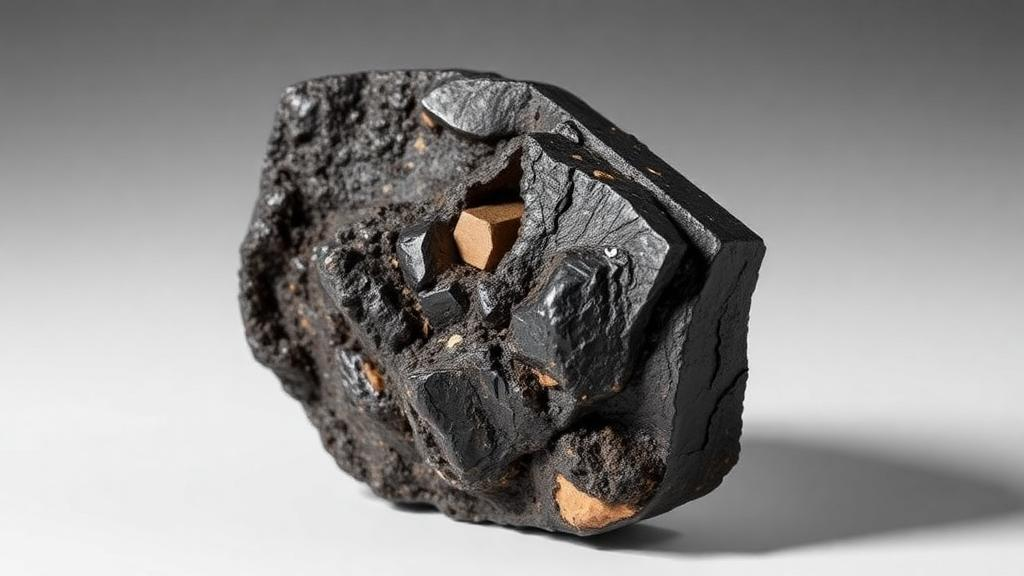
One of the rarest meteorites ever seen to fall from the sky has spent more than a century carrying the wrong name, and possibly the wrong birthplace. The Veramin meteorite, a stony-iron mesosiderite that tradition says landed in Persia around 1880, has long been associated with the town of Varamin near Tehran. But a new historical review by Dan Holtstam of the Swedish Museum of Natural History and Ataollah Hassani of Shahid Beheshti University, published in the History of Geo- and Space Sciences, argues that the fall almost certainly occurred near the village area of Booghin, roughly 100 kilometers northwest of Varamin, sometime between February and April 1880. The finding upends decades of assumptions about one of only seven witnessed mesosiderite falls ever recorded.
Mesosiderites are among the most enigmatic of all differentiated meteorites. Roughly half of their volume consists of iron-nickel metal, while the remainder is a jumble of silicate minerals and minor accessory phases, typically showing a highly brecciated, fragmented texture. How such intimate mixtures of metal and rock formed on their parent body remains a puzzle for planetary scientists, and every well-documented fall is therefore precious. Because so few mesosiderites have been recovered as witnessed falls, the circumstances of the Veramin event matter not only to historians but also to researchers who depend on accurate fall data to interpret these strange rocks.
The earliest printed account of the fall came from Ferdinand Dietzsch, a German mining engineer who was granted an audience with Naser al-Din Shah of the Qajar dynasty in the first half of May 1880. According to information relayed by the Shah, the meteorite had fallen near a village called Karand, described as twelve German miles, about 90 kilometers, east of Tehran, accompanied by a thunder-like sound. Dietzsch recorded the weight as 45 kilograms, converted from the old Turkic-Persian unit of 15 Tabriz batman, and received 400 grams of the material for examination. He specifically noted a blackish fusion crust on parts of the fragments, the melted outer rind that confirms a stone’s extraterrestrial origin.
Archival documents show that it was the Shah himself who ordered an investigation. He asked Aligholi Khan Mokhber od-Dowlah, his minister of telecommunications, to arrange a meeting with a foreign expert, and the minister replied in a letter that he would bring Monsieur Dij, meaning Dietzsch, to the royal court the following day. The first scientific examination was carried out by the Austrian meteoricist Aristides Brezina, who coined the name Veramin while commenting that the circumstances of the fall were still shrouded in obscurity. Brezina noted the fusion crust on his specimen, along with some rust, and grouped the stone with the newly fallen Estherville meteorite of 1879 and other known mesosiderites based on its primary mineralogy.
The first Iranian description came from Mohammad Hassan Khan Sani’ od-Dowlah, a Qajar scholar and statesman writing nearly two months after the event. In his memoirs he reported that the stone weighed approximately 15 man of Tabriz and that testing had revealed four tenths of pure iron, plus nickel, which made the stone glitter with silvery particles. He described pure iron grains mixed with a black aluminum silicate mineral and green pyroxene crystals, observations that align remarkably well with modern mineralogical analyses of the meteorite. Sani’ od-Dowlah was probably influenced by an oral report from Dietzsch, although he never mentioned the German engineer by name.
A pivotal piece of evidence is a Persian text on a cardboard sign preserved with the main mass of the meteorite in Tehran’s Golestan Palace, where it remains on display today. The explorer Sven Hedin, visiting the royal palace museum in May 1890, translated an abridged version into Swedish, and the American geologist Henry A. Ward reproduced a fuller English translation in 1901. The text describes a sudden roar from the clouds, followed by nine loud bangs like cannon shots, then something resembling smoke and fire that buried itself about two meters deep in the ground. It places the event near Booghin and Eshtehard, in the winter quarters of the Baghdadi Shahsevan tribes, and names Hedayatollah Khan Qajar, the deputy ruler of the tribe, as the official who took possession of the stone and sent it to Tehran.
Ward, who traveled to Persia after seeing a piece of the meteorite in Stockholm, secured permission to remove a larger fragment of about 1.3 kilograms for analysis, from which specimens were later distributed to museums worldwide. A weighing during his visit put the total mass at 51.5 kilograms. Ward was reluctant to change the meteorite’s name, partly because he could not locate the place names from the cardboard text on any map, and he mistakenly claimed that Dietzsch had used the name Veramin. In fact, Dietzsch never mentioned Veramin but referred to Karand, which the new review identifies as a mishearing of Zarand, a district some 70 kilometers west of Varamin. An independent European source, the Shah’s head court physician Joseph Désiré Tholozan, reported in 1884 that the fall took place in the district of Zerind, 100 kilometers west of Tehran, a statement the authors consider the most geographically accurate of all.
The dating of the fall is equally tangled. The cardboard text gives the date as the 8th of Jamadi-ul-avval in the year 1298 of the Hijri calendar, which would correspond to April 1881, an impossibility since Dietzsch saw the stone in May 1880. Sani’ od-Dowlah gave the year as 1297 A.H., and both he and the anonymous writer of the cardboard text state the Turkic zodiac year as the dragon year, which began on 20 March 1880. The authors reason that the entire sequence of excavating the stone, transporting it roughly 100 kilometers to Tehran by animal, informing the court, and conducting initial investigations would have taken considerable time, and that the nomadic tribesmen would have departed for summer pastures weeks before May. They conclude the fall most likely occurred between February and April 1880, with mid-February, as suggested by Tholozan, fitting the migration calendar of the Shahsevan tribes particularly well, though late March remains possible. The text also notes the event happened about three hours before sunset, which would place it between roughly 4:00 and 5:30 in the afternoon for that season.
The authors attribute the historical confusion largely to the ignorance of Western observers at the time regarding the language and geography of Persia, compounded by vagueness in local sources. The erroneous location information traces back to Brezina, who possibly received it from Baron Emil Gödel-Lannoy, an Austrian diplomat who supplied the meteorite samples for his examination. An alternative explanation, that someone deliberately spread false information to conceal the fall, seems less plausible, since the stone had already been secured before the foreigners became involved and it was the Shah himself who chose to inform them. The meteorite’s subsequent obscurity, during which the main mass was lost to science for nearly a century until Jamshid Hassanzadeh rediscovered and studied it in the 1980s, likely resulted from it being stored among less important objects in the palace museum amid the political instability of the waning Qajar dynasty.
Perhaps the most tantalizing implication of the study is that fragments of the Veramin meteorite may still lie buried in the arid ground of the Booghin-Eshtehard area. The eyewitness account describes the body breaking apart in a series of airbursts, the violent fragmentation that occurs when a meteoroid experiences extreme pressure and temperature during its descent through the atmosphere, and it is likely that several pieces landed on the ground. Given the dry climate and the depth of burial described in the historical text, any additional fragments could be partly preserved to this day. Previous searches, the authors note, were misled by the name Veramin and pointed to the wrong area entirely. With the fall location now corrected, the stage may finally be set for a properly directed hunt for new pieces of one of the world’s rarest witnessed meteorite falls, a stone that once thundered over the tents of nomadic tribesmen and ended up glittering on the floor of a Shah’s palace.
Subject of Research: Historical and scientific re-examination of the 1880 Veramin mesosiderite meteorite fall in Persia
Article Title: Revisiting the fall of the Veramin meteorite
Article References: Revisiting the fall of the Veramin meteorite. (n.d.). https://doi.org/10.5194/hgss-16-23-2025
Image Credits: AI Generated
Keywords: Veramin meteorite, mesosiderite, meteorite fall, Iran, Qajar dynasty, Booghin, Varamin, Naser al-Din Shah, Sven Hedin, Henry A. Ward, history of science, fireball
Cite Scienmag News
Grant Pearson. (October 10, 2026). A Royal Stone in the Wrong Place: New Research Rewrites the Story of Iran’s Veramin Meteorite. Scienmag. https://scienmag.com/a-royal-stone-in-the-wrong-place-new-research-rewrites-the-story-of-irans-veramin-meteorite/
Grant Pearson. "A Royal Stone in the Wrong Place: New Research Rewrites the Story of Iran’s Veramin Meteorite." Scienmag, 10 October 2026, https://scienmag.com/a-royal-stone-in-the-wrong-place-new-research-rewrites-the-story-of-irans-veramin-meteorite/. Accessed 10 October 2026.
Grant Pearson. "A Royal Stone in the Wrong Place: New Research Rewrites the Story of Iran’s Veramin Meteorite." Scienmag. October 10, 2026. https://scienmag.com/a-royal-stone-in-the-wrong-place-new-research-rewrites-the-story-of-irans-veramin-meteorite/


