


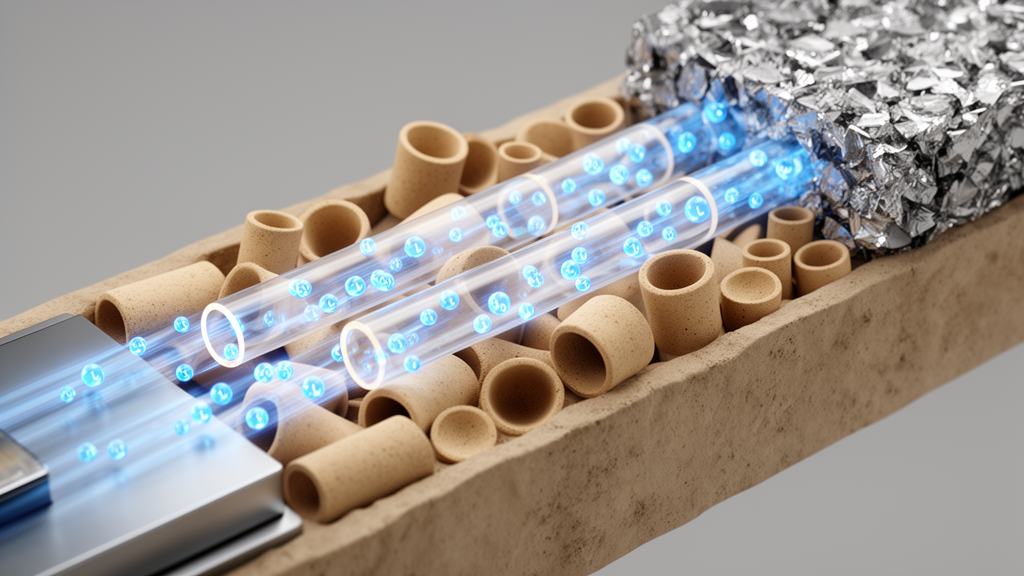
Solid-state batteries have long been heralded as the technology that will finally make electric vehicles safer, longer-lived, and more energy dense, but the materials at their heart have stubbornly refused to cooperate. Now a team of researchers in China reports a deceptively simple fix that could push one of the most promising candidate materials over the finish line: they have threaded tiny natural clay tubes through a polymer-ceramic electrolyte, creating an interconnected network of channels along which lithium ions can race far more freely than before. The resulting composite solid electrolyte, described in the journal Ionics, delivers ionic conductivity, mechanical strength, and cycling stability that together rank among the best achieved for this class of materials.
The work, led by Yongli Du, Zhenzhu Cao, and Liying Wang at Inner Mongolia University of Technology, tackles a problem that has haunted composite solid electrolytes since their inception. These materials blend the safety and flexibility of polymer membranes with the high conductivity of ceramic ion conductors, and they are widely regarded as key enablers of next-generation lithium metal batteries, which replace the flammable graphite anode of conventional cells with pure lithium metal. In principle, that substitution can dramatically increase energy density. In practice, composite electrolytes have been held back by two chronic weaknesses: ionic conductivity that falls short of liquid electrolytes, and poor compatibility at the interfaces where the electrolyte meets the electrodes. Both flaws shorten battery life and, in the worst case, invite dangerous failures.
The team’s solution centers on halloysite nanotubes, naturally occurring aluminosilicate minerals with a remarkable structural quirk. Each tube is a hollow cylinder roughly a nanometer scale in diameter, and its two ends carry opposite electrical polarities: the outer surface is negatively charged while the inner lumen is positively charged. That built-in asymmetry, the researchers found, is exactly what a struggling composite electrolyte needs. When the nanotubes are dispersed into a matrix of polyvinylidene fluoride, or PVDF, loaded with lithium bis(trifluoromethanesulfonyl)imide salt and garnet-type ceramic particles of a composition known as LLYZTO, the tubes act as bridges, stitching the ceramic particles together into continuous pathways for lithium ions.
The physics behind this improvement is subtle but elegant. In a conventional polymer electrolyte, lithium ions shuffle sluggishly through segmental motion of the polymer chains, while the bulky TFSI anions drift in the opposite direction, creating concentration gradients that degrade performance over time. The negatively charged outer surfaces of the halloysite nanotubes repel the TFSI anions, effectively delaying their diffusion and forcing the current to be carried overwhelmingly by lithium ions. Meanwhile, the positively charged inner channels and the tube surfaces coordinate with the salt, loosening the grip between lithium ions and their anion partners. The result is a dense, percolating network of fast ion conduction that runs between the ceramic particles rather than relying solely on the slow polymer phase.
The numbers reported for the optimized membrane, designated PLLH-7, are striking. Ionic conductivity reaches 8.52 × 10⁻⁴ siemens per centimeter, a figure that places it firmly in the territory once reserved for liquid electrolytes. The lithium-ion transference number climbs to 0.80, meaning that four out of every five charge carriers in the material are lithium ions rather than counterproductive anions, a ratio far above what typical polymer electrolytes manage. Mechanical strength reaches 12.3 megapascals, stiff enough to physically resist the growth of lithium dendrites, the needle-like metal filaments that can pierce electrolytes, short-circuit cells, and in extreme cases ignite fires. Dendrite suppression is arguably the single most important requirement for any electrolyte hoping to survive contact with lithium metal.
Symmetric lithium cells built with the new electrolyte demonstrated just that resilience, cycling stably for 2,400 hours with effective inhibition of dendrite formation. That kind of endurance in a symmetric configuration, where lithium is plated and stripped repeatedly on both electrodes, is a demanding test that many composite electrolytes fail within a few hundred hours. The team then moved to full cells to see how the material would perform in realistic battery chemistry, and the results held up on both ends of the voltage spectrum.
Paired with a lithium iron phosphate cathode, the material of choice for rugged, long-life batteries, the cell retained a discharge capacity of 131.6 milliampere-hours per gram after 350 cycles at a 0.2C rate, with a Coulombic efficiency of 95.4 percent. More impressively, when the electrolyte was matched with a nickel-rich NCM811 cathode, the high-voltage chemistry favored in electric vehicles for its energy density, the cell maintained 124.1 milliampere-hours per gram after 500 cycles at 1C. Sustaining that capacity at high voltage and high rate suggests the electrolyte resists oxidative degradation at the cathode interface as well as reduction at the anode, a dual tolerance that few polymer-based systems achieve.
What makes the advance particularly compelling is the raw material itself. Halloysite is a naturally abundant clay, chemically similar to kaolin, and it can be mined and processed at a fraction of the cost of engineered nanomaterials such as carbon nanotubes or synthesized ceramic whiskers. Its use here follows a growing body of evidence that one-dimensional fillers outperform spherical nanoparticles in composite electrolytes, because their elongated geometry allows them to form connected networks at much lower loadings. Earlier studies have shown similar benefits with oxide nanowires and beta-alumina nanowires, but halloysite brings the added advantage of its intrinsic dipolar surface chemistry, which the authors exploit to simultaneously accelerate lithium transport and suppress anion motion.
The study also fits into a broader strategy emerging across the solid-state battery field: rather than inventing entirely new chemistries, researchers are learning to orchestrate the interfaces within composite materials so that each component does what it does best. The garnet ceramic particles provide rigid, fast-conducting domains; the PVDF matrix provides flexibility, processability, and thermal stability; the lithium salt supplies mobile ions; and the nanotubes knit the whole assembly into a coherent transport architecture. The authors describe the approach as an effective method for improving the ionic conductivity, mechanical properties, and electrochemical performance of PVDF-based composite electrolytes, and the same design logic could plausibly extend to sodium and other emerging battery chemistries where halloysite has already shown promise.
Challenges remain before clay-toughened electrolytes find their way into commercial cells. Scaling up thin, defect-free membranes to the square meters required for automotive packs is notoriously difficult, and the long-term behavior of polymer-ceramic interfaces under thermal stress and high stack pressure still needs validation. The Coulombic efficiency of 95.4 percent, while respectable, leaves room for improvement compared with the best liquid systems. Nevertheless, the demonstration that a cheap, naturally occurring nanotube can transform the transport properties of a composite electrolyte offers a vivid reminder that in battery science, sometimes the most powerful tools are dug straight out of the ground. If the approach survives scale-up, the humble halloysite tube may earn a place inside the batteries that power the next generation of electric vehicles.
Subject of Research: Halloysite nanotube-reinforced composite solid electrolytes for lithium metal batteries
Article Title: Highly efficient ionic transport networks by one-dimensional HNTs to enhance the performance of composite solid electrolytes for lithium metal batteries
Article References: Du, Y., Cao, Y., Cao, Z., & Wang, L. (2026). Highly efficient ionic transport networks by one-dimensional HNTs to enhance the performance of composite solid electrolytes for lithium metal batteries. Ionics. https://doi.org/10.1007/s11581-026-07481-4
Image Credits: AI Generated
DOI: 10.1007/s11581-026-07481-4
Keywords: solid-state batteries, composite solid electrolytes, halloysite nanotubes, lithium metal batteries, ionic conductivity, PVDF, garnet electrolyte, lithium dendrites, transference number, LLYZTO, energy storage, nanocomposites
Cite Scienmag News
Faith Mcneil. (October 9, 2026). Clay Nanotubes Build Superhighways for Lithium Ions in Solid Batteries. Scienmag. https://scienmag.com/clay-nanotubes-build-superhighways-for-lithium-ions-in-solid-batteries/
Faith Mcneil. "Clay Nanotubes Build Superhighways for Lithium Ions in Solid Batteries." Scienmag, 9 October 2026, https://scienmag.com/clay-nanotubes-build-superhighways-for-lithium-ions-in-solid-batteries/. Accessed 9 October 2026.
Faith Mcneil. "Clay Nanotubes Build Superhighways for Lithium Ions in Solid Batteries." Scienmag. October 9, 2026. https://scienmag.com/clay-nanotubes-build-superhighways-for-lithium-ions-in-solid-batteries/


