


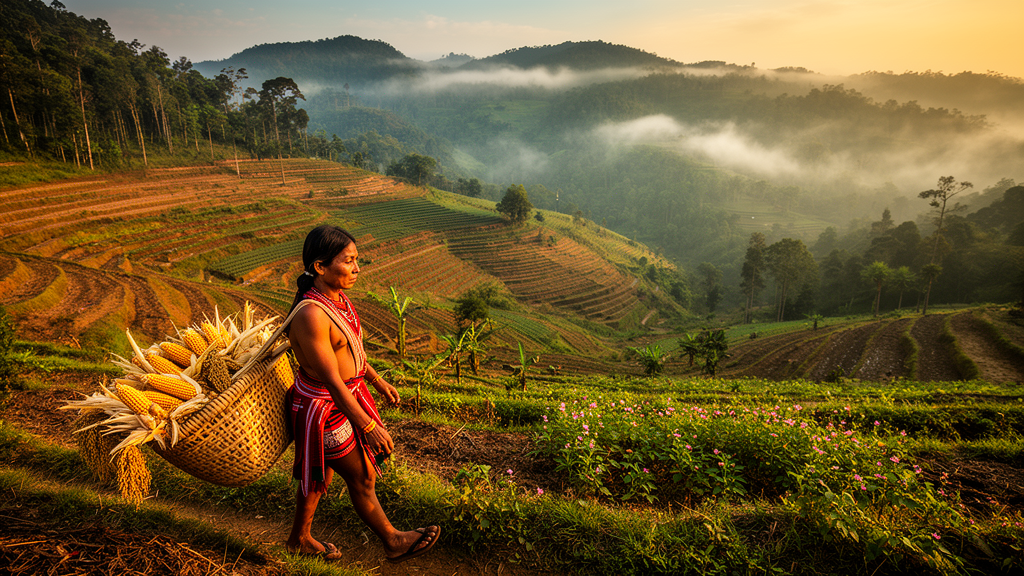
In the steep, forested ridges of the Naga Self-Administered Zone in northwestern Myanmar, entire landscapes have long been misread by outsiders. Shifting cultivation, known locally as jhum, has been portrayed for decades by governments and conservation agencies as a primitive and destructive practice, a driver of deforestation and an obstacle to modern agricultural development. A new study published in PLOS Sustainability and Transformation turns that narrative on its head. Drawing on extensive fieldwork in 42 villages across Layshi Township, researchers found that jhum landscapes are, in the eyes of the Indigenous Naga communities who live in them, the most multifunctional and valuable land-use systems in the entire regional mosaic, providing food, medicine, building materials, income, and cultural continuity in ways that no alternative land use can match.
The research team, led by Glenn Hunt and including collaborators from Myanmar and Europe, set out to document what they call the lived multifunctionality of these upland landscapes. Rather than measuring land-use performance solely through external metrics such as yields per hectare or carbon stocks, the researchers asked the people who inhabit and manage these landscapes how they perceive and value them. This methodological choice matters, because the gap between technocratic assessments and local understandings of sustainability has real consequences. In Myanmar, land that is managed under customary jhum cycles is frequently classified by the state as vacant, fallow, or degraded, a bureaucratic label that opens the door to appropriation, concession allocation, and forced conversion to other uses.
The fieldwork combined three complementary approaches. Participatory mapping sessions allowed villagers to draw and annotate the land-use mosaic of their territories, identifying jhum fields, forests, home gardens, terraced paddy fields, and other elements. Livelihood product inventories then catalogued the enormous range of goods that each land-use type contributes to household economies, from staple crops and wild vegetables to medicinal plants, fibers, fuelwood, and timber. Finally, community-based scoring exercises asked villagers to rate each land-use type against a set of locally defined functions, producing a quantitative picture of perceived multifunctionality that could be compared across villages and land-use categories.
The results were striking in their consistency. Jhum fields, the very land-use type most often maligned in policy discourse, emerged as the most multifunctional of all. They provided the widest range of livelihood products of any land use in the mosaic and contributed reliably to food security, the supply of medicines, the availability of construction materials, and the reproduction of cultural practices. This is not an accident of design but the product of a sophisticated management system. In jhum cultivation, plots are cleared, cultivated for a limited period, and then left to regenerate under fallow, a rotational cycle that maintains a dynamic patchwork of vegetation at different successional stages across the landscape. That patchwork, the study shows, is precisely what generates the breadth of products and services that communities depend upon.
Forests and home gardens play equally important, but complementary, roles. Forests supply wild foods, medicinal plants, and materials that jhum fields alone cannot provide, while home gardens close to the homestead support dietary diversity and generate income through the sale of vegetables, fruits, and small livestock. Terraced paddy fields, where they exist, contribute staple grain but occupy a narrower functional niche. The study emphasizes that none of these land-use types functions in isolation. Together they form an interdependent landscape mosaic in which households deliberately spread their livelihood activities across multiple land uses, reducing risk and buffering against crop failure, price shocks, and seasonal scarcity. This diversification strategy, refined over generations, is a hallmark of resilient upland livelihood systems across Southeast Asia.
The technical core of the study lies in its systematic comparison of perceived multifunctionality across land-use types. By aggregating community scores and product inventories, the researchers could demonstrate that the functional profile of jhum is not merely broad but also consistent: it contributes to nearly every valued function, even where other land uses outperform it on any single measure. Forests, for example, may supply more timber, and paddy fields more rice, but jhum fields deliver a balanced portfolio of contributions that underpins everyday subsistence. The authors argue that this portfolio logic is invisible to conventional land assessments, which typically evaluate each land-use type against a narrow set of agronomic or forestry indicators and therefore systematically undervalue rotational systems.
The policy implications are profound. In Myanmar, as in many other countries with significant upland Indigenous populations, state land classifications determine which areas can be titled, leased, or conserved. When jhum fallows are mapped as vacant or degraded land, the rotational cycle that sustains both livelihoods and regenerating vegetation is broken, and communities can lose access to the very landscapes that feed them. The study documents how this misrecognition is not simply a technical error but a clash between epistemologies: between a governance framework that reads landscapes through static land-cover categories, and an Indigenous understanding that reads them through lived relationships, seasonal cycles, and customary institutions. The authors frame this as a matter of epistemic justice, arguing that sustainability transformations cannot be inclusive if the knowledge systems of the people who manage the land are excluded from the categories used to govern it.
The findings also speak to a broader global debate. Shifting cultivation supports millions of people across the tropical uplands of Asia, Africa, and Latin America, and it has been the subject of contested narratives for more than a century. Colonial administrators condemned it, development programs have sought to replace it with sedentary agriculture, and some conservation initiatives have blamed it for deforestation. Yet a growing body of research suggests that, at appropriate fallow lengths and population densities, rotational systems can maintain biodiversity, soil fertility, and carbon stocks while sustaining livelihoods without external inputs. The Naga Hills study adds a crucial dimension to this literature by grounding the argument in the detailed perceptions of the communities themselves, showing that what outside observers see as degraded fallow is locally understood as a productive landscape in a necessary phase of renewal.
For the Naga communities of Layshi Township, the stakes are immediate. Their territories lie in a remote border region that has experienced conflict, restricted access, and limited state investment, making self-provisioned livelihoods all the more essential. The interdependence of jhum fields, forests, and gardens means that interventions targeting any single land-use type ripple through the whole system. Converting fallows to plantations, restricting forest access, or pushing paddy expansion onto sloping land each erodes a different strand of the livelihood web. The study’s participatory methods, by making local valuations explicit and comparable, offer a practical template for land-use planning that begins with recognition rather than replacement, and that treats villagers as experts on their own landscapes rather than as obstacles to development.
Ultimately, the research makes a case that extends well beyond the Naga Hills. If sustainability transformations are to succeed in the world’s upland regions, they must be built on an accurate understanding of how multifunctional landscapes actually work and on respect for the people who sustain them. Recognizing customary land-use systems such as jhum, the authors conclude, is critical not only for ecological sustainability but for more equitable development policy. The alternative, continuing to classify living, working landscapes as empty and degraded, risks destroying precisely the diversity and resilience that both local communities and the global community now urgently need to protect.
Subject of Research: Indigenous perceptions of the multifunctionality of shifting cultivation landscapes in the Naga Hills of Myanmar
Article Title: Lived multifunctionality: Indigenous perceptions of shifting cultivation landscapes in the Naga Hills of Myanmar
Article References: Hunt, G., Makury, A., Fogerite, J., von der Mühlen, M., Htet, A. S., Bastide, J., Heinimann, A., & Rueff, H. (2026). Lived multifunctionality: Indigenous perceptions of shifting cultivation landscapes in the Naga Hills of Myanmar. PLOS Sustainability and Transformation, 5(10), e0000288. https://doi.org/10.1371/journal.pstr.0000288
Image Credits: AI Generated
DOI: 10.1371/journal.pstr.0000288
Keywords: shifting cultivation, jhum, Naga Hills, Myanmar, indigenous knowledge, multifunctional landscapes, land governance, food security, epistemic justice, sustainability transformation, participatory mapping, upland livelihoods
Cite Scienmag News
Courtney Benton. (October 9, 2026). Indigenous Naga Communities Reveal the Hidden Richness of Shifting Cultivation Landscapes. Scienmag. https://scienmag.com/indigenous-naga-communities-reveal-the-hidden-richness-of-shifting-cultivation-landscapes/
Courtney Benton. "Indigenous Naga Communities Reveal the Hidden Richness of Shifting Cultivation Landscapes." Scienmag, 9 October 2026, https://scienmag.com/indigenous-naga-communities-reveal-the-hidden-richness-of-shifting-cultivation-landscapes/. Accessed 9 October 2026.
Courtney Benton. "Indigenous Naga Communities Reveal the Hidden Richness of Shifting Cultivation Landscapes." Scienmag. October 9, 2026. https://scienmag.com/indigenous-naga-communities-reveal-the-hidden-richness-of-shifting-cultivation-landscapes/


