


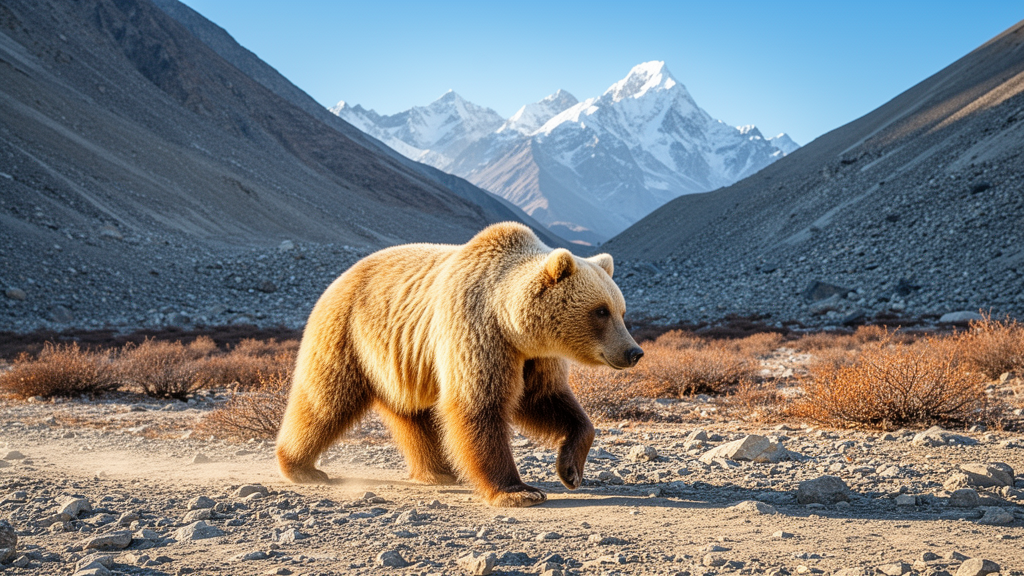
High in the cold, wind-scoured deserts of Nepal’s Trans-Himalaya, where the landscape rises above 4,000 meters and the air holds little moisture, one of Asia’s most elusive carnivores has finally been given a confirmed identity. A new study published in Ecology and Evolution presents the first genetically verified record of the Tibetan brown bear (Ursus arctos pruinosus) in Nepal, resolving decades of uncertainty about which subspecies of brown bear inhabits the country’s remote northern mountains. By combining mitochondrial DNA analysis of non-invasively collected scat and hair samples with multi-year camera-trap surveys, researchers have established that the bears of central and western Nepal belong to the Tibetan Plateau lineage rather than the Himalayan brown bear found farther west.
The question of subspecies identity matters far more than a taxonomic technicality. Globally, the brown bear is listed as Least Concern by the IUCN, but that sweeping label conceals sharp regional declines. In Nepal, the species is classified as Critically Endangered, with fewer than 20 mature individuals estimated nationwide and a distribution restricted to the northern high Himalayas. The species enjoys full legal protection under Nepal’s National Parks and Wildlife Conservation Act of 1973, yet conservation planning has been hampered by a fundamental problem: nobody knew for certain which bear they were protecting. Historical records relied on indirect signs, local reports, and photographs, none of which could reliably distinguish the Tibetan brown bear from its Himalayan relative, whose range is centered on northern Pakistan and northwestern India.
Previous mitochondrial DNA studies had shown that the two subspecies represent genetically distinct evolutionary lineages despite their geographic proximity. The Tibetan brown bear occupies the Tibetan Plateau and adjoining high-altitude regions, while the Himalayan brown bear is largely confined to the northwestern Himalaya. But no genetic study of brown bears had ever been conducted within Nepal itself. The new research, led by Rishi Baral of Hokkaido University and colleagues, set out to close that gap by sampling two key landscapes: Mustang District within the Annapurna Conservation Area and Dolpa District within Shey-Phoksundo National Park, both characterized by cold arid climates, rugged terrain, and alpine steppe vegetation.
Between 2022 and 2024, field teams working with experienced local personnel collected ten non-invasive samples putatively attributed to brown bears, seven fecal samples and three hair samples, located using associated field signs such as tracks, digging marks, and feeding sites. The researchers swabbed the outer mucosal layer of feces with sterile swabs preserved in buffer, collected hair with sterilized forceps, and geo-referenced every sample with handheld GPS units before storage at minus 20 degrees Celsius. In the laboratory, DNA was extracted under sterile conditions with negative controls to monitor contamination, and a short fragment of the mitochondrial control region, the D-loop, was amplified using bear-specific primers designed for subspecies discrimination.
The genetic results were strikingly clear. Seven of the ten samples yielded successful mitochondrial sequences, and every one of them carried the same haplotype, one that phylogenetic analysis placed firmly within the Tibetan brown bear lineage. The Nepalese sequences formed a well-supported clade with reference samples from the Tibetan Plateau, while the Himalayan brown bear emerged as a distinct sister lineage, clearly separate. Bootstrap support values for the major nodes exceeded 70 percent, and the sloth bear served as a divergent outgroup. Haplotype diversity and nucleotide diversity were both zero, meaning no mitochondrial variation was detectable among the samples analyzed, a pattern consistent with historical bottlenecks, long-term isolation, and restricted female dispersal reported for Tibetan brown bears across their core range.
Microsatellite genotyping, though successful in only 40 percent of samples, a common limitation with degraded non-invasive material, identified two unique individuals, both male. One was detected in Upper Mustang from a single hair sample, and the other from three fecal samples collected in Dolpa. The male-only detection pattern fits a well-documented trend in bear genetics: males disperse farther and hold larger home ranges, so they are more frequently encountered in surveys, while females tend to remain near their birthplaces. That sex bias raises the possibility that female-mediated gene flow into Nepal is particularly limited, potentially deepening the genetic isolation of any resident bears or linking them only through seasonal movement across the Tibetan border.
The camera-trap data provided independent ecological corroboration. As part of a broader mammalian community survey, the team deployed 96 motion-triggered infrared camera stations, 64 in Mustang and 32 in Dolpa, arranged on a systematic 4-by-4-kilometer grid across elevations of roughly 3,500 to 5,600 meters, with stations separated by at least 2 kilometers and no bait or scent lures used. Over 9,336 camera-trap nights of effort, the traps recorded four independent brown bear capture events at three stations in Upper Mustang between April 2023 and June 2024, at elevations from 3,834 to 4,816 meters across alpine steppe, shrubland, and grassland. One bear was photographed twice in a single day at Lomanthang, moving upslope at dawn and downslope in the evening, apparently after concealing itself from five feral dogs detected nearby. Another individual spent the night of June 5, 2023 playing and jumping in front of a camera at Damodar Kunda. In Dolpa, cameras set for long-term snow leopard monitoring captured four additional brown bear detections in 2023 and 2024, including one animal that paused to inspect the lens at nearly 5,000 meters.
Independent experts from the IUCN Species Survival Commission’s Bear Specialist Group reviewed the photographs and consistently judged the recorded animals consistent with the Tibetan brown bear, citing pale to dark brown pelage, prominent shoulder humps, and concave facial profiles. The study also compiled a verified photograph of a live bear taken by a local horse owner above Samdo village in the Manaslu Conservation Area, showing an individual feeding on a carcass, evidence of either scavenging or predation. Synthesizing these records with published reports spanning 2008 to 2025, the authors mapped confirmed brown bear occurrence across several Trans-Himalayan landscapes, including Humla, Dolpa, Mustang, Manaslu, and the Kanchenjunga Conservation Area, all along the southern periphery of the species’ global range.
The authors are careful to note the limits of their data. With only two genetically confirmed individuals and no detectable mitochondrial variation, the study cannot yet demonstrate a resident breeding population in Nepal. Some detected animals may be dispersing or transient males from larger populations on the Tibetan Plateau. Whether Nepal supports permanent residents, seasonal migrants, or a movement corridor connecting Himalayan and Plateau populations remains an open question that will require expanded non-invasive sampling targeting females, nuclear genomic markers to assess connectivity and effective population size, and long-term monitoring across the fragmented alpine habitat.
Still, the repeated detections across multiple years and locations suggest that Nepal’s Trans-Himalayan landscapes are regularly used by brown bears rather than visited by accident. For a nationally Critically Endangered carnivore at the edge of its range, that distinction carries real weight. Peripheral populations often show reduced genetic diversity and heightened vulnerability to environmental change, infrastructure development, livestock grazing, and human-bear conflict, but they can also serve as stepping stones or refugia under future climate scenarios. The researchers argue that maintaining landscape connectivity across Trans-Himalayan corridors and mitigating conflict in pastoral communities should be immediate priorities, alongside transboundary collaboration with counterparts in China. The study establishes the first molecular baseline for Tibetan brown bears in Nepal and demonstrates how genetics, camera trapping, and local ecological knowledge can be woven together to illuminate the lives of species that dwell where few observers can follow.
Subject of Research: Genetic and camera-trap confirmation of the Tibetan brown bear (Ursus arctos pruinosus) in central Nepal
Article Title: Confirmation of the Tibetan Brown Bear (Ursus arctos pruinosus) in Central Nepal Based on Genetic and Camera‐Trap Evidence
Article References: Baral, R., Gurung, R. B., Sapkota, A., Subedi, N., Giordano, A. J., Paudel, R. P., Kadariya, R., Khanal, G., Kodzue, K., Tsubota, T., & Shimozuru, M. (2026). Confirmation of the Tibetan Brown Bear ( Ursus arctos pruinosus ) in Central Nepal Based on Genetic and Camera‐Trap Evidence. Ecology and Evolution, 16(10), Article e74400. https://doi.org/10.1002/ece3.74400
Image Credits: AI Generated
DOI: 10.1002/ece3.74400
Keywords: Tibetan brown bear, Ursus arctos pruinosus, Nepal, mitochondrial DNA, camera trapping, non-invasive genetics, Trans-Himalaya, conservation, phylogeography, Annapurna Conservation Area, critically endangered, wildlife monitoring
Cite Scienmag News
Juliet Wilcox. (October 9, 2026). Genetic Sleuthing Confirms the Mysterious Tibetan Brown Bear Roams Nepal’s High Deserts. Scienmag. https://scienmag.com/genetic-sleuthing-confirms-the-mysterious-tibetan-brown-bear-roams-nepals-high-deserts/
Juliet Wilcox. "Genetic Sleuthing Confirms the Mysterious Tibetan Brown Bear Roams Nepal’s High Deserts." Scienmag, 9 October 2026, https://scienmag.com/genetic-sleuthing-confirms-the-mysterious-tibetan-brown-bear-roams-nepals-high-deserts/. Accessed 9 October 2026.
Juliet Wilcox. "Genetic Sleuthing Confirms the Mysterious Tibetan Brown Bear Roams Nepal’s High Deserts." Scienmag. October 9, 2026. https://scienmag.com/genetic-sleuthing-confirms-the-mysterious-tibetan-brown-bear-roams-nepals-high-deserts/


