


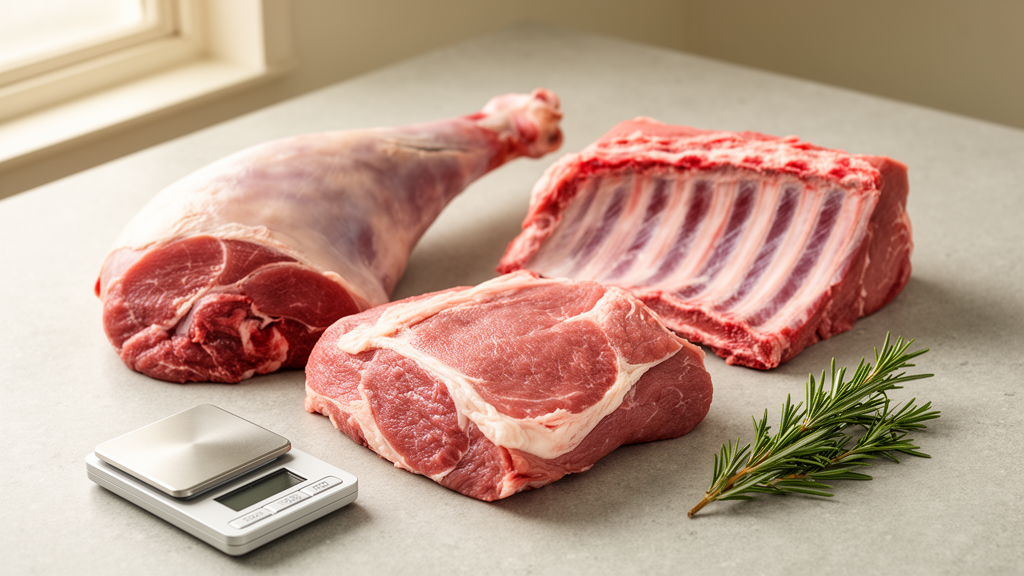
When it comes to producing high-quality lamb, one of the most consequential decisions a farmer makes is deceptively simple: when to send the animal to slaughter. A new study of Lalahan lambs, a Turkish sheep genotype bred from Kivircik and Akkaraman crosses, suggests that this decision matters less than many producers might assume, at least for the core chemical and physical properties of the meat. Researchers at Ankara University found that raising lambs to heavier slaughter weights of 35, 40, or 45 kilograms left most meat quality traits essentially unchanged, while subtly reshaping the fatty acid profile and switching the activity of a key fat-metabolism gene in liver and muscle tissue. The findings, published in Archives Animal Breeding, offer some of the first molecular-level data on a breed that has never been characterized in this much depth before.
The Lalahan sheep is a relatively new genotype, created by combining melting of the Kivircik and Akkaraman breeds, so that the animals carry roughly 75 percent Kivircik and 25 percent Akkaraman ancestry. Although earlier studies had examined the breed’s fertility, milk yield, and morphology, no one had systematically tracked how meat quality and the expression of fat-metabolism genes change across different slaughter weights. To fill that gap, the research team, led by Rabia Arslan with Necmettin Ünal and Akın Yakan, obtained thirty-six male lambs weaned at ninety days and weighing about twenty kilograms. The lambs were randomly divided into three groups and fed intensively on a controlled concentrate and alfalfa hay regimen until they reached the target live weights of 35, 40, and 45 kilograms. From each group, six lambs representing the average weight of their cohort were selected for slaughter, producing eighteen animals for detailed analysis.
The researchers measured a battery of classic meat quality indicators: pH decline, instrumental color, water-holding capacity, cooking loss, and complete fatty acid composition. Samples were taken from two muscles, the longissimus dorsi lumbalis and the semimembranosus, as well as from liver and tail fat. pH was recorded with a portable meter at fifteen minutes, one hour, and twenty-four hours after slaughter, while color was quantified using the standard L*, a*, and b* coordinates after a thirty-minute bloom period. Water-holding capacity was assessed by compressing five-gram samples under a 2250-gram weight, and cooking loss was determined by vacuum-packing fifty-gram samples and heating them at eighty degrees Celsius for one hour. Fatty acids were extracted by Soxhlet method, converted to methyl esters, and separated on a 100-meter gas chromatography column, allowing the team to quantify dozens of individual fatty acids in each tissue.
The pH results told a nuanced story. Fifteen minutes after slaughter, the longissimus muscle pH values were 6.44, 6.41, and 6.39 in the 35, 40, and 45 kilogram groups respectively, a statistically significant but practically small difference. By twenty-four hours, values had fallen to 5.38, 5.50, and 5.45, again differing significantly between groups. Crucially, all of these values fall within the range considered ideal for high-quality meat, which typically requires an ultimate pH between 5.50 and 5.80. The rate of pH decline also slowed slightly as slaughter weight increased, a pattern consistent with some previous studies of heavier lambs, although the literature on this point has been contradictory, with work on Spanish breeds and Merinos reporting the opposite trend.
Color proved to be the most weight-sensitive of the physical traits. While brightness and yellowness were statistically indistinguishable across groups, the redness index, a*, rose significantly with slaughter weight in both muscles examined. The researchers attribute this to myoglobin, the oxygen-binding pigment that accumulates as animals mature physiologically. This interpretation aligns with a large commercial study of more than eight thousand lambs showing that maturity-linked muscle characteristics, particularly myoglobin concentration, are major determinants of fresh lamb color. In practical terms, heavier Lalahan lambs produce visibly redder meat, which many consumers associate with freshness and quality. Water-holding capacity, ranging from about 11.5 to 14.3 percent, and cooking loss, between roughly 26 and 29 percent, showed no significant differences across slaughter weights, suggesting that juiciness-related traits are stable regardless of when the lambs are finished.
The fatty acid analysis revealed that tissue type mattered far more than slaughter weight. Across all groups and tissues, oleic acid, the monounsaturated C18:1 fatty acid prized for its cholesterol-lowering effects, was the most abundant, followed by palmitic and stearic acids. Slaughter weight did significantly shift several individual fatty acids: palmitic acid increased with weight, particularly in the heaviest group, while the beneficial linoleic acid and the omega-3 docosahexaenoic acid declined. Yet the summary indices that nutritionists care most about, including the ratios of polyunsaturated to saturated fatty acids, unsaturated to saturated fatty acids, omega-6 to omega-3, and the atherogenic and thrombogenic indices, were statistically unaffected by slaughter weight. The atherogenic index stayed comfortably below one in all groups, and the thrombogenic index hovered near one, both favorable signals for cardiovascular health.
There was one nutritional caveat. The polyunsaturated to saturated fatty acid ratio in all three weight groups ranged from 0.15 to 0.18, well below the recommended minimum of 0.4. However, the researchers note that this is a well-documented characteristic of sheep meat generally, with many indigenous genotypes reporting ratios between 0.1 and 0.2. Ruminant metabolism, with its rumen microbes hydrogenating unsaturated fatty acids, makes this ratio difficult to improve through feeding alone. The liver stood out as the most favorable tissue, with a polyunsaturated to saturated ratio of 0.36, approaching the recommended threshold, while muscle and tail fat were far lower.
The molecular arm of the study focused on three genes that orchestrate fat metabolism: SREBP-1c, a master transcription factor controlling de novo lipogenesis in the liver; PPARγ, a nuclear receptor regulating fatty acid absorption, transport, and storage; and FASN, the enzyme gene that builds saturated fatty acid chains. Using quantitative real-time PCR with rigorous RNA quality controls, the team measured expression in liver, longissimus muscle, and gluteal adipose tissue, normalizing against housekeeping genes and comparing each group to the 35 kilogram controls. The results were strikingly tissue-specific. SREBP-1c and PPARγ expression did not differ significantly across weight groups in any tissue, suggesting that the central regulatory machinery of lipogenesis remains balanced as lambs grow. But FASN behaved differently: in the 45 kilogram group, its expression was significantly downregulated in the liver, roughly threefold, and showed significant differences in muscle tissue as well, while gluteal fat showed no significant changes for any of the three genes.
This FASN finding carries real biological weight. Because FASN directly determines the synthesis rate of saturated fatty acids, its suppression in heavier lambs hints at meaningful reorganization of lipid metabolism as growth slows. The authors suggest that reduced FASN expression in muscle may be linked to the slower growth rate of the heaviest animals, since anabolic genes respond to the body’s growth factors. Interestingly, the muscle fatty acid profile itself did not differ significantly across groups even as the saturated to unsaturated balance shifted, implying that compensatory pathways smooth out some of the gene-level changes. The researchers also note that comparisons with published data hint the Lalahan genotype may perform somewhat better than its parent Kivircik breed, though they caution that direct breed comparisons require identical experimental conditions.
The practical takeaway is that Lalahan lambs deliver consistently favorable meat quality across a broad slaughter window, giving producers flexibility without sacrificing eating quality or nutritional indices. Given the conditions of Central Anatolia, where the breed was developed, the authors recommend a slaughter weight of forty kilograms as the optimal compromise between carcass value and meat characteristics. For a livestock sector increasingly interested in indigenous genotypes that combine local adaptation with marketable meat quality, the study provides a template: by pairing classical quality measurements with gene expression profiling, it becomes possible to see not just what the meat is like, but why. As demand grows for traceable, breed-specific lamb products, this kind of molecular characterization may become the standard by which new and heritage breeds alike are judged.
Subject of Research: Effects of slaughter weight on meat quality, fatty acid composition, and lipid metabolism gene expression in Lalahan lambs
Article Title: Effects of different slaughter weights on meat quality parameters and gene expression related to fat metabolism in muscles, liver, and gluteal fat in Lalahan lambs
Article References: Arslan, R., Ünal, N., & Yakan, A. (2026). Effects of different slaughter weights on meat quality parameters and gene expression related to fat metabolism in muscles, liver, and gluteal fat in Lalahan lambs. Archives Animal Breeding, 69(3), 397-409. https://doi.org/10.5194/aab-69-397-2026
Image Credits: AI Generated
Keywords: Lalahan lambs, sheep, meat quality, slaughter weight, fatty acid composition, gene expression, FASN, SREBP-1c, PPARγ, lipid metabolism, lamb production, animal breeding
Cite Scienmag News
Juliet Wilcox. (October 9, 2026). Slaughter Weight Shapes Lamb Meat Quality and Fat Metabolism Genes. Scienmag. https://scienmag.com/slaughter-weight-shapes-lamb-meat-quality-and-fat-metabolism-genes/
Juliet Wilcox. "Slaughter Weight Shapes Lamb Meat Quality and Fat Metabolism Genes." Scienmag, 9 October 2026, https://scienmag.com/slaughter-weight-shapes-lamb-meat-quality-and-fat-metabolism-genes/. Accessed 9 October 2026.
Juliet Wilcox. "Slaughter Weight Shapes Lamb Meat Quality and Fat Metabolism Genes." Scienmag. October 9, 2026. https://scienmag.com/slaughter-weight-shapes-lamb-meat-quality-and-fat-metabolism-genes/


