


Air pollution is invisible, anxiety-inducing and, for many people, abstract. A team of French researchers has now shown that the way to make citizens care about it may be to start not with the pollution itself, but with something far more playful: magnets. In a study published in the journal Geoscience Communication, scientists from the Géosciences Environnement Toulouse laboratory and their collaborators describe a hands-on workshop built around magnetic phenomena that was designed to draw the public into a community-based participatory research project on urban air quality in Toulouse, France. Over five years, the workshop reached more than a thousand people and helped recruit over 150 households into the project, offering a striking demonstration that wonder can be a scientific recruitment tool.
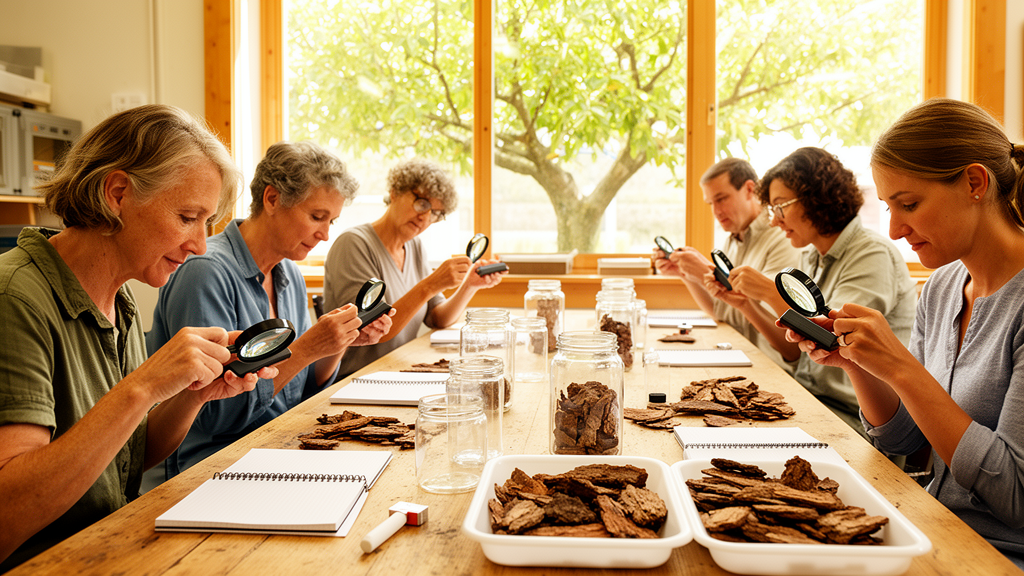
The workshop was created to support NanoEnvi, a community-based participatory research project launched in April 2018 in Toulouse. Rather than deploying electronic sensors, NanoEnvi asked residents and school classrooms to host passive biosensors: garlands of five to six small squares of London plane tree bark, each roughly four square centimeters, suspended from nylon threads for a full year. Tree bark is an efficient natural collector of airborne particles, capturing them on its surface through physical interception. The team then used environmental magnetism to analyze the samples, measuring the concentration of iron-rich magnetic particles that act as reliable proxies for particulate matter pollution, particularly traffic-related emissions from exhaust and non-exhaust sources such as brake and tire wear.
Environmental magnetism has real practical advantages for citizen science. Magnetic measurements are fast, inexpensive and non-destructive, which makes them well suited to participatory monitoring networks in which volunteers, not laboratories, do the collecting. But the method is unfamiliar outside a narrow academic niche, and the researchers recognized that asking people to hang bark garlands outside their windows would require more than a leaflet. They needed a way to introduce the underlying physics, make airborne particles tangible, and build trust before asking for a year-long commitment. The answer was a four-part workshop that could be staged at science fairs, neighborhood events and elementary schools.
The first component was pure spectacle. A researcher demonstrated magnetic attraction, beginning with a familiar wooden toy train and escalating to the powerful neodymium and ferrite magnets used in the laboratory, which the public could not handle for safety reasons but could watch in action. The centerpiece was a transparent plastic bottle filled with cooking oil and iron powder of two grain sizes. When shaken and placed against a magnet, the iron particles snapped into shapes that traced the magnetic field lines, offering a visible, almost poetic rendering of an invisible force and a natural opening to discuss the geometry of Earth’s magnetic field, geomagnetism and paleomagnetism. A magnetic slime paste, made to dance and slither by a hidden magnet, completed the sequence, building amazement step by step.
The second component let visitors become the scientists. Each participant received a vial of soil and water, a magnet, a plastic pipette and a small laboratory tube. By shaking the vial, holding the magnet against its surface just below the waterline and pipetting the dark cloud of magnetic particles into the tube, visitors performed a miniature version of a real laboratory extraction. Because naturally occurring magnetic particles in soil are too sparse to see, the team enriched the vials with commercial magnetite powder to guarantee a visible result. The coordination required, holding the magnet while pipetting at the same moment, proved challenging for adults and children alike, and that shared struggle became a bridge: some seven-year-olds with learning difficulties mastered it quickly while their parents fumbled, reversing the usual hierarchy of expertise.
The third component brought participants to the actual measurement. Using a Bartington MS2 magnetic susceptibility system adapted for field use, visitors measured five plane tree bark samples collected from locations across Toulouse, plotted the values on a city map with colored stickers, and interpreted the pattern themselves. The samples traced a path from a quiet canal-side environment to the dense traffic of the city center, and participants could formulate the hypothesis that the magnetic particles trapped in the bark came from road traffic, growing more concentrated in the air breathed by city-center dwellers. Depending on the setting, the workshop was rounded out by a fourth element: a twenty-minute researcher talk, a debate, or an invitation for children to draw their own solutions for cleaner air, sometimes captured by a live sketching artist in classrooms where photography was not permitted.
The reach was substantial. Between 2018 and 2023, the team ran the workshop at nine scientific outreach events and in three elementary schools in Toulouse, engaging roughly 850 event participants and 195 schoolchildren, and later took it to a social center in Senegal with ninety children. More than 150 people registered for NanoEnvi during or after these encounters, hosting bark biosensors in their homes or classrooms. Crucially, the researchers deliberately avoided pressure: registration was explained one-on-one by a researcher or doctoral student, took ten to twenty minutes, and the crowds at the stands made any coercion impossible. They also prioritized audiences who rarely attend science outreach, including schools in priority education zones and community centers in neighborhoods with predominantly immigrant populations.
The evaluation relied on observation rather than surveys, which the team found disrupted the interaction dynamics and created implicit expectations of reciprocity. The qualitative evidence was nonetheless vivid. Children took their particle-filled tubes home to show their families using fridge magnets. A student in a class for children with learning difficulties vividly recalled the workshop two years later and could describe its objectives. One child, presented with an active air-pumping experiment, questioned the pump’s ecological impact, revealing that the concept of passive biosensors had genuinely taken root, and prompting the researcher to rethink aspects of the methodology. Three children who left a stand with magnets returned half an hour later, having run their own experiments on soil and leaves they found nearby, an enthusiasm that convinced a school principal to welcome the team into the building.
The researchers distilled four lessons from the project. First, protocols must evolve: the extraction experiment could be redesigned to give more autonomy to people with limited fine motor skills, and while the full workshop is hard to reproduce outside environmental magnetism, its magnetic demonstrations and extraction exercise are easily adaptable to other educational projects. Second, face-to-face encounters enabled genuine two-way dialogue, in which scientists explained their values and methods while participants shaped the project itself, leading to new districts being included, a community garden spin-off, and continued refinement of the biosensors. Third, the workshop unexpectedly fostered communication between physicists, geoscientists and humanities researchers, because adapting the discourse for a non-academic audience forced a shared language across disciplines and seeded new collaborations. Fourth, and perhaps most importantly, the hands-on format helped mitigate eco-anxiety.
That last point may be the study’s most consequential finding. Air pollution is one of the leading environmental causes of premature death in Europe, and media coverage of the World Health Organization’s estimate of nine million premature deaths worldwide was circulating in France during the project. When the team first tried to recruit at an open-air market with leaflets alone, the effort failed: passersby either ignored the topic or reacted with visible anxiety. The workshop, by contrast, paired a worrying subject with positive emotions generated by touching, experimenting with and being delighted by a physical phenomenon. The researchers believe these stimulating, almost art-like experiences offered an emotional outlet, and that participation in the research itself empowered citizens facing potentially degraded air. In a field where environmental messaging often defaults to alarm, the Toulouse team’s results suggest a different recipe: make the invisible visible, let people play with the physics first, and the commitment to act may follow on its own.
Subject of Research: A hands-on magnetism-based outreach workshop for engaging citizens in participatory urban air quality monitoring using tree bark biomonitors
Article Title: Make the invisible visible: reveal the magnetic field and air pollution to foster engagement in a community-based participatory research project
Article References: Make the invisible visible: reveal the magnetic field and air pollution to foster engagement in a community-based participatory research project. (n.d.). https://doi.org/10.5194/gc-9-261-2026
Image Credits: AI Generated
Keywords: citizen science, air pollution, environmental magnetism, tree bark biomonitoring, participatory research, Toulouse, particulate matter, science outreach, eco-anxiety, magnetic susceptibility, community engagement, geoscience communication
Cite Scienmag News
Russell Cooper. (October 9, 2026). Magnets, Tree Bark and Wonder: How a Simple Workshop Turned Citizens into Air Pollution Scientists. Scienmag. https://scienmag.com/magnets-tree-bark-and-wonder-how-a-simple-workshop-turned-citizens-into-air-pollution-scientists/
Russell Cooper. "Magnets, Tree Bark and Wonder: How a Simple Workshop Turned Citizens into Air Pollution Scientists." Scienmag, 9 October 2026, https://scienmag.com/magnets-tree-bark-and-wonder-how-a-simple-workshop-turned-citizens-into-air-pollution-scientists/. Accessed 9 October 2026.
Russell Cooper. "Magnets, Tree Bark and Wonder: How a Simple Workshop Turned Citizens into Air Pollution Scientists." Scienmag. October 9, 2026. https://scienmag.com/magnets-tree-bark-and-wonder-how-a-simple-workshop-turned-citizens-into-air-pollution-scientists/


