


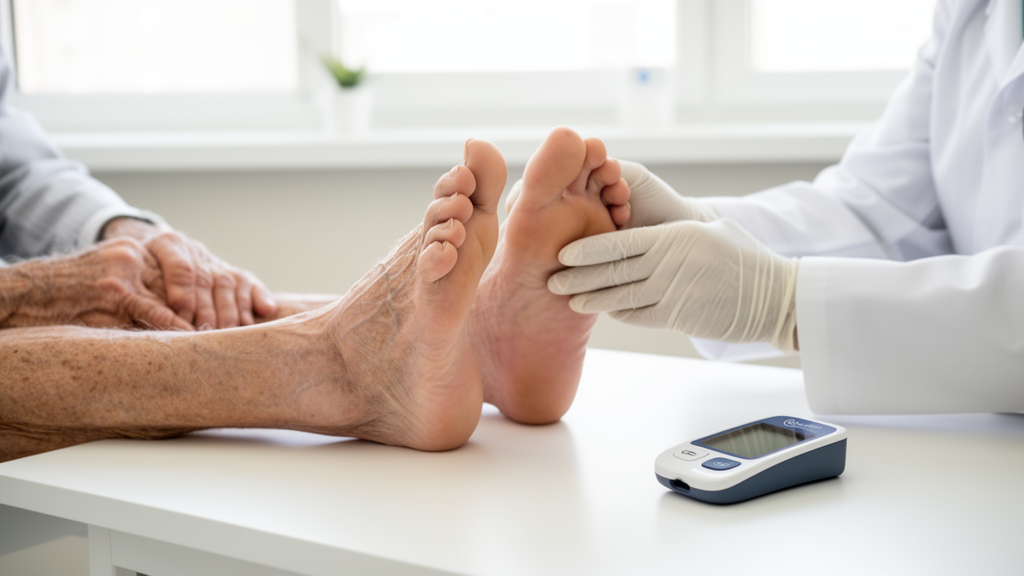
More than half of patients attending a specialist diabetes center in Saudi Arabia are walking around with feet already at elevated risk of ulceration, according to a new cross-sectional study published in Diabetes Therapy. Researchers analyzing 710 electronic medical records from the Abdullah Al-Othaim Diabetes Center at Qassim University found that 53.2% of patients qualified as at-risk under the International Working Group on the Diabetic Foot (IWGDF) classification system, a figure that matches almost exactly the pooled global prevalence of 53.2% reported in a 2023 systematic review spanning 36 studies and nearly 12,000 participants across 23 countries. The finding suggests that the burden of diabetic foot risk in a tertiary care setting in the Middle East mirrors the worldwide picture, and it arrives at a moment when the region is bracing for one of the steepest proportional increases in diabetes prevalence anywhere on Earth.
The study, led by Fatimah Z. Alenazi of Qassim University together with colleagues in Saudi Arabia, Lebanon, South Africa, and Portugal, set out to answer a deceptively simple question: which factors independently predict whether a patient’s feet fall into the danger zone, and whether they have already developed an active ulcer? The team focused on three candidate variables with strong clinical plausibility: glycated hemoglobin (HbA1c), the standard laboratory marker of average blood sugar over the preceding two to three months; age; and sex. Using a census sampling approach, they extracted every eligible record with a confirmed diabetes diagnosis and a documented foot assessment between January 2022 and December 2024, excluding only nine records with missing or non-numeric HbA1c values.
The technical backbone of the analysis was a pair of multivariable binary logistic regression models, one for each outcome. The primary outcome was at-risk diabetic foot status, defined as an IWGDF risk category of 1 or higher under the 2019 stratification system, which grades patients from category 0 (no loss of protective sensation or arterial disease) up to category 3 (previous ulceration or amputation). The secondary outcome was active foot ulceration, defined as a full-thickness wound distal to the ankle identified by the treating clinician during the same visit. Age and HbA1c were entered as continuous variables, with the HbA1c estimate expressed per 1% increase, and the models were assessed for calibration using the Hosmer–Lemeshow test and for explanatory power using the Nagelkerke R-squared statistic.
The results delivered a clear verdict on two of the three variables. Older age emerged as the strongest predictor of at-risk foot status, with each additional year of life raising the odds by 2.8% (odds ratio 1.028; 95% confidence interval 1.016–1.039; P < 0.001). The descriptive data traced the same gradient: at-risk status affected 39.6% of patients under 50, 55.3% of those aged 50 to 65, and 62.1% of those over 65. Male sex carried an independent 40% increase in the odds of at-risk status (OR 1.403; 95% CI 1.036–1.901; P = 0.029), with 58.3% of men classified as at risk compared with 48.4% of women. Both findings align with established biology: aging brings cumulative microvascular and macrovascular damage, progressive peripheral neuropathy, worsening peripheral arterial disease, thinner skin, slower tissue repair, and a heavier comorbidity burden, while men in many cohorts show higher rates of arterial disease and less favorable cardiovascular risk profiles.
The surprise came from HbA1c. Despite its reputation as the master metric of diabetes control, the glycemic marker showed no independent association with at-risk foot status (OR 1.037; P = 0.422) and fell short of statistical significance for active ulceration (OR 1.224; P = 0.077). Yet the raw descriptive numbers told a more suggestive story. Foot ulcer prevalence climbed steadily across HbA1c categories, from 1.9% among patients with HbA1c below 7.0% to 2.6% in the 7.0–9.0% band and 6.3% among those exceeding 9.0%. The authors argue that this gradient is biologically plausible and consistent with the known pathophysiology of wound breakdown, which involves chronic inflammation, immune dysfunction, endothelial impairment, and delayed repair, all of which are sensitive to current metabolic state.
Why might a single HbA1c reading fail to predict foot risk while still tracking ulceration descriptively? The researchers offer a mechanistic explanation rooted in the different time scales of the two outcomes. The IWGDF classification is built on structural, cumulative risk factors, including peripheral neuropathy, peripheral arterial disease, foot deformity, previous ulceration, and amputation, which develop over years or decades of glycemic exposure and vascular injury. A single recent HbA1c measurement captures only a snapshot of that long arc. Active ulceration, by contrast, represents acute tissue breakdown and impaired healing, processes that may respond more directly to current metabolic control. In other words, the foot risk category reflects the accumulated damage of the past, while the open wound may reflect the metabolic environment of the present.
The authors are careful, however, not to overstate what their data can support. The dataset lacked a long list of variables that any foot specialist would consider essential: diabetes duration, severity of neuropathy and peripheral arterial disease, renal function and chronic kidney disease, diabetic retinopathy, body mass index, smoking status, medication use, nationality, and socioeconomic status. Because these potential confounders could not be adjusted for, residual confounding cannot be excluded, and the independent role of HbA1c in diabetic foot risk cannot be confirmed or ruled out on the basis of this study alone. The team also notes that the most recent HbA1c value may not correspond in time to the foot assessment, introducing possible exposure misclassification, and that a single measurement may poorly represent long-term glycemic variability.
Several other quirks in the data deserve cautious reading. Active ulceration was recorded in only 21 patients, or 3.0% of the cohort, and its distribution across subgroups was uneven in ways that resist simple interpretation. Ulcer prevalence peaked in the 50-to-65 age group at 4.4% rather than among the over-65s at 2.6%, a pattern the authors attribute plausibly to survivor bias, more intensive surveillance of older patients, and reduced mobility in the oldest group, which may limit the repetitive mechanical trauma that drives skin breakdown even as structural risk rises. Similarly, although men carried higher at-risk status, active ulcers were actually more frequent in women, 3.7% versus 2.0%, a discrepancy that could reflect differences in healthcare utilization, footwear, mobility, or wound healing rather than biology. With so few ulcer events, the statistical models had limited precision, and the authors emphasize that their age–sex–HbA1c models were never intended as comprehensive risk-prediction tools.
The study’s strengths lie in its design discipline. The census approach avoided discretionary subsampling, the standardized IWGDF framework allowed comparison with international benchmarks, and reporting followed the STROBE guidelines for observational research. Its limitations are equally clear: the single tertiary center limits generalizability to primary care and community settings, the cross-sectional design forbids any causal inference, and the absence of the total number of diabetic patients seen at the center means the completeness of screening coverage could not be determined. A history of lower-extremity amputation was documented in only four patients and was deliberately excluded from the models, partly because amputation history is itself a defining criterion of IWGDF category 3, which would make its inclusion circular.
The practical message for clinicians and health systems is nonetheless concrete. With more than half of specialist-attending patients already in an at-risk category, the authors argue that foot screening and preventive care should be tailored to demographic profiles, with intensified surveillance for older patients and men, and delivered through multidisciplinary teams spanning podiatry, vascular assessment, endocrinology, and patient education. Glycemic optimization remains a cornerstone of diabetic foot prevention, but the study suggests that blood sugar control alone cannot identify who is in danger. What is needed next, the researchers conclude, are prospective, multicenter, longitudinal studies that capture the full spectrum of clinical, laboratory, and behavioral variables, so that risk-prediction models can be built and validated for Saudi Arabia and the wider Middle East and North Africa region, where the diabetes epidemic is still gathering force.
Subject of Research: Associations of glycemic control, age, and sex with diabetic foot risk and active foot ulceration in patients with diabetes in Saudi Arabia
Article Title: Associations of Glycemic Control, Age, and Sex with Diabetic Foot Risk and Active Foot Ulceration among Patients with Diabetes in Saudi Arabia: A Cross-Sectional Study
Article References: Alenazi, F. Z., Alslamah, T., Alharbi, B., Alotaibi, W. I., Fawaz, M., Algeffari, M., Alsalamah, Y. S., & Raposo, A. (2026). Associations of Glycemic Control, Age, and Sex with Diabetic Foot Risk and Active Foot Ulceration among Patients with Diabetes in Saudi Arabia: A Cross-Sectional Study. Diabetes Therapy. https://doi.org/10.1007/s13300-026-01923-y
Image Credits: AI Generated
DOI: 10.1007/s13300-026-01923-y
Keywords: diabetic foot, foot ulceration, HbA1c, glycemic control, IWGDF risk stratification, type 2 diabetes, peripheral neuropathy, peripheral arterial disease, Saudi Arabia, cross-sectional study, logistic regression, diabetes complications
Cite Scienmag News
Ophelia Keating. (October 9, 2026). Age and Sex Drive Diabetic Foot Risk While Blood Sugar Tells a Surprising Story. Scienmag. https://scienmag.com/age-and-sex-drive-diabetic-foot-risk-while-blood-sugar-tells-a-surprising-story/
Ophelia Keating. "Age and Sex Drive Diabetic Foot Risk While Blood Sugar Tells a Surprising Story." Scienmag, 9 October 2026, https://scienmag.com/age-and-sex-drive-diabetic-foot-risk-while-blood-sugar-tells-a-surprising-story/. Accessed 9 October 2026.
Ophelia Keating. "Age and Sex Drive Diabetic Foot Risk While Blood Sugar Tells a Surprising Story." Scienmag. October 9, 2026. https://scienmag.com/age-and-sex-drive-diabetic-foot-risk-while-blood-sugar-tells-a-surprising-story/


