


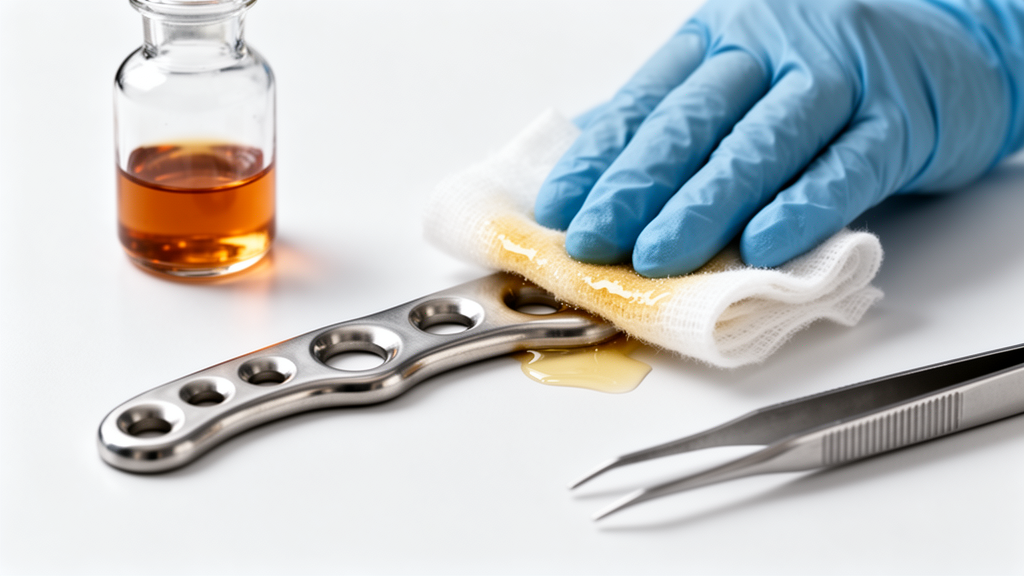
When bacteria settle onto a metal plate inside the human body, they do not simply sit there as isolated cells. Within hours they begin secreting a slimy, self-made fortress of polysaccharides, proteins, and extracellular DNA, gradually assembling into a three-dimensional biofilm that is notoriously resistant to antibiotics and immune attack. For patients with orthopedic implants, this microbial architecture is one of the most feared complications in surgery, turning a routine fracture fixation or joint replacement into a chronic, hard-to-eradicate infection. A new in vitro study from researchers at Loyola University Chicago, published in the Journal of Bone and Joint Infection, has now put six commonly used antiseptic irrigation solutions head-to-head against mature Staphylococcus aureus biofilms grown on stainless steel, the workhorse metal of fracture fixation hardware, and the results carry a clear message: povidone-iodine, even in heavily diluted form, is a remarkably effective biofilm killer.
The research team, led by Madison Balagtas and supervised by Ashley E. Levack of the Department of Orthopaedic Surgery and Rehabilitation at Loyola University Medical Center, set out to fill a conspicuous gap in the literature. Previous comparisons of antiseptic solutions had relied largely on static well-plate models and focused on arthroplasty surfaces such as porous titanium, polymethylmethacacrylate cement, cobalt-chromium, and oxidized zirconium. Stainless steel, despite being the most widely used metal in plates, screws, and nails for fracture fixation, had never been directly tested for its susceptibility to antiseptic irrigation. Moreover, static models fail to capture the hydrodynamic conditions that shape biofilm architecture in real wounds, where fluids constantly move and shear forces sculpt the microbial community into structures quite different from those grown in a motionless dish.
To address both shortcomings, the investigators turned to the CDC biofilm reactor, a validated laboratory system that grows reproducible biofilms under continuous flow. Sterile disk-shaped coupons made of 316L stainless steel, ten millimeters in diameter, were mounted in polypropylene holders inside the reactor vessel containing five hundred milliliters of tryptic soy broth. The system was inoculated with methicillin-sensitive S. aureus strain ATCC 49230 at approximately one hundred thousand colony-forming units per milliliter and operated in batch mode for twenty-four hours at thirty-seven degrees Celsius with gentle stirring. It then switched to continuous-flow mode for another forty-eight hours, with dilute medium pumped through the vessel at 6.94 milliliters per minute, delivering roughly twenty liters over the flow phase. By the end of the seventy-two-hour cultivation period, the coupons carried mature, flow-conditioned biofilms that more closely approximate the hydrodynamic environment of a surgical field than any static culture could.
The treatment phase was deliberately simple and clinically grounded. Each biofilm-coated coupon was rinsed gently in phosphate-buffered saline to remove non-adherent planktonic cells, then submerged for exactly three minutes in one of six irrigation solutions: normal saline, ten percent povidone-iodine, 0.35 percent povidone-iodine diluted in saline, a one-to-one mixture of ten percent povidone-iodine with three percent hydrogen peroxide, a commercial hypochlorous acid wound solution, or a 0.05 percent chlorhexidine gluconate lavage. The three-minute dwell time mirrors established orthopedic irrigation protocols and matches the conditions used in prior comparative studies, allowing direct comparison across investigations. Untreated controls and saline groups were included in every experimental run to separate the mechanical effect of rinsing from genuine chemical antibiofilm activity.
Quantifying what survived the treatment required careful biofilm disruption. Coupons were transferred to tubes of fresh medium and subjected to probe sonication at approximately seventeen to eighteen watts, using a manual pulsing rhythm of five seconds on and five seconds off for a cumulative five minutes of active sonication, with samples kept on ice throughout to prevent heat damage. The resulting suspensions were serially diluted, spread-plated onto agar in triplicate, incubated overnight, and counted. The entire protocol, from bacterial culture through colony enumeration, was repeated on four separate dates, with three coupons per treatment per run and three agar plates per coupon, yielding 252 plates across all runs and groups. Statistical analysis employed a mixed-effects negative binomial regression model, an approach well suited to the overdispersed count data typical of biofilm experiments, with experimental date as a fixed effect and culture plate as a random effect, and robust sandwich standard errors to guard against model misspecification.
The results were striking. Every antiseptic solution produced a statistically significant reduction in viable bacteria compared with untreated controls, but the magnitude varied enormously. Ten percent povidone-iodine achieved the greatest effect, a 3.46-log10 reduction equivalent to 99.97 percent killing, leaving only about 2,300 colony-forming units per milliliter against a control burden of nearly 6.8 million. Remarkably, the dilute 0.35 percent formulation performed almost identically, with a 3.42-log10 reduction and 99.96 percent killing. The difference between full-strength and dilute povidone-iodine was a negligible 0.04 logs, and their confidence intervals overlapped substantially. Both concentrations comfortably surpassed the three-log10 reduction threshold widely used as an operational benchmark for bactericidal antibiofilm activity in orthopedic biofilm research.
The remaining solutions trailed behind. The povidone-iodine and hydrogen peroxide mixture achieved a 3.24-log10 reduction, still above the threshold but slightly inferior to povidone-iodine alone, with no evidence of the synergistic enhancement some prior work had suggested. Hypochlorous acid delivered a 2.95-log10 reduction and chlorhexidine gluconate a 2.46-log10 reduction, both exceeding 99 percent killing yet falling short of the three-log benchmark. Chlorhexidine-treated coupons retained roughly tenfold more viable bacteria than the povidone-iodine groups. Normal saline, the default irrigant in many operating rooms, managed only a 0.15-log10 reduction, or about 30 percent, leaving bacterial burdens within the same order of magnitude as untreated controls. In practical terms, for every ten thousand bacteria on an untreated coupon, only three would remain after ten percent povidone-iodine treatment, whereas saline would leave roughly seven thousand behind.
The equivalence of dilute and full-strength povidone-iodine may prove to be the study’s most consequential finding. Surgeons frequently dilute ten percent povidone-iodine out of concern for cytotoxicity to osteoblasts, fibroblasts, and other host cells, since in vitro evidence shows that concentrations of 0.1 percent and above can impair the survival and migration of these cell types. Yet clinical series have not consistently linked intraoperative povidone-iodine irrigation to adverse wound healing. The new data suggest that such dilution may cost little in antibiofilm potency, a reassuring combination of preserved efficacy and reduced tissue toxicity. Mechanistically, povidone-iodine releases free molecular iodine that oxidizes microbial membrane lipids, proteins, and nucleic acids, and dilute formulations may release a higher proportion of free iodine relative to total iodine content, potentially explaining the preserved activity at 0.35 percent. Earlier work by Oduwole and colleagues also showed that even sub-inhibitory povidone-iodine concentrations suppress staphylococcal biofilm formation by downregulating the icaADBC operon, complementing the present findings on established biofilms.
Intriguingly, the results diverge from a 2025 study by Chao and colleagues, who found that 0.35 percent povidone-iodine and 0.05 percent chlorhexidine both failed to achieve a three-log reduction against mature S. aureus biofilms on cobalt-chromium and oxidized zirconium surfaces in a static model. The Loyola team hypothesizes that biofilms grown under continuous flow in the CDC reactor may differ structurally from static well-plate biofilms in ways that improve antiseptic penetration, and that surface material and bacterial strain differences may also contribute. These model-dependent discrepancies underscore why testing across multiple biofilm systems and implant surfaces matters before drawing firm clinical conclusions. Similarly, the absence of synergy in the povidone-iodine and hydrogen peroxide mixture contrasts with a study by Wan and colleagues that applied the two agents sequentially with double the total contact time, highlighting how concentration, sequence, and exposure duration can reshape apparent drug interactions.
The authors are careful to frame their findings within the limits of the model. The experiments used a single organism, methicillin-sensitive S. aureus, whereas chronic implant infections often involve methicillin-resistant strains, coagulase-negative staphylococci, gram-negative bacteria, and polymicrobial communities whose antiseptic susceptibility may differ. Only stainless steel was tested, the static three-minute soak ignores the mechanical forces of pulse lavage that contribute to bacterial debridement in the operating room, colony counting was performed without formal blinding, and cytotoxicity to bone and soft tissue was not assessed. Notably, the Fracture-Related Infection Consensus Group currently recommends low-pressure saline irrigation and does not advise antiseptic additives, citing cytotoxicity concerns. This study does not overturn that guidance, but it adds meaningful in vitro evidence to an ongoing debate, establishing a comparative efficacy baseline on a fracture-fixation-relevant surface and justifying further translational work with multiple species, realistic irrigation workflows, and paired cytotoxicity profiling before antiseptic irrigation practice changes at the bedside.
Subject of Research: Antiseptic irrigation efficacy against Staphylococcus aureus biofilms on stainless steel orthopedic implants
Article Title: In vitro analysis of antiseptic solution effects on Staphylococcus aureus biofilms on orthopedic implant materials
Article References: Balagtas, M., Chrulski, K., Feffer, M., Baldridge, M., & Levack, A. E. (2026). In vitro analysis of antiseptic solution effects on Staphylococcus aureus biofilms on orthopedic implant materials. Journal of Bone and Joint Infection, 11(4), 493-501. https://doi.org/10.5194/jbji-11-493-2026
Image Credits: AI Generated
Keywords: biofilm, Staphylococcus aureus, povidone-iodine, orthopedic implants, stainless steel, antiseptic irrigation, CDC biofilm reactor, chlorhexidine, hypochlorous acid, fracture-related infection, surgical debridement, antibiotic tolerance
Cite Scienmag News
Ophelia Keating. (October 9, 2026). Diluted Povidone-Iodine Wipes Out Staphylococcus aureus Biofilms on Stainless Steel Implants. Scienmag. https://scienmag.com/diluted-povidone-iodine-wipes-out-staphylococcus-aureus-biofilms-on-stainless-steel-implants/
Ophelia Keating. "Diluted Povidone-Iodine Wipes Out Staphylococcus aureus Biofilms on Stainless Steel Implants." Scienmag, 9 October 2026, https://scienmag.com/diluted-povidone-iodine-wipes-out-staphylococcus-aureus-biofilms-on-stainless-steel-implants/. Accessed 9 October 2026.
Ophelia Keating. "Diluted Povidone-Iodine Wipes Out Staphylococcus aureus Biofilms on Stainless Steel Implants." Scienmag. October 9, 2026. https://scienmag.com/diluted-povidone-iodine-wipes-out-staphylococcus-aureus-biofilms-on-stainless-steel-implants/


