


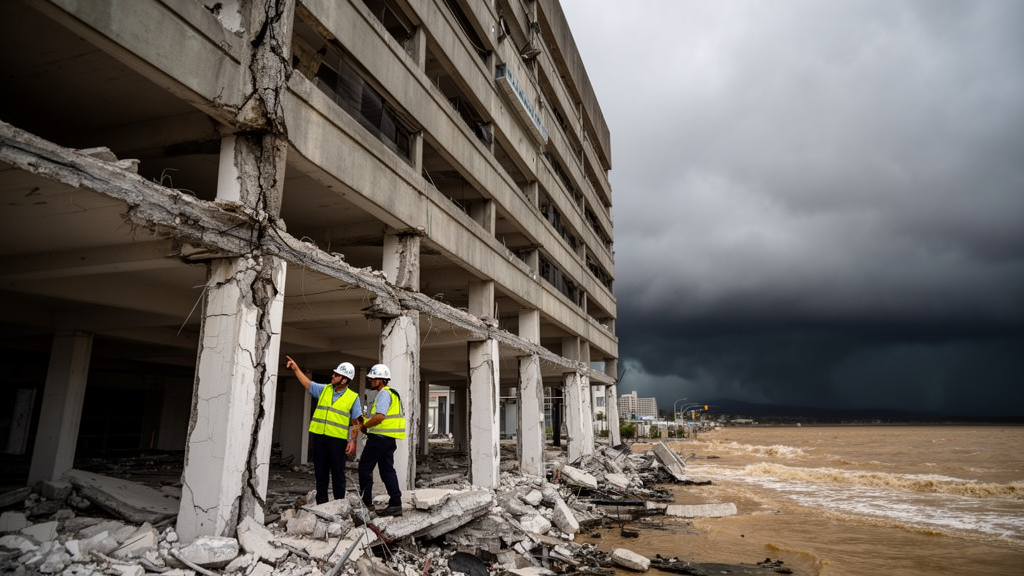
When Hurricane Maria tore across Puerto Rico in September 2017, it delivered a double blow: ferocious winds stripped roofs and shattered building envelopes while torrential rain and flooding soaked the weakened structures below. Two years later, before the island had fully recovered, a magnitude 6.4 earthquake struck the southern coast. A new study published in Natural Hazards and Earth System Sciences now offers a rigorous quantitative framework for understanding how such overlapping and sequential disasters compound each other’s damage, and its findings carry a stark warning for risk assessors everywhere: ignoring the damage left behind by one disaster can dramatically underestimate the losses caused by the next.
The research, led by Alessandro Borre of the University of Genoa and the CIMA Research Foundation, together with Silvia De Angeli of the Université de Lorraine and colleagues, addresses a long-standing gap in disaster science. Scientists have long recognised conceptually that hazards interact, but the literature has lacked standardised, reproducible methods for quantifying those interactions. Most existing quantitative models of multi-hazard physical damage are confined to seismic scenarios, such as earthquakes followed by aftershocks or tsunamis, and often focus on single infrastructure types like bridges. Recovery, meanwhile, is typically treated simplistically or ignored altogether, even though it determines how much vulnerability persists when the next hazard arrives.
The team’s methodology distinguishes between two fundamental impact dynamics. Concurrent impacts arise when two or more hazards overlap in space and time, as when Hurricane Maria’s winds and floods struck the same buildings simultaneously. Consecutive impacts occur when hazards strike close enough together that assets have not fully recovered before the second event begins. The researchers translated these dynamics, previously described only in qualitative diagrams and conceptual frameworks, into a compact piecewise mathematical formulation controlled by two classification parameters, which they implemented as modular, open-source Python code.
The mathematics is elegant in its economy. For concurrent hazards, damage is computed through a bivariate vulnerability function that takes the maximum intensity of each hazard as input, capturing the amplification that arises when multiple stressors act on the same asset at once. For consecutive hazards, the model tracks each asset’s physical integrity through discrete time steps. After the first event, a recovery function, which can be linear, exponential, logistic, or user-defined, gradually restores the asset’s condition. When the second hazard arrives, the model calculates the residual damage remaining at that moment and applies the second event’s damage only to the portion of the asset still undamaged, preventing double-counting. Crucially, the vulnerability function applied to the second event is state-dependent: it shifts to reflect the fact that a partially damaged building is more fragile than an intact one.
To probe the internal mechanics of this formulation, the team conducted a systematic model behaviour analysis, varying three parameters: the time interval between events, the shape of the recovery trajectory, and the degree of state-dependent vulnerability modification. The results show that cumulative damage is strongly path-dependent. When the second event strikes during early recovery, losses substantially exceed the sum of two independent events. As the interval between events grows, additional cumulative loss declines and converges toward independent behaviour, but the rate of convergence depends heavily on the recovery function. Exponential recovery, with rapid early restoration, limits amplification; logistic recovery, with delayed early restoration, prolongs vulnerability and sustains elevated losses across a much wider range of inter-event timings.
Perhaps the most striking insight from the behaviour analysis concerns the fragility profile itself. When the researchers shifted the second event’s vulnerability function upward by 10, 20, and 30 percent to represent increasing fragility from incomplete recovery, they observed convex, non-linear amplification of cumulative damage. Even a modest 10 percent shift produced measurable increases in additional loss, while 30 percent shifts substantially raised both median outcomes and the upper tail of the loss distribution. The amplification, in other words, does not arise merely from the magnitude of residual damage but from a structural reconfiguration of vulnerability between events. Consecutive multi-hazard interaction, the authors conclude, is not simply additive accumulation but a transformation of the system’s response function.
The framework’s real test came in Puerto Rico, an island that experienced an extraordinary concentration of disasters in a short window. Hurricane Maria alone caused nearly 90 billion US dollars in damage, and reconstruction progressed unevenly; by the end of 2019, significant portions of the building stock remained unrestored. A post-hurricane assessment identified nearly 138,000 buildings still damaged more than a year after the storm, many concentrated in coastal and southern municipalities such as Ponce and Guayanilla, precisely the regions that later experienced the strongest ground shaking, exceeding 0.5 g peak ground acceleration, during the January 2020 earthquake. The team modelled the hurricane phase using a compound wind-flood damage model built on standard FEMA Hazus vulnerability functions, and their simulated compound loss of approximately 90 billion dollars matched official assessments without any post-event parameter fitting.
For the seismic phase, the researchers applied their consecutive damage model, transforming standard FEMA fragility curves into state-dependent curves to reflect residual hurricane damage. Because building-level recovery data were unavailable, they explored a predefined range of vulnerability modifications from 5 to 30 percent, applied uniformly across the building portfolio. The results revealed a pattern with profound implications: when the earthquake was modelled as an independent single-hazard event, assuming full recovery of building vulnerability after Maria, the simulated loss came to 1,205,525 dollars in 2020 prices, underestimating the official figure of roughly 1.7 million dollars by about 29 percent. But when the fragility medians for both structural and non-structural components were shifted by 15 percent, the simulated total loss rose to 1,742,296 dollars, closely matching the official estimate. The 15 percent value falls within the predefined exploration range and represents one plausible residual vulnerability scenario rather than a calibrated constant, yet the improved agreement demonstrates the structural importance of incorporating incomplete recovery.
The authors are careful to delineate the framework’s boundaries. The methodology targets sudden-onset hazards such as hurricanes and earthquakes, excluding slow-onset processes like droughts and sea-level rise. It captures only direct physical damage, not the indirect socioeconomic consequences that proved so devastating in Puerto Rico, where prolonged power outages triggered health crises, migration, and economic decline. Recovery is approximated with simple functional forms and assumed uniform across structural and non-structural components, even though non-structural elements typically recover faster. The portfolio-based approach groups buildings into categories, smoothing over localised variations in topography, construction quality, and exposure. These limitations, the researchers argue, define the scope of validity rather than undermining the approach, and they chart clear paths for future work, including agent-based recovery modelling, dynamic exposure tracking, functionality-based indirect impact assessment, and integration with probabilistic hazard occurrence models for predictive applications.
The broader significance of the study extends well beyond Puerto Rico. By providing a transparent, reproducible analytical template, the framework enables forensic reconstruction of past multi-hazard events, systematic exploration of the drivers of cumulative damage, and scenario-based assessment of alternative hazard timings and recovery pathways. Planners could use it to ask what-if questions: how much would losses shrink if recovery accelerated by a year, or how much would they grow if the next earthquake arrived sooner? The Puerto Rico case also demonstrates that post-disaster analysis can feed back into vulnerability modelling, allowing state-dependent fragility functions to be derived from observed cumulative impacts. As climate change intensifies hurricanes and urbanisation concentrates exposure in hazard-prone regions, the assumption that disasters strike fully recovered, fully intact systems becomes increasingly untenable. This study provides the quantitative machinery to retire that assumption, and with it, a more honest accounting of what consecutive disasters really cost.
Subject of Research: Quantitative assessment of physical damage and recovery dynamics from concurrent and consecutive natural hazards
Article Title: A quantitative methodology for analysing physical damage and recovery dynamics from concurrent and consecutive hazards: forensic insights from Puerto Rico
Article References: Borre, A., Ottonelli, D., Trasforini, E., Ghizzoni, T., Rudari, R., Zoppi, G., Boni, G., & De Angeli, S. (2026). A quantitative methodology for analysing physical damage and recovery dynamics from concurrent and consecutive hazards: forensic insights from Puerto Rico. Natural Hazards and Earth System Sciences, 26(10), 4763-4783. https://doi.org/10.5194/nhess-26-4763-2026
Image Credits: AI Generated
DOI: 10.5194/nhess-26-4763-2026
Keywords: multi-hazard risk, Puerto Rico, Hurricane Maria, earthquake sequence, recovery dynamics, fragility curves, damage assessment, disaster forensics, vulnerability, compound events, risk modelling, Python
Cite Scienmag News
Violet Maxwell. (October 9, 2026). Forensic Model Reveals Hidden Damage When Disasters Strike in Sequence. Scienmag. https://scienmag.com/forensic-model-reveals-hidden-damage-when-disasters-strike-in-sequence/
Violet Maxwell. "Forensic Model Reveals Hidden Damage When Disasters Strike in Sequence." Scienmag, 9 October 2026, https://scienmag.com/forensic-model-reveals-hidden-damage-when-disasters-strike-in-sequence/. Accessed 9 October 2026.
Violet Maxwell. "Forensic Model Reveals Hidden Damage When Disasters Strike in Sequence." Scienmag. October 9, 2026. https://scienmag.com/forensic-model-reveals-hidden-damage-when-disasters-strike-in-sequence/


