


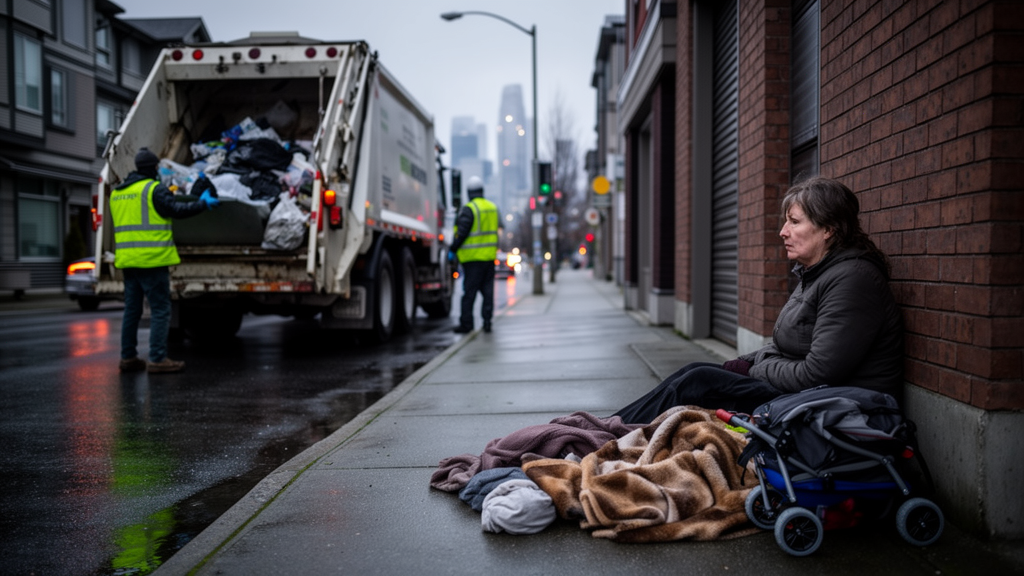
For cities across North America, the response to visibly growing homelessness has increasingly taken a hard edge: municipal crews arriving at tent encampments, clearing them out, and confiscating whatever personal belongings people cannot carry away. The practice, often described as an encampment sweep, is frequently justified as a matter of public order, safety, or sanitation. But a new prospective cohort study from Vancouver, Canada, suggests that these operations may do precisely the opposite of what their proponents intend. Rather than accelerating people’s exit from homelessness, the forced loss of possessions and displacement from public spaces appears to dramatically reduce the likelihood that an unhoused person will transition into housing at all.
The study, published in PLOS Medicine by a research team led by Kanna Hayashi of Simon Fraser University and colleagues including Thomas Kerr, drew on two harmonized prospective cohort studies of people who use drugs in Vancouver. Participants were followed through semi-annual interviews between December 1, 2021 and May 31, 2025, a window that captured a period of intense municipal enforcement activity in the city. The researchers focused on a specific and measurable question: among people who were homeless at a given study visit, did those who reported that municipal authorities had confiscated their belongings become less likely to report that they were no longer homeless six months later?
The analytical approach was deliberately rigorous. Because people who experience sweeps differ systematically from those who do not—in drug use patterns, health status, and exposure to other social and structural risks—the researchers used proportional hazard marginal structural modeling, a statistical framework designed to handle time-varying confounders that are themselves affected by prior exposure. This method allowed the team to adjust for a wide range of shifting factors, including demographic characteristics, evolving drug use patterns, health conditions, and other social and structural exposures, thereby isolating the association between enforcement actions and housing transitions more credibly than a naive comparison would permit.
The numbers themselves tell a striking story. Among 235 participants who were unhoused at baseline, 59, or 25.1 percent, reported that authorities had confiscated their belongings. Over the course of follow-up, 128 participants, or 54.5 percent, stopped reporting homelessness, corresponding to an incidence rate of 55.6 cases per 100 person-years, with a 95 percent confidence interval of 46.4 to 66.1. In other words, in this cohort, roughly half of unhoused people who use drugs did manage to exit homelessness within the observation period—making the divergence between those who experienced sweeps and those who did not all the more consequential.
When the statistical models were applied, the association was unambiguous. Experiencing confiscation of belongings was negatively associated with transitioning out of homelessness, with an adjusted hazard ratio of 0.35 and a 95 percent confidence interval of 0.13 to 0.94, a result that reached statistical significance at p equals 0.036. In practical terms, people whose possessions were seized by municipal authorities were about two-thirds less likely to stop being homeless during follow-up than comparable people who did not report such confiscation, after accounting for the full battery of time-varying confounders.
The researchers also conducted a secondary analysis that broadened the exposure beyond confiscation. Between June 1, 2023 and May 31, 2025, they examined municipal government-enforced forced displacement, which may or may not have involved the seizure of belongings. Among 154 participants in this analysis, 50, or 32.5 percent, reported forced displacement at baseline, and 62, or 40.3 percent, stopped reporting homelessness during follow-up. The association here was even stronger: forced displacement carried an adjusted hazard ratio of 0.07, with a 95 percent confidence interval of 0.02 to 0.20 and a p value below 0.001. People who were forcibly displaced were, in this model, more than ninety percent less likely to exit homelessness during the follow-up period than those who were not.
The mechanism behind such a powerful association is not difficult to reconstruct, and the study’s authors point to the ways in which sweeps can undermine the fragile pathways that lead from the street to housing. Identification documents, medications, contact information for housing workers, shelter referrals, and the basic equipment of daily survival are all routinely lost when belongings are confiscated. Each lost item can stall a housing application, sever a connection to a case manager, or force a person back into survival mode that consumes the time and energy needed to navigate bureaucratic systems. Displacement also disrupts the geographic stability that outreach workers rely on to find and support clients, meaning that the very services designed to end homelessness may lose contact with the people they are meant to help.
The findings arrive amid a broader North American trend in which encampment clearings have intensified, often accompanied by legal battles over the rights of unhoused people and by public debate over whether enforcement or services should dominate municipal responses. Prior research has already documented a range of health-related harms associated with sweeps, including increased overdose risk, loss of harm reduction supplies, and deterioration in physical and mental health. What this study adds is a direct estimate of the impact on the central outcome that housing policy ostensibly pursues: whether people actually stop being homeless. The answer, in this Vancouver cohort, is that enforcement appears to push that outcome further away.
The authors are careful to acknowledge the limitations inherent in observational research. The study design cannot establish causation with the certainty of a randomized trial, and the researchers note that the rates of transitioning from homelessness may have been overestimated in their sample. Residual confounding remains possible despite the sophistication of the marginal structural models, and the cohort’s focus on people who use drugs means the findings may not generalize to all unhoused populations. Still, the consistency and magnitude of the associations, particularly for forced displacement, are difficult to dismiss as statistical noise, and the prospective design with repeated interviews substantially strengthens the evidence relative to cross-sectional studies.
The policy implications are pointed. The authors conclude that the confiscation of personal belongings and forced displacement might undermine pathways to housing, and they call for approaches that prioritize access to dignified and affordable housing rather than practices that perpetuate homelessness. They also flag an important direction for future research: assessing the quality of the housing that unhoused people are eventually placed in, and examining how that quality relates to returns to homelessness. As cities continue to grapple with visible encampments and mounting political pressure, this study offers a quantitative warning that the broom may be a more powerful obstacle to housing than the tent itself.
Subject of Research: The relationship between municipal encampment sweeps and persistent homelessness among unhoused people who use drugs in Vancouver
Article Title: Encampment sweeps and persistent homelessness among unhoused people who use drugs in Vancouver, Canada: A prospective cohort study
Article References: Hayashi, K., Sayre, E. C., McDermid, J., Marsh, S., Shane, C., Milloy, M.-J. S., P.O.W.E.R., & Kerr, T. (2026). Encampment sweeps and persistent homelessness among unhoused people who use drugs in Vancouver, Canada: A prospective cohort study. PLOS Medicine, 23(9), e1005033. https://doi.org/10.1371/journal.pmed.1005033
Image Credits: AI Generated
DOI: 10.1371/journal.pmed.1005033
Keywords: homelessness, encampment sweeps, forced displacement, housing policy, Vancouver, people who use drugs, prospective cohort study, marginal structural modeling, public health, PLOS Medicine, harm reduction, social determinants of health
Cite Scienmag News
Phoebe Ingram. (October 9, 2026). City Sweeps That Seize Belongings May Trap People in Homelessness, Vancouver Study Finds. Scienmag. https://scienmag.com/city-sweeps-that-seize-belongings-may-trap-people-in-homelessness-vancouver-study-finds/
Phoebe Ingram. "City Sweeps That Seize Belongings May Trap People in Homelessness, Vancouver Study Finds." Scienmag, 9 October 2026, https://scienmag.com/city-sweeps-that-seize-belongings-may-trap-people-in-homelessness-vancouver-study-finds/. Accessed 9 October 2026.
Phoebe Ingram. "City Sweeps That Seize Belongings May Trap People in Homelessness, Vancouver Study Finds." Scienmag. October 9, 2026. https://scienmag.com/city-sweeps-that-seize-belongings-may-trap-people-in-homelessness-vancouver-study-finds/


