


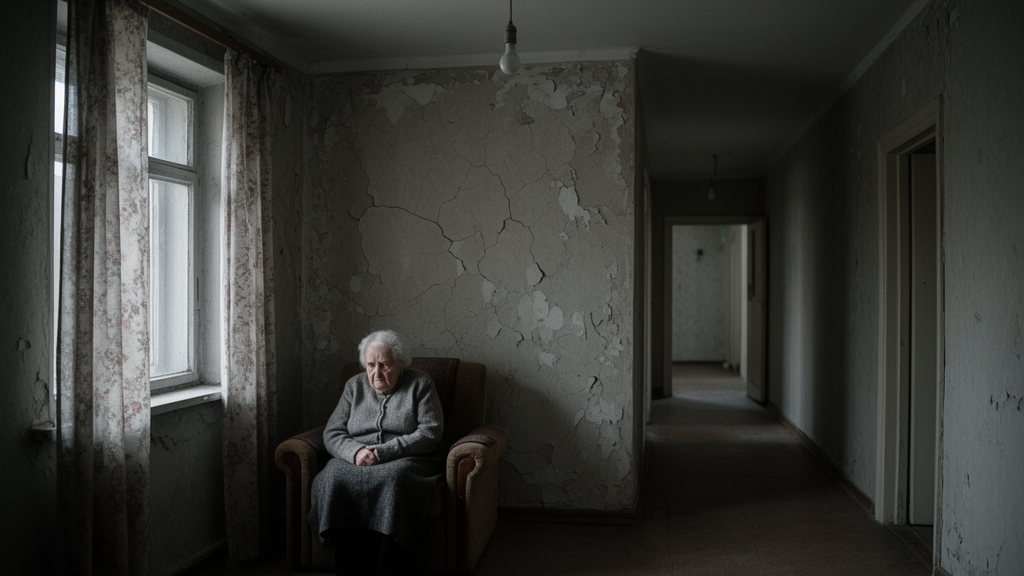
For millions of older people who live alone, the home is not merely a shelter but the center of nearly every waking hour. When that home is damp, poorly heated, structurally unsound, or otherwise deficient, the psychological cost can be severe. A new study published in BMC Psychology adds a crucial twist to this picture: the damage done by substandard housing to mental health depends heavily on two moderating forces—the strength of a person’s social connections and whether they live in an urban or rural setting. Drawing on nationally representative data from South Korea, researcher Sok An of Daegu University found that social capital can substantially buffer the depressive impact of housing deprivation, while rural residence amplifies it, creating what the study describes as a form of double jeopardy for isolated elders in the countryside.
The research analyzed information from 1,557 older adults aged 65 and above who were living alone in single-person households, using the 16th wave (2021) of the Korean Welfare Panel Study, a longitudinal survey conducted by the Korea Institute for Health and Social Affairs and Seoul National University since 2006. The sample, with an average age of 78.5 years, was overwhelmingly female at 82.72 percent, and education levels were low, with 72 percent of participants having completed less than a middle school education. Roughly 69 percent of participants lived in urban areas while about 31 percent resided in rural regions, and more than half rated their own health as poor.
Depressive symptoms were measured with the 11-item Center for Epidemiological Studies-Depression scale, a validated instrument covering depressed mood, positive affect, somatic complaints, and interpersonal difficulties, rated on a four-point scale. The average depression score in the sample was 18.24, with a possible range from 11 to 44. Housing deprivation was assessed against Korea’s minimum housing standards, which cover five dimensions: structural integrity, insulation and ventilation, limits on noise and pollution, location outside disaster-prone zones, and safe electrical and fire-evacuation systems. Each deficiency reported by a respondent contributed to a latent housing deprivation score, with the average participant showing a score of 0.49 on a scale from 0 to 4.
Social capital, the study’s key protective variable, was operationalized as a latent construct built from four indicators spanning both cognitive and structural dimensions: general trust in other people, willingness to help in emergencies, satisfaction with social relationships, and participation in volunteer activities. This dual conceptualization follows a well-established framework in health psychology that distinguishes the direct benefits of social networks from their stress-buffering function. According to the stress-buffering model, cognitive social capital—subjective trust and perceived support—acts as the primary psychological mechanism shielding individuals from environmental and physical stressors, while structural capital provides the network pathways through which support flows.
To test how these variables interact, the study employed structural equation modeling with latent moderated structural equations, a technique that allows researchers to estimate interaction effects between variables that are themselves measured with error. Rather than treating housing deprivation or social capital as simple summed scores, the approach models each as a latent construct indicated by multiple items, explicitly separating true variance from measurement noise. Confirmatory factor analyses supported the measurement structure of all three latent variables, with composite reliability values of 0.90 for housing deprivation, 0.883 for depressive symptoms, and 0.62 for social capital, the latter deemed sufficient given that the method controls for measurement error in the structural estimates.
The results were striking in their pattern of moderation. In the main effects model, housing deprivation was positively associated with depressive symptoms (β = 0.26), while social capital showed a strong negative association (β = -0.37). But the interaction terms told the more consequential story. The latent interaction between social capital and housing deprivation was significant and negative (β = -0.23), meaning that the depressive effect of poor housing weakened as social capital increased. The interaction between rural residence and housing deprivation was also significant (β = 0.09), indicating that the same degree of housing deficiency produced worse mental health outcomes in rural settings than in urban ones. A likelihood ratio test confirmed that the interaction model fit the data significantly better than the main effects model alone.
The visualized interaction plots made these dynamics concrete. For individuals with low social capital, depression levels climbed steadily as housing deprivation worsened. For those with high social capital, depression levels remained essentially stable regardless of housing quality—a flat line where an upward slope would be expected. In the urban-rural comparison, both groups showed increasing depression with worsening housing, but the rural curve sat consistently higher, and the gap between urban and rural predictions widened as housing quality deteriorated. In other words, the mental health penalty of a leaking roof or a broken heating system is not distributed equally across geography; it falls disproportionately on those with the fewest neighbors, services, and institutions to fall back on.
The mechanism behind the rural disparity likely involves compounding vulnerabilities. Rural built environments often lack the infrastructure that supports well-being, including safe roads, walkable neighborhoods, and accessible community resources. Barriers to healthcare and mental health services are exacerbated by transportation gaps and physical distance from providers, and opportunities for social participation are correspondingly restricted. Urban older adults facing the same housing deficiencies, by contrast, benefit from a higher density of community resources, closer proximity to social services, and localized support networks that can partially absorb the psychological shock of inadequate living conditions. The study’s bivariate correlations hinted at this complexity: depression correlated moderately and negatively with social capital (r = -0.36) but only weakly with housing deprivation (r = 0.03) and rural residence (r = 0.02) in isolation, underscoring that the key effects emerge through interaction rather than simple direct association.
Among the control variables, self-rated health and income both retained significant associations with depression, with better self-rated health and higher income predicting fewer depressive symptoms, while age, sex, and education showed no significant effects. The author is careful to note the study’s limitations: the cross-sectional design precludes causal inference, self-reported measures may carry reporting bias, and unmeasured factors such as personality traits and coping mechanisms could influence the outcomes. Regional heterogeneity within the broad rural and urban categories was also not examined, leaving open questions about which specific environmental features—transportation infrastructure, walkability, facility accessibility, or ambient conditions—drive the observed disparities.
The policy implications are nonetheless pointed. The findings argue against uniform, nationwide approaches and in favor of geographically targeted interventions: housing rehabilitation programs concentrated in rural areas, paired with community-based initiatives designed to build social capital where it is scarcest. Strengthening trust, mutual aid, and volunteer participation may serve as a comparatively cost-effective complement to expensive physical renovations, offering a buffer that no insulation retrofit alone can provide. As populations across East Asia and beyond continue to age and the share of elders living alone grows, the study suggests that mental health in later life is forged at the intersection of walls and relationships—and that societies ignore either side of that equation at their peril.
Subject of Research: The relationship between housing deprivation and depression among older adults living alone, moderated by social capital and urban–rural residence
Article Title: Housing deprivation and depression in older adults living alone: the moderating roles of social capital and urban–rural region
Article References: An, S. (2026). Housing deprivation and depression in older adults living alone: the moderating roles of social capital and urban–rural region. BMC Psychology, 14(1), Article 1457. https://doi.org/10.1186/s40359-026-05317-4
Image Credits: AI Generated
DOI: 10.1186/s40359-026-05317-4
Keywords: housing deprivation, depression, older adults, social capital, rural health, urban health, mental health, structural equation modeling, Korean Welfare Panel Study, living alone, stress-buffering, aging
Cite Scienmag News
Glenn Wilkins. (October 9, 2026). Poor Housing Hits Hardest When Community Ties Are Weak, Study of Older Adults Finds. Scienmag. https://scienmag.com/poor-housing-hits-hardest-when-community-ties-are-weak-study-of-older-adults-finds/
Glenn Wilkins. "Poor Housing Hits Hardest When Community Ties Are Weak, Study of Older Adults Finds." Scienmag, 9 October 2026, https://scienmag.com/poor-housing-hits-hardest-when-community-ties-are-weak-study-of-older-adults-finds/. Accessed 9 October 2026.
Glenn Wilkins. "Poor Housing Hits Hardest When Community Ties Are Weak, Study of Older Adults Finds." Scienmag. October 9, 2026. https://scienmag.com/poor-housing-hits-hardest-when-community-ties-are-weak-study-of-older-adults-finds/


