


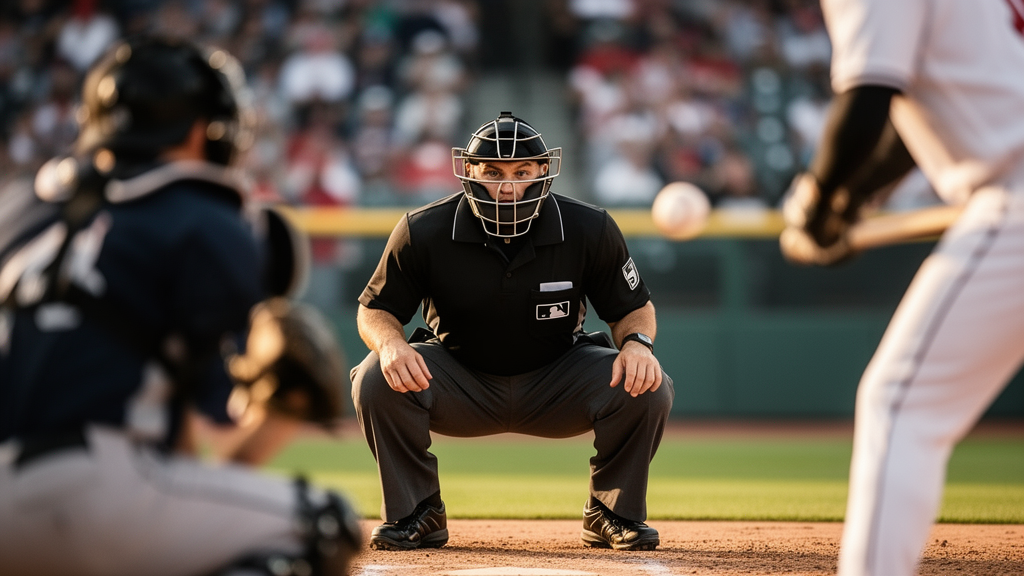
Every baseball fan knows the feeling: a pitch that looked like a strike in a 3-0 count somehow becomes a ball when the umpire has already called two strikes. For decades, this count-dependent drift in the effective strike zone has been treated as a quirk of human judgment, a soft spot in the performance of highly trained professionals. A new study published in Communications Psychology argues that something far more profound is happening behind home plate. Drawing on nearly half a million called pitches from ten seasons of Major League Baseball, researchers Mitsuto Tomomura and Masahiro Shinya of Hiroshima University show that the umpire’s shifting strike zone bears the mathematical fingerprints of Bayesian sensory integration, one of the most influential ideas in modern cognitive neuroscience.
Bayesian sensory integration describes how the brain combines two sources of information when making a decision about the world: the noisy evidence arriving through the senses, and prior expectations built from experience. The key insight is that neither source should be trusted equally. Instead, the brain is thought to weight each source in proportion to its reliability. When sensory evidence is sharp and unambiguous, it dominates the decision. When sensory evidence is degraded, by darkness, distance, motion, or sheer speed, prior expectations are pulled more heavily into the computation, biasing perception toward what is statistically likely. This framework has been validated extensively in laboratory psychophysics, where volunteers judge dots, tones, and flashes under carefully controlled noise. What has remained largely untested is whether the same computational principle governs expert decision-making in the wild, where the stakes are real and the conditions are anything but controlled.
Major League Baseball turned out to be an almost perfect natural laboratory for answering that question. The researchers assembled a dataset of 451,172 called pitches spanning the 2015 to 2024 seasons, each one a binary judgment, strike or ball, made by a professional umpire in a fraction of a second. A fastball arriving at ninety-five miles per hour gives the umpire roughly 400 milliseconds to locate the ball in three-dimensional space and compare its crossing point against an invisible five-sided zone. The sensory task is genuinely difficult, the perceptual noise is real, and critically, the game itself provides a rich structure of prior expectations: the count, the sequence of balls and strikes, changes what pitches are statistically likely to arrive and where they are likely to cross the plate.
The first analytical step was to confirm that the count bias, long discussed anecdotally and in sabermetric circles, is a systematic and measurable phenomenon. The researchers fitted psychometric functions to the umpires’ calls at four boundaries of the strike zone, high, low, inside, and outside, separately for each of the twelve possible ball-count combinations. From these fits they extracted the Point of Subjective Equality, or PSE, the pitch location at which an umpire is equally likely to call the pitch a strike or a ball. The PSE is effectively the perceptual boundary of the strike zone, and its movement across counts quantifies exactly how the zone expands and contracts. The analysis confirmed that the boundary shifts reliably with the count, producing the familiar pattern in which the zone appears to grow when the pitcher is behind and shrink when the batter is behind in the count.
With the bias established, the team turned to the central question of mechanism. They built a Bayesian model in which the umpire’s brain treats count-specific distributions of pitch locations as prior knowledge. In this framework, the umpire does not judge each pitch in isolation. Instead, the perceptual estimate of where the ball crossed the plate is combined with an internal expectation, learned over years of experience, about where pitches tend to cross in that particular count. When the model, fitted directly to individual binary calls, was compared against a baseline model that had no access to count information, the Bayesian version reproduced the observed PSE shifts and outperformed the baseline at three of the four zone boundaries. The agreement was strongest at the high and outer boundaries, where the count-specific priors appear to exert their greatest influence on the perceptual decision.
Perhaps the most striking result came from analyzing the umpires individually rather than as a group. Bayesian theory makes a counterintuitive but testable prediction: the influence of prior expectations should scale with perceptual uncertainty. An observer whose sensory evidence is noisy and unreliable should lean harder on priors; an observer with crisp perception should need them less. When the researchers examined 89 individual umpires, they found exactly this relationship. Umpires with higher perceptual uncertainty, inferred from the steepness of their psychometric functions, relied more strongly on count-specific priors, both at neutral counts and in the overall magnitude of their count-dependent bias. This is precisely the signature that Bayesian integration would produce, and it is difficult to explain through simpler accounts such as fatigue, favoritism, or inattention.
The implications of this reframing are considerable. If the count bias is a byproduct of rational inference rather than a lapse in competence, then the long-standing debate over umpire accuracy takes on a new character. The bias is not random noise corrupting an otherwise perfect perceptual machine; it is the expected behavior of a system optimally trading off unreliable evidence against structured expectation. In this view, the umpire who calls a borderline pitch differently at 3-0 than at 0-2 is not making an error in any straightforward sense. He is doing what the visual system does in every domain, from judging the slant of a hill to recognizing a face in fog: exploiting every scrap of statistical regularity the environment offers to squeeze the most reliable estimate possible out of noisy data.
The study also speaks to a broader ambition in cognitive neuroscience: carrying laboratory-validated principles out into ecologically demanding, real-world settings. Demonstrations of Bayesian integration typically involve artificial tasks with experimentally imposed priors, leaving open the question of whether brains actually deploy these computations when the priors must be learned from years of natural experience and the decisions carry professional consequences. Expert baseball umpires, with their thousands of hours of training and their exposure to millions of pitches, offer a rare case where the priors are plausibly well learned, the sensory uncertainty is measurable, and the behavioral record is enormous. The convergence between the model’s predictions and the observed calls suggests that the same neural arithmetic documented with dots and tones operates in the most pressured judgment calls in professional sport.
The work arrives at a moment when baseball itself is wrestling with the automation of this very judgment. Electronic ball-strike systems, already tested in professional leagues, promise a zone that never drifts with the count. The new findings do not settle whether such systems should replace human umpires, but they sharpen the terms of the debate. A perfectly consistent zone would eliminate the count bias, but it would also eliminate a behavior that, on this evidence, reflects an optimally functioning perceptual system rather than a defective one. Whether leagues prioritize mechanical consistency or the human capacity for rational inference under uncertainty is now a policy question informed by computational neuroscience, not merely a matter of tradition.
For the researchers, the takeaway is a matter of scientific principle as much as sporting interest. A fundamental law of neural computation, weighting evidence by reliability, appears to govern expert human decision-making in one of the most ecologically demanding contexts that can be studied at scale. The count bias that fans have cursed for generations turns out to be a window into the Bayesian brain, visible in every called strike, reframed not as umpire error but as the rational use of prior information under perceptual uncertainty.
Subject of Research: Bayesian sensory integration and count-dependent bias in Major League Baseball umpire pitch calls
Article Title: Bayesian sensory integration explains ball-count bias in Major League Baseball umpires
Article References: Tomomura, M., & Shinya, M. (2026). Bayesian sensory integration explains ball-count bias in Major League Baseball umpires. Communications Psychology. https://doi.org/10.1038/s44271-026-00534-4
Image Credits: AI Generated
DOI: 10.1038/s44271-026-00534-4
Keywords: Bayesian inference, sensory integration, umpires, baseball, strike zone, perceptual uncertainty, psychophysics, decision-making, prior expectations, cognitive neuroscience, sports science, Communications Psychology
Cite Scienmag News
Glenn Wilkins. (October 9, 2026). Umpires Are Bayesian Brains: Count Bias in Baseball Calls Reveals Rational Perception. Scienmag. https://scienmag.com/umpires-are-bayesian-brains-count-bias-in-baseball-calls-reveals-rational-perception/
Glenn Wilkins. "Umpires Are Bayesian Brains: Count Bias in Baseball Calls Reveals Rational Perception." Scienmag, 9 October 2026, https://scienmag.com/umpires-are-bayesian-brains-count-bias-in-baseball-calls-reveals-rational-perception/. Accessed 9 October 2026.
Glenn Wilkins. "Umpires Are Bayesian Brains: Count Bias in Baseball Calls Reveals Rational Perception." Scienmag. October 9, 2026. https://scienmag.com/umpires-are-bayesian-brains-count-bias-in-baseball-calls-reveals-rational-perception/


