


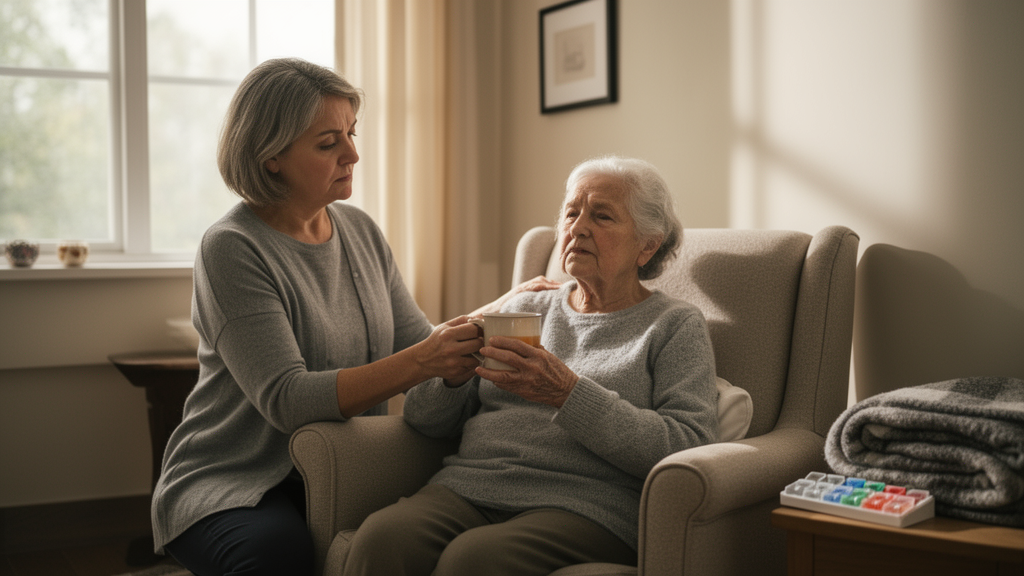
Family caregivers of people living with dementia carry one of the most demanding and least visible jobs in modern healthcare, and a research team in China has now built a rigorous new instrument to measure a burden that existing tools have largely missed. In a study published in BMC Nursing, Haiyan Ren, Shuo Wang and colleagues at Xuzhou Medical University report the development and validation of a Role Dilemma Scale designed specifically for family members caring for relatives with dementia at home. Unlike conventional questionnaires that concentrate narrowly on caregiver burden, the new scale targets the deeper psychological strain that arises when a person is forced to juggle incompatible roles, from spouse and child to nurse, financial provider and employee, often simultaneously and without formal training.
The theoretical foundation of the work is Role Stress Theory, a framework from social psychology that describes how individuals experience strain when the expectations attached to their social roles become unclear, excessive or mutually contradictory. Applied to dementia care, the theory predicts that caregivers will face distinct forms of role stress: uncertainty about what their role actually requires, a sense of lacking the skills the role demands, collisions between caregiving and other life roles, an overwhelming volume of caregiving tasks, and a rigid inability to step away from the role even temporarily. The researchers set out to determine whether these five theoretical strands could be reliably measured in real caregivers, and whether doing so would add clinical value beyond existing burden scales.
Building the instrument followed the classical multi-stage approach to scale development. The team first generated a pool of candidate items from a systematic review of the literature and from semi-structured interviews with 21 family caregivers of people living with dementia, allowing the lived experience of caregivers themselves to shape the wording and content of the questions. The draft items were then refined through two rounds of Delphi consultation, a structured consensus technique in which a panel of eight experts independently rates and comments on each item, with the group’s feedback used to revise, merge or discard questions between rounds. A pre-test with 30 family caregivers checked that the items were comprehensible and acceptable before the formal psychometric evaluation began.
For the main validation study, 354 family caregivers completed the survey. The sample was randomly split into two subsamples of roughly 40 and 60 percent, a standard strategy in psychometrics that allows different statistical procedures to be run on independent data. The smaller subsample was used for item analysis and exploratory factor analysis, a data-driven technique that identifies how items cluster together into underlying dimensions. The larger subsample was reserved for confirmatory factor analysis, which tests whether the structure suggested by the first half of the data holds up in data it has never seen. This two-sample design guards against the common pitfall of building and validating a scale on the same participants, which can inflate apparent performance.
The analyses converged on a final 23-item scale organized into five dimensions: Role Ambiguity, Role Incapacity, Role Conflict, Role Overload and Role Rigidity. Each dimension maps directly onto a component of Role Stress Theory, giving the instrument a strong conceptual backbone. The five factors together explained 67.92 percent of the total variance in responses, a substantial proportion indicating that the five dimensions capture most of the meaningful variation in how caregivers experience role dilemmas. Content validity was equally strong, with a scale-level content validity index using universal agreement of 0.957, meaning that nearly every item was judged relevant by every expert rater.
Confirmatory factor analysis on the larger subsample demonstrated a good model fit across the conventional benchmarks used in structural equation modeling. The ratio of chi-square to degrees of freedom was 1.296, comfortably below the threshold of 3 that typically signals acceptable fit. The root mean square error of approximation, which quantifies how closely the proposed model reproduces the observed covariance structure, was 0.038, well under the 0.05 cutoff for close fit. The comparative fit index reached 0.971, approaching the ideal value of 1.0. Taken together, these statistics indicate that the five-factor structure of the scale is statistically sound and not an artifact of the exploratory phase.
Reliability testing showed similarly robust results. Across the full formal survey sample, the total scale achieved a Cronbach’s alpha of 0.892, indicating excellent internal consistency, while the five individual dimensions ranged from 0.830 to 0.895, all within the range generally considered good to excellent for a multi-item scale. To assess stability over time, 30 participants completed the scale a second time after 14 days, allowing the researchers to estimate test-retest reliability. Consistent responses across a two-week interval suggest that the instrument measures a relatively stable characteristic of the caregiving situation rather than transient mood or momentary stress.
The clinical significance of the new tool lies in what it can detect that burden scales cannot. Persistent role dilemmas have been linked in the broader literature to impaired physical and mental health in both caregivers and the people they care for, yet most existing instruments were designed for generic caregiving populations or focus almost exclusively on the volume of tasks performed. By distinguishing ambiguity from incapacity, conflict from overload, and both from rigidity, the scale gives clinicians and researchers a differentiated profile of where a particular caregiver is struggling. That granularity matters because the appropriate intervention differs by dimension: education and clear guidance for ambiguity, skills training for incapacity, respite and family negotiation for conflict and overload, and permission to step back for rigidity.
The authors argue that the validated scale enables healthcare professionals to systematically identify multifaceted role dilemmas among dementia family caregivers and to design targeted, individualized support rather than one-size-fits-all programs. In health systems where home-based care remains the backbone of dementia support, and where formal services are often scarce or expensive, protecting the wellbeing of family caregivers is a matter of system stability as much as individual compassion. A brief, psychometrically validated instrument that can be administered in routine nursing practice offers a practical route to screening, monitoring and evaluating interventions at scale.
The study also carries methodological weight for the field of caregiver research. Its transparent sequence of item generation, expert consensus, pre-testing, split-sample factor analysis and reliability assessment follows the highest current standards for instrument development, and its grounding in an explicit theory makes the resulting dimensions interpretable rather than merely statistical. As populations age worldwide and the number of people living with dementia continues to climb, tools of this kind will become increasingly essential for quantifying an invisible workforce. The researchers caution that further use in diverse settings will help establish the scale’s generalizability, but the initial evidence suggests that the quiet, contradictory roles that family caregivers are forced to occupy can now be measured with the precision they deserve.
Subject of Research: Development and psychometric validation of a role dilemma scale for family caregivers of people living with dementia
Article Title: Development and validation of the role dilemma scale for family caregivers of people living with dementia
Article References: Ren, H., Luo, Z., Zhang, W., Liu, X., Wang, Q., Zhou, F., & Wang, S. (2026). Development and validation of the role dilemma scale for family caregivers of people living with dementia. BMC Nursing. https://doi.org/10.1186/s12912-026-05419-9
Image Credits: AI Generated
DOI: 10.1186/s12912-026-05419-9
Keywords: dementia, family caregivers, role dilemma, scale development, psychometrics, Role Stress Theory, confirmatory factor analysis, reliability, validity, caregiver burden, nursing research, home-based care
Cite Scienmag News
Cassandra Pierce. (October 9, 2026). New Scale Captures the Hidden Role Dilemmas of Dementia Family Caregivers. Scienmag. https://scienmag.com/new-scale-captures-the-hidden-role-dilemmas-of-dementia-family-caregivers/
Cassandra Pierce. "New Scale Captures the Hidden Role Dilemmas of Dementia Family Caregivers." Scienmag, 9 October 2026, https://scienmag.com/new-scale-captures-the-hidden-role-dilemmas-of-dementia-family-caregivers/. Accessed 9 October 2026.
Cassandra Pierce. "New Scale Captures the Hidden Role Dilemmas of Dementia Family Caregivers." Scienmag. October 9, 2026. https://scienmag.com/new-scale-captures-the-hidden-role-dilemmas-of-dementia-family-caregivers/


