


Houston played host in late September to the 2026 Geothermal Rising Conference, the flagship annual gathering of the geothermal industry, and few companies attracted as much attention there as Quaise Energy, the Massachusetts-based startup chasing what it believes will be the world’s first commercial superhot geothermal power plant. The company left the conference with three pieces of news that together signal how quickly superhot geothermal is moving from a speculative concept toward an engineering reality: a federal award of up to $25 million from the U.S. Department of Energy, a detailed technical presentation on the company’s progress at its Oregon project site, and major industry awards for two of its employees.
The Department of Energy announcement placed Quaise among five entities selected to share in a broader package of roughly $99 million spread across 21 projects intended to advance geothermal energy in the United States. For Quaise, the up-to-$25 million award will support its work on Project Obsidian, the company’s flagship effort now under construction in Oregon, which is designed to prove that rock heated to hundreds of degrees Celsius can be tapped at depth and converted into firm, zero-carbon electricity. The federal backing arrives only a month after the company announced the close of a $180 million Series B financing round led by Nabors Industries and Prelude Ventures, with participation from JERA Co., Inc. and Idemitsu Kosan, giving the young company an unusually deep war chest for a technology that remains at the demonstration stage.
The appeal of superhot geothermal is easy to state in a single number. According to a 2025 report from the Clean Air Task Force, if superhot rock resources are successfully developed, they could supply 63 terawatts of firm, carbon-free power by tapping just one percent of the world’s superhot rock resources, a figure more than eight times current global electricity generation. Unlike solar and wind, geothermal plants run around the clock, offering the kind of always-on output that grid operators usually reserve for nuclear or fossil generation. The obstacle has always been access: rock hot enough to drive superhot turbines, generally above about 375 degrees Celsius at which water becomes supercritical, exists almost everywhere on Earth, but only at depths of roughly four to twelve miles beneath the surface, far beyond the reach of conventional drilling.
Conventional rotary drills, the workhorses of the oil and gas industry, were simply never engineered for the temperatures and pressures found at those depths. Drill bits wear out rapidly, the cost of drilling rises exponentially with depth, and no existing mechanical technology can economically reach the superhot zone. Quaise’s answer is a fundamentally different approach to boring through the Earth: millimeter wave energy, close cousins of the microwaves used in household ovens, beamed down the wellbore to melt and vaporize rock rather than grind through it. The technique, developed out of research at MIT, is intended to work in a hybrid scheme in which conventional drilling handles the softer sediments near the surface, where it is already optimized, and millimeter waves take over in the hard basement rock below.
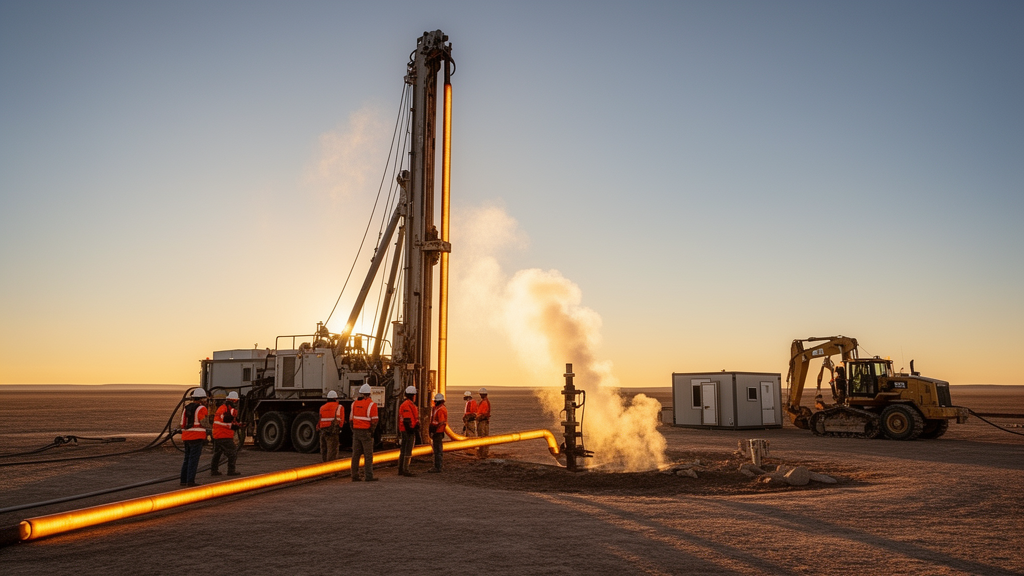
Project Obsidian, however, is deliberately designed to minimize risk before that hybrid drilling is ever deployed. The site in Oregon is what Quaise calls a Tier I location, where superhot temperatures can be reached at only about three miles deep, shallow enough to be accessed with conventional drilling tools. As Dr. Trenton Cladouhos, Vice President of Geothermal Resource Development at Quaise, told attendees at the conference, the pace of work has been rapid. Beginning in early 2025 the company leased the land, filed the necessary permits, began surface construction, and assembled its team, and this July it began drilling its first confirmation well. Cladouhos presented a paper on Project Obsidian at the conference, which ran from September 20 to 23 in Houston.
That first well will reach a depth of about 15,000 feet, nearly three miles, into rock as hot as 750 degrees Fahrenheit, or roughly 400 degrees Celsius. Its purpose is confirmatory rather than productive: it will verify key variables such as bottom-hole temperature and the geomechanical and physical properties of the superhot rock, and it will be fitted with sensors to monitor surrounding conditions. Critically, it will also test a set of high-temperature technologies that have never before been integrated into a single well, a necessary step in proving that the downhole hardware needed to harness superhot heat can survive the environment in which it must operate.
Quaise is not relying on field data alone. The company is funding concurrent laboratory work at Oregon State University, where the Experimental Deep Geothermal Energy lab, known as EDGE and established last year, recreates underground conditions in controlled experiments. Led by Dr. Brian Tattitch, Assistant Professor and Barrow Family Chair in Mineral Resource Geology, the lab can operate at up to 932 degrees Fahrenheit and 500 atmospheres of pressure, and it recently completed successful flow tests of water through rock at superhot temperatures and pressures. Understanding how injected water interacts with superhot rock, how heat is transferred, and how the rock responds mechanically is essential to designing the reservoirs that future plants will depend on, and data from the lab will complement what the Oregon wells reveal in the field.
The confirmation well is the first of seven planned for Phase One of Project Obsidian, a phase expected to deliver more than 50 megawatts of electric power to the grid by 2030. The remaining six wells will form two separate geothermal systems of three wells each. One will target rock reaching temperatures as high as 689 degrees Fahrenheit, or 365 degrees Celsius, with an average of 315 degrees Celsius, sitting at the very edge of what today’s technology can achieve and therefore carrying lower technical risk. The other will target rock as hot as 779 degrees Fahrenheit, or 415 degrees Celsius, averaging 365 degrees Celsius. In each system, water will be pumped down a central injection well into the hot rock, and two production wells on either side will capture the heated water and carry it to the surface and a waiting power plant. As Cladouhos explained, lessons from the first, lower-temperature system, combined with the OSU laboratory testing, are expected to reduce the technology risk for the hotter system that follows.
The land-use mathematics of the project underscore one of geothermal’s quiet advantages. The seven wells will occupy a surface footprint of just 20 acres while reaching a subsurface area of 200 acres. According to the University of Texas at Austin, geothermal systems use less than three percent of the land required for comparable solar- or wind-energy installations, a point of growing relevance as renewable build-outs encounter land-use conflicts. Quaise’s longer-term blueprint, laid out in its tiers-of-development framework, extends well beyond Oregon. Tier II sites, covering nearly 40 percent of the planet, would access superhot rock at intermediate geothermal gradients, while Tier III sites would require drilling as much as 12 miles down, the depth at which superhot rock becomes available almost everywhere. The company argues that Tier III sites hold the key to making superhot geothermal a truly global energy source, potentially providing power to more than 90 percent of humanity.
The conference also brought personal recognition for the people behind the technology. Cladouhos received the Geothermal Pioneer Award, which recognizes outstanding achievement and contributions to the development of geothermal resources that have led the way for the rest of the industry. Daniel Dichter, a senior mechanical engineer at Quaise, won the Young Professional (Technical) Award, given to innovators and researchers under the age of 35 whose applied research has advanced knowledge in the geothermal field. Carlos Araque, CEO and President of Quaise, said the company’s ambition has always been to make superhot geothermal a backbone of the modern energy system, offering affordable, zero-carbon power and true energy independence for communities and nations everywhere, and that Project Obsidian is where the company first delivers on that promise. Eight years after its founding, Quaise now has federal funding, fresh private capital, a drilling program underway, and laboratory results in hand, and the industry will be watching to see whether Oregon’s deep rock can indeed become the first commercial proof that the Earth’s deepest heat belongs on the grid.
Subject of Research: Development of superhot geothermal energy using millimeter-wave drilling for commercial zero-carbon power generation
Article Title: Quaise Energy makes news at US geothermal conference with announcement of up to $25 million US funding, talk on company’s progress to date, and awards to two employees
Article References: Quaise Energy makes news at US geothermal conference with announcement of up to $25 million US funding, talk on company’s progress to date, and awards to two employees. (n.d.). Original publication
Image Credits: AI Generated
DOI: Not provided
Keywords: Quaise Energy, superhot geothermal, Project Obsidian, millimeter-wave drilling, US Department of Energy, Geothermal Rising Conference, Clean Air Task Force, Oregon State University, zero-carbon energy, geothermal drilling, Series B financing, renewable energy
Cite Scienmag News
Violet Maxwell. (October 9, 2026). Quaise Energy lands up to $25 million US award in push for first superhot geothermal plant. Scienmag. https://scienmag.com/quaise-energy-lands-up-to-25-million-us-award-in-push-for-first-superhot-geothermal-plant/
Violet Maxwell. "Quaise Energy lands up to $25 million US award in push for first superhot geothermal plant." Scienmag, 9 October 2026, https://scienmag.com/quaise-energy-lands-up-to-25-million-us-award-in-push-for-first-superhot-geothermal-plant/. Accessed 9 October 2026.
Violet Maxwell. "Quaise Energy lands up to $25 million US award in push for first superhot geothermal plant." Scienmag. October 9, 2026. https://scienmag.com/quaise-energy-lands-up-to-25-million-us-award-in-push-for-first-superhot-geothermal-plant/


