


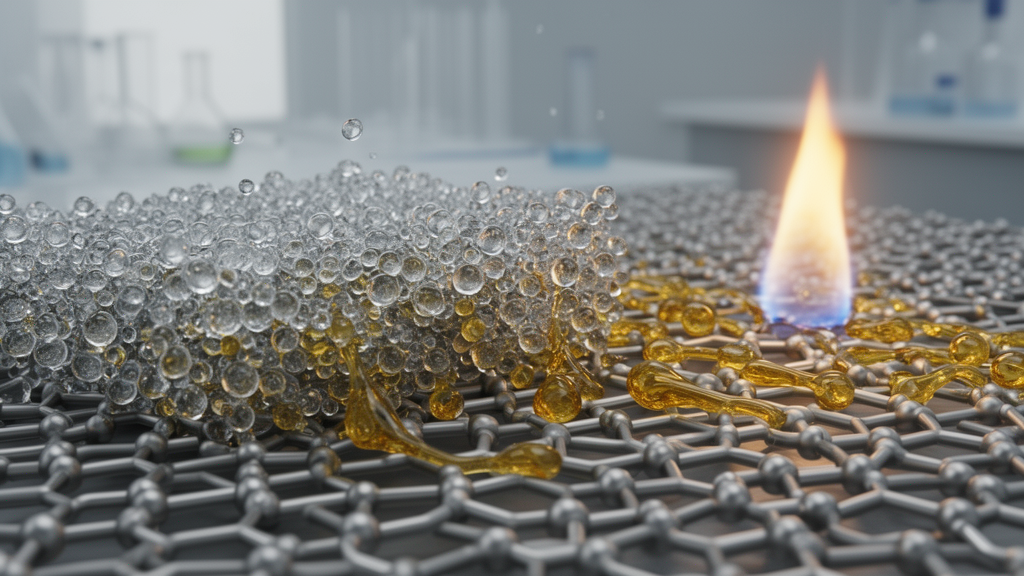
Water that refuses to stick, oil that flows freely through a mesh, and fabric that shrugs off flames sound like the ingredients of three separate research projects. A team at South China University of Technology has now folded all of them into a single coating, and the recipe is surprisingly short. In work published in the Journal of Materials Science, Delin Lai, Haoguang Wang, Gang Kong, Chunshan Che and Xinrui Miao describe an ultra-slippery superhydrophobic, or USS, coating made by calcining a composite of the metal-organic framework UiO-66 wrapped in polydimethylsiloxane, the silicone better known as PDMS. The entire transformation happens in one heating step, without fluorine chemistry, and the resulting surface delivers anti-condensation behavior, high-throughput oil-water separation and flame retardancy on the same platform.
The starting point of the study is a familiar frustration in surface science. Superhydrophobic coatings, which repel water so thoroughly that droplets bead up and roll away, typically demand elaborate multi-stage synthesis, energy-hungry processing and, very often, fluorinated compounds that raise environmental and regulatory concerns. Long-chain per- and polyfluoroalkyl substances have come under increasing scrutiny for their persistence, so materials researchers have been searching for fluorine-free routes that do not sacrifice performance. The Chinese team’s answer is to let a single thermal treatment do the chemical heavy lifting, converting a blended precursor into a functional hierarchical surface in one pass through the furnace.
The chemistry behind the transformation is where the elegance lies. UiO-66 is a zirconium-based metal-organic framework, a crystalline lattice of zirconium clusters linked by organic struts, prized for its chemical robustness and thermal stability. When a UiO-66@PDMS composite is calcined, the framework’s organic components burn away and the zirconium nodes are converted into zirconium dioxide, or ZrO2, while the PDMS does not simply vanish. Instead, it partially decomposes, leaving behind oligomeric silicone fragments. The result is a composite microstructure in which inorganic ZrO2 particles derived from the framework are married to residual PDMS-derived oligomers, and it is precisely this combination that endows the coating with its slippery superhydrophobic character.
That dual character matters because superhydrophobicity and slipperiness address different aspects of how water interacts with a surface. A water contact angle exceeding 150 degrees signals that droplets sit atop trapped air pockets with minimal solid contact, so they bead and roll. Slipperiness adds a dynamic dimension: droplets that do make contact slide off easily rather than pinning to the texture. Surfaces that combine both traits resist the accumulation of condensed moisture far better than conventional superhydrophobic materials, which can fail when water vapor infiltrates the texture and condenses inside it, flooding the air pockets and collapsing the water-repellent effect. The USS coating’s composite structure appears to sidestep that failure mode.
The anti-condensation performance is one of the study’s headline results. In humid environments, the coating effectively inhibits water vapor from condensing on treated surfaces, and under low-temperature conditions it extends the freezing-thawing cycle time of water droplets while maintaining stable superhydrophobic properties. That combination is directly relevant to real infrastructure. Condensation on cooled surfaces plagues power transmission equipment, optical lenses, refrigeration systems and building envelopes, and ice formation on aircraft wings, wind turbine blades and power lines remains a costly and hazardous problem. A coating that delays both condensation and freezing, without fluorine, could find wide application in cold and humid climates.
The second major demonstration involves oil-water separation, a technology with urgent environmental stakes given the frequency of oil spills and the volume of oily industrial wastewater. The researchers applied the USS coating to stainless-steel mesh, turning it into a superhydrophobic, oleophilic filter that lets oil pass while blocking water. The numbers are striking: the modified mesh achieved a separation flux of up to 40,000 liters per hour per square meter for trichloromethane, a dense chlorinated solvent that passes through under gravity alone. Flux at that scale means large volumes of oil-water mixture can be processed quickly, which is essential for any practical spill-response or wastewater-treatment deployment.
Equally important is durability, the Achilles heel of many laboratory superhydrophobic surfaces that lose their magic after a few uses. The coated mesh retained a separation efficiency above 90 percent and a water contact angle still exceeding 150 degrees even after 15 separation cycles. Sustained performance across repeated use suggests that the calcined composite structure is mechanically and chemically robust enough to survive continuous contact with liquids, a prerequisite for commercial membranes and filters. The result also aligns with a broader trend in the field, where metal-organic frameworks and their derivatives are increasingly being harnessed as building blocks for superwettable separation materials.
The third function, flame retardancy, is perhaps the most unexpected for a coating that also repels water. When USS-coated cotton fabric was exposed to flame, the coating absorbed flame heat and generated a dense char layer, a carbonaceous barrier that inhibits combustion by shielding the underlying fibers from heat and oxygen. The coating also cut down black smoke emission, addressing a major hazard in textile fires, since smoke inhalation is a leading cause of fire fatalities. Critically, the treated fabric kept its structural integrity and its superhydrophobicity intact through the process, meaning the water repellency does not have to be sacrificed to gain fire protection.
Multifunctionality of this kind is increasingly the benchmark for advanced coatings, because real-world surfaces rarely face a single threat. A tent fabric, a worker’s protective garment or an industrial filter might simultaneously encounter rain, oil contamination and fire risk. Previous efforts have combined such properties by stacking multiple layers or blending numerous additives, often at the cost of complexity and performance trade-offs. The UiO-66@PDMS route achieves the combination from a single precursor and a single thermal step, which simplifies manufacturing and reduces the energy footprint compared with conventional multi-step superhydrophobic coating preparation.
The work, conducted at the College of Materials Science and Engineering at South China University of Technology and supported by the Key-Area Research and Development Program of Guangdong Province and the Natural Science Foundation of Guangdong Province, offers a template that other laboratories can adapt. Because UiO-66 is one of the most studied and chemically tunable metal-organic frameworks, and PDMS is cheap, widely available and easy to process, the strategy could in principle be extended to other substrates and other framework chemistries. For now, the study stands as a demonstration that a furnace, a framework and a silicone can together produce a surface that repels water, resists ice, filters oil and fights fire, all without a single fluorine atom.
Subject of Research: Fluorine-free ultra-slippery superhydrophobic multifunctional coatings fabricated by one-step calcination of UiO-66@polydimethylsiloxane
Article Title: Fabricating ultra-slippery superhydrophobic multifunctional coatings by one-step calcination of UiO-66@polydimethylsiloxane
Article References: Lai, D., Wang, H., Kong, G., Che, C., & Miao, X. (2026). Fabricating ultra-slippery superhydrophobic multifunctional coatings by one-step calcination of UiO-66@polydimethylsiloxane. Journal of Materials Science. https://doi.org/10.1007/s10853-026-13895-2
Image Credits: AI Generated
DOI: 10.1007/s10853-026-13895-2
Keywords: superhydrophobic coating, UiO-66, metal-organic framework, polydimethylsiloxane, calcination, oil-water separation, flame retardancy, anti-condensation, anti-icing, ZrO2, fluorine-free, surface wettability
Cite Scienmag News
Neil Sanderson. (October 9, 2026). One-Step Calcined MOF Coating Repels Water, Splits Oil and Resists Fire. Scienmag. https://scienmag.com/one-step-calcined-mof-coating-repels-water-splits-oil-and-resists-fire/
Neil Sanderson. "One-Step Calcined MOF Coating Repels Water, Splits Oil and Resists Fire." Scienmag, 9 October 2026, https://scienmag.com/one-step-calcined-mof-coating-repels-water-splits-oil-and-resists-fire/. Accessed 9 October 2026.
Neil Sanderson. "One-Step Calcined MOF Coating Repels Water, Splits Oil and Resists Fire." Scienmag. October 9, 2026. https://scienmag.com/one-step-calcined-mof-coating-repels-water-splits-oil-and-resists-fire/


