


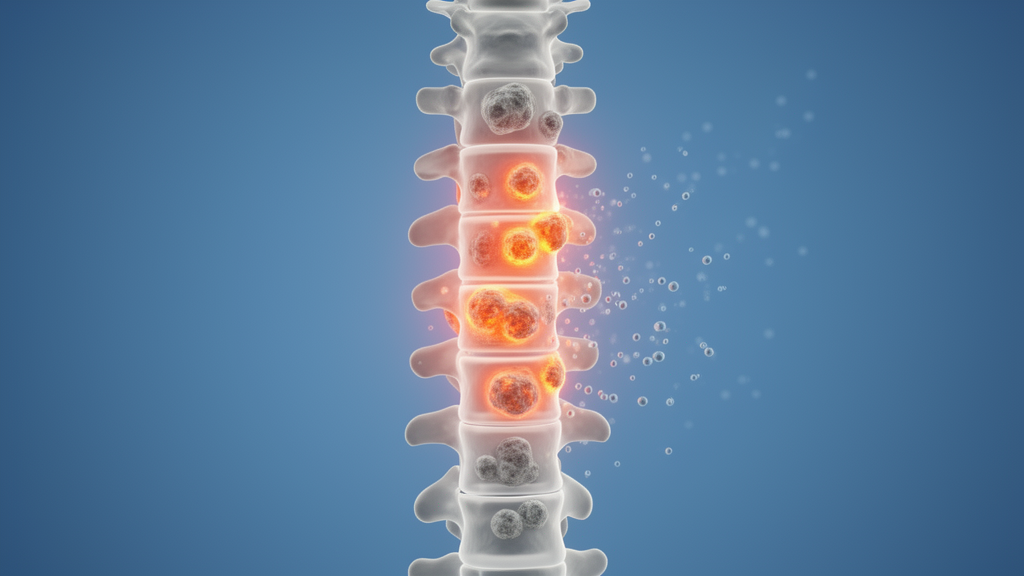
For patients living with radiographic axial spondyloarthritis, a chronic inflammatory disease that fuses and stiffens the spine, one of the most stubborn diagnostic puzzles has just been cracked open by a molecular imaging technique. A team of Dutch researchers has shown that a specialized positron emission tomography tracer can distinguish between lesions driven by inflammation and those caused by ordinary wear and tear, simply by watching how they behave over the course of a year of biologic drug treatment. The findings, published in the European Journal of Nuclear Medicine and Molecular Imaging, could reshape how clinicians monitor one of the most disabling forms of inflammatory arthritis.
The core problem is deceptively simple. Axial spondyloarthritis attacks the sacroiliac joints and the spine, driving chronic inflammation that eventually produces new, abnormal bone formation. But the spines of these patients, many of them still relatively young, also accumulate degenerative lesions of the kind seen in osteoarthritis: worn discs, bony outgrowths called osteophytes, and enlarged facet joints. On conventional X-rays and even magnetic resonance imaging, the two lesion types can look frustratingly similar, with overlapping features such as bone proliferation, bone marrow edema, and fatty infiltration. Chronic inflammation and mechanical stress in spondyloarthritis can even accelerate degenerative change, so the two processes frequently coexist in the same vertebra. Misreading a degenerative lesion as active inflammatory disease, or vice versa, can lead to the wrong treatment decision.
The Amsterdam University Medical Center-led team turned to sodium fluoride labeled with fluorine-18, a radioactive tracer with a strong affinity for hydroxyapatite, the mineral that makes up bone. Wherever osteoblasts are actively laying down new bone, the tracer accumulates, lighting up regions of heightened bone remodeling on PET/CT scans. That makes it a sensitive molecular readout of osteoblastic activity, capable of detecting changes before structural damage becomes visible on plain radiographs, which typically take at least two years to show meaningful change. The catch is that degenerative lesions also remodel bone, so they too can accumulate the tracer. Until now, no study had systematically defined how to tell the two lesion types apart on fluoride PET, or tested whether their longitudinal behavior during treatment could serve as a discriminating signature.
The researchers analyzed data from twenty patients with active radiographic axial spondyloarthritis enrolled in a substudy of the AS0013 trial, a phase 2a study of the biologic drugs bimekizumab and certolizumab pegol conducted across eight countries. All patients fulfilled the modified New York criteria, had high disease activity scores, elevated C-reactive protein, and had previously failed at least two nonsteroidal anti-inflammatory drugs. Each participant underwent fluoride PET/CT scans at three timepoints: before starting biologic therapy, and again at twelve and fifty-two weeks after treatment began. The imaging protocol was unusually rigorous, including dynamic scanning over the heart and thoracic spine with venous blood sampling to validate quantitative measurements of tracer delivery and uptake.
Two blinded readers, a musculoskeletal radiologist and a nuclear medicine specialist, independently reviewed the scans as chronological triplets, using the low-dose CT component as an anatomical reference. They applied predefined classification principles: degenerative lesions typically sit at intervertebral discs and facet joints and show disc degeneration, osteophytes, and joint hypertrophy on CT, while spondyloarthritis lesions favor the sacroiliac joints and vertebral corners, where erosions, sclerosis, and bridging syndesmophytes develop. Only lesions classified identically by both readers were carried forward, a deliberately conservative choice that sacrificed statistical power in exchange for confidence. In total, the readers detected 276 PET-positive lesions across the twenty patients, with individual burdens ranging from two to forty-two lesions per person.
The results were striking. Of the 276 lesions, 98, roughly 36 percent, were classified as spondyloarthritis-related, while 46, about 17 percent, were classified as degenerative. Over the year of biologic treatment, the number of spondyloarthritis lesions fell from 98 at baseline to 67 at week twelve, a 32 percent drop, and then to 55 at week fifty-two, an additional 18 percent decline. The degenerative lesions, by contrast, barely moved, fluctuating only between 40 and 42 throughout the study. The anatomical distribution reinforced the pattern: 84 percent of the spondyloarthritis lesions clustered in the thoracic spine, particularly the costovertebral joints, while nearly half of the degenerative lesions sat in the lumbar spine, the classic home of osteoarthritic wear.
Quantitative analysis told the same story with even greater precision. The team measured standardized uptake values corrected for each patient’s integrated whole-blood tracer activity, a pharmacokinetic refinement that accounts for individual differences in tracer delivery. Between baseline and week twelve, 84 percent of the spondyloarthritis lesions showed a decrease in tracer uptake, with individual declines reaching nearly 70 percent, and the mean decrease across these lesions was 27 percent. By week fifty-two, 88 percent of spondyloarthritis lesions had declined. The degenerative lesions behaved entirely differently: most either increased, in some cases by more than 100 percent, or showed only mild decreases. A repeated measures mixed model confirmed the divergence statistically, with a nominally significant difference in uptake change between the lesion types at both week twelve and week fifty-two.
The logic behind this natural experiment is elegant. Biologic drugs such as bimekizumab, which blocks interleukin-17A, and certolizumab pegol, an anti-TNF agent, are designed to suppress inflammatory bone remodeling but have no proven efficacy on degenerative joint disease. So lesions that quiet down under treatment are almost certainly inflammatory, while lesions that ignore the drug are almost certainly degenerative. The longitudinal behavior of the tracer effectively becomes a functional fingerprint of each lesion’s underlying biology, something no single static scan could provide. Notably, the researchers found no instance in which one reader classified a lesion as spondyloarthritis-related while the other called it degenerative, suggesting the visual criteria are robust when applied by experienced readers.
The study does carry caveats. With only twenty patients, generalizability is limited, and there is no gold standard against which to verify the lesion classifications. The readers, although blinded to clinical data, were not blinded to changes in tracer uptake over time, since the triplet-review approach was chosen to keep closely spaced lesions from being confused across timepoints. The authors also note that fluoride PET does not directly reveal the underlying pathology of a lesion, only its bone-remodeling activity, and that cost and availability currently limit routine clinical use. Future validation studies, including cohorts of pure osteoarthritis patients without inflammatory disease, will be needed to confirm the approach.
Even so, the implications are considerable. As total-body PET scanners with lower radiation burdens enter clinical service, and as artificial intelligence algorithms mature for automated lesion detection and classification, fluoride PET/CT could become a practical tool for separating treatable inflammation from irreversible degeneration in spondyloarthritis patients. The authors also envision hybrid PET/MRI approaches that combine metabolic and soft-tissue information, and standardized imaging protocols that would enable multicenter research. For a disease in which treatment decisions hinge on knowing whether active inflammation is still smoldering in the spine, a tracer that can effectively interrogate each lesion individually, and watch it respond to therapy in real time, represents a genuinely new window into disease biology.
Subject of Research: Differentiating inflammatory from degenerative spinal lesions in axial spondyloarthritis using longitudinal sodium fluoride PET/CT imaging during biologic therapy
Article Title: Differentiation of axial spondyloarthritis-related lesions from degenerative lesions on Na[18F]Fluoride PET/CT in a longitudinal dataset of patients with radiographic axial spondyloarthritis
Article References: de Jongh, J., Groothuizen, S., Zwezerijnen, G. J., Hemke, R., Doorschodt, T., Maguire, R. P., Vaux, T., & van der Laken, C. J. (2026). Differentiation of axial spondyloarthritis-related lesions from degenerative lesions on Na[18F]Fluoride PET/CT in a longitudinal dataset of patients with radiographic axial spondyloarthritis. European Journal of Nuclear Medicine and Molecular Imaging. https://doi.org/10.1007/s00259-026-08178-6
Image Credits: AI Generated
DOI: 10.1007/s00259-026-08178-6
Keywords: axial spondyloarthritis, Na[18F]Fluoride PET/CT, biologic therapy, bimekizumab, certolizumab pegol, degenerative lesions, osteoblastic activity, sacroiliac joints, syndesmophytes, molecular imaging, rheumatology, SUV quantification
Cite Scienmag News
Ophelia Keating. (October 9, 2026). PET Tracer Reveals Which Spinal Lesions Respond to Biologic Drugs in Axial Spondyloarthritis. Scienmag. https://scienmag.com/pet-tracer-reveals-which-spinal-lesions-respond-to-biologic-drugs-in-axial-spondyloarthritis/
Ophelia Keating. "PET Tracer Reveals Which Spinal Lesions Respond to Biologic Drugs in Axial Spondyloarthritis." Scienmag, 9 October 2026, https://scienmag.com/pet-tracer-reveals-which-spinal-lesions-respond-to-biologic-drugs-in-axial-spondyloarthritis/. Accessed 9 October 2026.
Ophelia Keating. "PET Tracer Reveals Which Spinal Lesions Respond to Biologic Drugs in Axial Spondyloarthritis." Scienmag. October 9, 2026. https://scienmag.com/pet-tracer-reveals-which-spinal-lesions-respond-to-biologic-drugs-in-axial-spondyloarthritis/


