


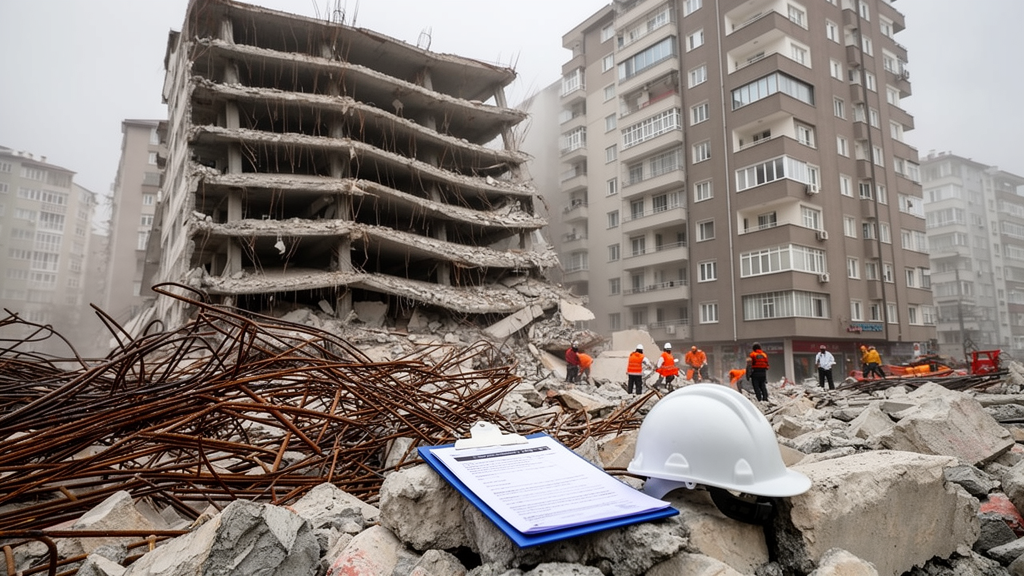
When a governance system is reformed on paper but the responsibility for failure is never genuinely moved to those who now hold new powers, the result can be catastrophic. That is the stark warning at the heart of a new Comment published in Nature Communications by Yasemin D. Aktas of University College London and Cassidy Johnson of the UCL Bartlett Development Planning Unit. Drawing on field reconnaissance after the devastating earthquakes that struck southern Türkiye in February 2023, the authors argue that building governance reforms can displace accountability rather than transfer it, and that the collapse at scale of formally inspected, post-reform buildings in the disaster exemplifies this failure mode. The paper is less a technical post-mortem of structural deficiencies than an institutional diagnosis: it asks why a regulatory system that looked robust on paper failed to protect the people living inside the buildings it certified.
The February 2023 earthquakes, centered near Kahramanmaraş on the East Anatolian Fault, killed tens of thousands of people and damaged or destroyed hundreds of thousands of buildings across eleven provinces. For earthquake engineers, the scale of the destruction was grimly familiar: Türkiye has long carried one of the world’s highest seismic hazard exposures, and successive earthquakes over the past decades have repeatedly exposed weaknesses in construction quality, code enforcement, and retrofit policy. What made the 2023 disaster particularly troubling, the authors note, was that many of the collapsed buildings had been built after major regulatory reforms and had passed through the country’s formal building inspection regime. Buildings that were, in the language of the state, inspected and compliant, failed in exactly the ways that inspection was supposed to prevent.
Türkiye overhauled its building inspection system in 2018, replacing an older framework in which municipal authorities directly controlled construction oversight with a system of licensed private building inspection firms. The reform was, on its face, a classic governance modernization: it moved inspection out of the hands of bodies that critics said were under-resourced and vulnerable to local political pressure, and into the hands of accredited private professionals with defined legal responsibilities. The logic was that accountability would transfer along with the task. Inspectors would be liable for what they certified; developers and contractors would face independent scrutiny; and the state would retain a supervisory role. The new paper argues that this transfer never truly happened, and that understanding why requires looking at how accountability actually behaves inside complex regulatory systems.
The central conceptual move in the Comment is the distinction between transferring a task and transferring accountability. A reform can hand a function, such as structural inspection, to a new actor while leaving the underlying incentives, information flows, and sanction mechanisms unchanged. In that case, the authors argue, accountability is not transferred but displaced: it drifts into institutional gaps where no actor is meaningfully answerable for failure. The private inspector may lack the independence, resources, or legal exposure to enforce the code against powerful developers. The municipality may believe it has washed its hands of oversight. The central government may assume the new system is self-policing. Each actor can point to another as the responsible party, and the chain of answerability that should connect a stamped drawing to a safe building quietly dissolves.
The field evidence from the 2023 earthquake zone gave the authors an unusually direct test of this hypothesis. Post-reform buildings that had been through the inspection process collapsed in the same manner, and at comparable rates in some localities, as older buildings constructed under the previous regime. If the reform had genuinely transferred accountability, one would expect the inspected stock to perform measurably better under identical shaking. The reconnaissance findings, gathered as part of an Earthquake Engineering Field Investigation Team mission supported by UK Engineering and Physical Sciences Research Council funding, indicated that the formal inspection stamp had not functioned as a reliable proxy for structural quality. The paper treats this not as evidence that inspection is useless, but as evidence that inspection without genuine accountability transfer is a procedural ritual rather than a safety mechanism.
The authors ground their argument in comparative institutional analysis, and their acknowledgements point to Chile as an instructive counterpoint. Chile’s regulatory framework, refined after its own long history of great subduction-zone earthquakes, is widely regarded as achieving a closer coupling between design authority, construction oversight, and liability. The paper credits Juan Carlos De La Llera Martín of the Pontificia Universidad Católica de Chile with clarifying details of that framework, suggesting that the authors use it to identify the institutional conditions under which accountability transfer can actually work. The contrast matters because it rules out a lazy conclusion that private inspection is inherently flawed. The lesson is instead conditional: the same institutional design can succeed or fail depending on whether liability, professional incentives, and enforcement capacity move together with the task.
Underlying the analysis is a set of technical realities about what building inspection can and cannot achieve. Structural safety in a major earthquake depends on decisions made long before an inspector arrives on site: geotechnical assessment, architectural configuration, the quality of reinforcement detailing, concrete strength, and the integrity of the construction sequence. An inspector who visits intermittently cannot retroactively verify hidden reinforcement or correct a poorly proportioned frame. Effective oversight therefore depends on continuous professional responsibility across the whole delivery chain, with each actor, designer, contractor, inspector, and certifier, bearing a defined and enforceable share of the risk. Where the law assigns nominal responsibility but the market makes rigorous enforcement economically suicidal for the individual professional, or where inspectors are paid by the developers they are meant to police, the nominal chain of accountability becomes a chain of plausible deniability.
The paper’s framing of the 2023 disaster as an invitation to urban disaster is deliberately forward-looking. Türkiye faces an enormous retrofit challenge: millions of existing buildings predate modern seismic codes, and the reconstruction of the earthquake zone is itself a vast new wave of construction passing through the same governance system. If the displacement of accountability identified in the Comment is not corrected, the same failure mode could recur in the rebuilt cities, and in the megacity of Istanbul, where seismologists anticipate a major earthquake on the North Anatolian Fault within the coming decades. The authors’ argument implies that the most urgent investment is not only in engineering capacity but in institutional design: independent funding for inspectors, genuine professional liability, transparent records, and state supervision with real teeth.
What gives the Comment its wider resonance is that the failure mode it describes is not unique to Türkiye or to earthquake engineering. Governance reforms worldwide, in building safety, food safety, financial oversight, and environmental regulation, routinely devolve tasks to private or quasi-independent actors on the assumption that accountability follows automatically. The 2017 Grenfell Tower fire in London, for example, exposed a comparable tangle of fragmented responsibility in building regulation, where no single actor felt answerable for the safety of the cladding system. The Nature Communications paper offers a conceptual vocabulary, accountability transfer versus displacement, that can be applied across these domains, and a sober empirical anchor in the Turkish earthquake evidence.
The authors are careful about what their evidence can and cannot support. Their Comment draws on reconnaissance observations and institutional analysis rather than a comprehensive statistical audit of the collapsed building stock, and they acknowledge the contribution of an anonymous building inspection professional who provided context on current inspection practice in Türkiye. But the core claim is difficult to dismiss: a regulatory reform that looks like accountability transfer but leaves answerability where it was before is worse than no reform at all, because it manufactures public confidence in a system that has not changed. As reconstruction accelerates across the earthquake zone and Istanbul’s clock keeps ticking, the paper’s message is that the safety of cities depends not on the existence of inspection regimes but on whether the people who run them can truly be held to account when the ground shakes.
Subject of Research: Building governance reform and accountability transfer in seismic building inspection, examined through the 2023 Türkiye earthquake disaster
Article Title: Building governance reform without accountability transfer invites urban disaster
Article References: Aktas, Y. D., & Johnson, C. (2026). Building governance reform without accountability transfer invites urban disaster. Nature Communications. https://doi.org/10.1038/s41467-026-78062-2
Image Credits: AI Generated
DOI: 10.1038/s41467-026-78062-2
Keywords: building governance, accountability transfer, Türkiye earthquake 2023, building inspection, seismic safety, urban resilience, governance reform, earthquake engineering, regulatory failure, Chile building regulation, disaster risk reduction, Nature Communications
Cite Scienmag News
Violet Maxwell. (October 9, 2026). Reform Without Accountability: Why Inspected Buildings Still Fell in the 2023 Türkiye Earthquake. Scienmag. https://scienmag.com/reform-without-accountability-why-inspected-buildings-still-fell-in-the-2023-turkiye-earthquake/
Violet Maxwell. "Reform Without Accountability: Why Inspected Buildings Still Fell in the 2023 Türkiye Earthquake." Scienmag, 9 October 2026, https://scienmag.com/reform-without-accountability-why-inspected-buildings-still-fell-in-the-2023-turkiye-earthquake/. Accessed 9 October 2026.
Violet Maxwell. "Reform Without Accountability: Why Inspected Buildings Still Fell in the 2023 Türkiye Earthquake." Scienmag. October 9, 2026. https://scienmag.com/reform-without-accountability-why-inspected-buildings-still-fell-in-the-2023-turkiye-earthquake/


