


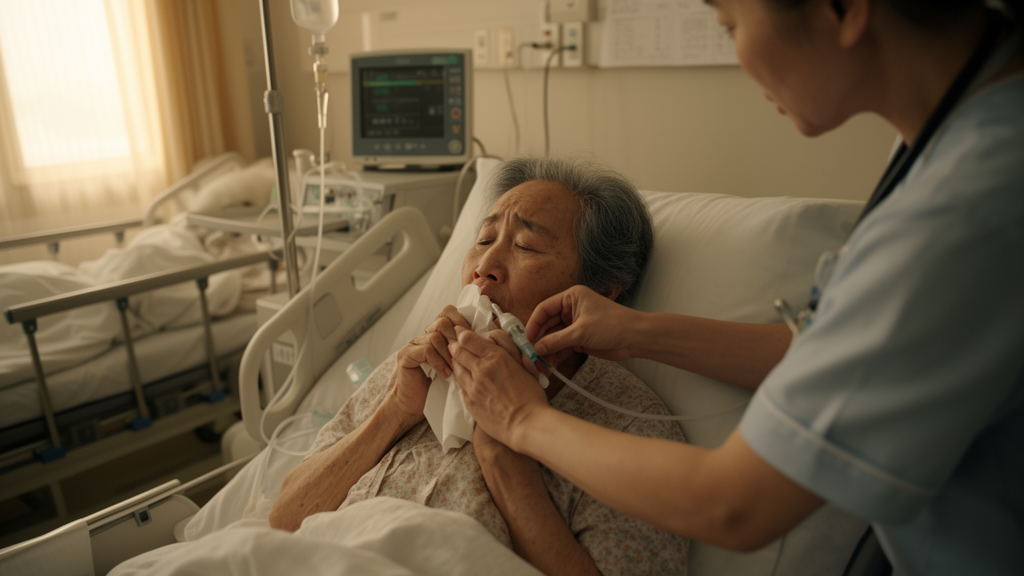
Whooping cough, long dismissed as a childhood illness vanquished by vaccines, is staging an alarming comeback among one of the populations least equipped to fight it: the elderly. A new cross-sectional study from Zhejiang Province, China, published in BMC Public Health, has for the first time quantified in detail what pertussis costs older adults and their health system—and the numbers reveal a disease that is far more than a nuisance for people over sixty. In 2024, Zhejiang recorded a staggering 38-fold rise in notified pertussis cases compared with the previous year, including 632 cases among adults aged sixty and above, one of the highest counts of any province in China. Behind those statistics lies a story of delayed diagnoses, unexpected hospitalizations, and a financial toll that falls disproportionately on the sickest patients.
The research team, led by Hui Wu of the Jiangxi Provincial Center for Disease Control and Prevention together with colleagues from the Zhejiang Provincial Center for Disease Control and Prevention, set out to fill a conspicuous gap in the evidence base. While the global resurgence of pertussis has been documented extensively in infants and, more recently, in adolescents and young adults, population-based data on the economic consequences of infection among older adults in China were essentially nonexistent. Using multi-stage stratified sampling, the investigators recruited pertussis patients aged sixty or older from three prefecture-level cities in Zhejiang—Hangzhou, Jiaxing, and Jinhua—drawing on national surveillance records, hospital information systems, and face-to-face interviews conducted in 2025. Of those approached, 195 participants completed the study, a response rate of 81.3 percent that lends considerable weight to the findings.
The headline figure is striking: the aggregate economic burden across the cohort reached 1,366,260 RMB, with a mean total cost per case of 7,007 RMB. But averages in cost data can be misleading, and the distribution here was heavily skewed. The median total cost was just 1,819 RMB, with an interquartile range stretching from 653 to 9,234 RMB—a pattern indicating that most patients incurred modest expenses while a minority, chiefly those requiring hospital admission, absorbed enormous costs. This right-skewed distribution is precisely why the researchers turned to generalized linear models with a gamma distribution and log link, a statistical approach designed for non-negative, continuous cost data that would be distorted by ordinary linear regression.
Breaking the burden into its components reveals where the money actually goes. Direct costs—medical expenditures, medications, diagnostic tests, and travel to care—accounted for 75.9 percent of the total, with medical spending alone representing 69.3 percent of the overall burden. Indirect costs, primarily lost productivity and the value of unpaid caregiving time, contributed the remaining 24.1 percent. For a disease that many clinicians still associate with school-age children, these figures underscore that pertussis in older adults is a genuinely resource-intensive condition, one that consumes hospital beds, laboratory capacity, and family resources in equal measure.
The starkest contrast in the study emerged between outpatients and inpatients. Among patients treated without hospital admission, the median total economic burden was a comparatively manageable 811 RMB. Among those hospitalized, the median soared to 11,098 RMB—nearly fourteen times higher, a difference that was highly statistically significant. In the generalized linear model, inpatient status was by far the dominant driver of cost, multiplying the expected total burden by a factor of 11.93 compared with outpatient care. Fever independently increased costs by 32 percent, and each additional day between the onset of symptoms and diagnosis added roughly two percent to the expected total, reflecting how prolonged illness before confirmation compounds both medical and indirect expenses.
Perhaps the most consequential finding concerns hospitalization itself. The overall hospitalization rate among older adults with pertussis in the cohort was 40.5 percent—an extraordinarily high proportion for a vaccine-preventable bacterial infection, and one that signals substantial clinical severity in this age group. To identify who was most at risk, the team fitted a multivariable binary logistic regression model, adjusting for potential confounders and checking for multicollinearity using variance inflation factors. The results painted a clear portrait of vulnerability: rural residence nearly tripled the odds of hospitalization (odds ratio 3.08), male sex raised them nearly threefold (odds ratio 2.80), and each additional year of age increased the odds by 15 percent, a cumulative effect that grows rapidly across the later decades of life.
Clinical presentation mattered as much as demographics. Patients presenting with fever were more than four times as likely to be hospitalized as those without it (odds ratio 4.11), while the presence of complications—conditions such as pneumonia that often accompany pertussis in frail older bodies—nearly tripled the odds (odds ratio 2.94). A prolonged interval between symptom onset and diagnosis also independently elevated hospitalization risk, with each additional day increasing the odds by four percent. Taken together, these determinants suggest a dangerous feedback loop: delayed recognition of pertussis in older adults allows the infection to progress, complications to develop, and the eventual illness to become severe enough to demand inpatient care, which in turn drives the economic burden to its highest levels.
The technical rigor of the study deserves attention in its own right. Cost data violate the assumptions of ordinary least squares regression because they cannot be negative and cluster near zero with a long right tail; the gamma distribution with a log link handles this structure naturally, modeling costs on a multiplicative scale so that coefficients can be interpreted as proportional changes in expected expenditure. The logistic regression for hospitalization followed standard epidemiological practice, and the multi-stage stratified sampling design across three cities with different economic and geographic profiles strengthens the generalizability of the findings within Zhejiang, though the authors and independent observers alike would caution that a single-province, cross-sectional design cannot capture temporal changes or prove causation for the associations identified.
Why is pertussis resurging among the elderly in the first place? The bacterium Bordetella pertussis causes a respiratory infection whose classic symptom—a prolonged, paroxysmal cough—can last for weeks and, in older adults, is easily mistaken for bronchitis, asthma, or other common conditions. Immunity from childhood vaccination wanes over decades, and in China, as in most countries, routine booster vaccination of older adults with tetanus-diphtheria-acellular pertussis (Tdap) vaccines is not standard practice. Waning immunity, improved PCR-based diagnostics that detect infections previously missed, and the cyclical nature of pertussis epidemics all likely contribute to the surge documented in Zhejiang. Older adults also face age-related declines in respiratory reserve, making even a nominally mild infection far more dangerous than it would be in a vaccinated adolescent.
The public health implications are concrete. The authors argue that enhanced diagnosis, strengthened surveillance, and improved clinical management represent the most promising near-term strategies to reduce hospitalizations and blunt the economic burden. Practically, that means training frontline clinicians to consider pertussis in the differential diagnosis of prolonged cough in patients over sixty, expanding access to timely laboratory confirmation, and evaluating whether targeted Tdap vaccination of older adults—already recommended in several high-income countries—would be cost-effective in the Chinese context. With a 40.5 percent hospitalization rate and a per-case cost that can exceed 11,000 RMB for admitted patients, the study makes a compelling economic case that prevention in this age group is not merely a clinical nicety but a fiscal imperative. As populations across China and much of the world continue to age, the silent resurgence of whooping cough among the elderly is a warning that vaccine-preventable diseases never truly disappear—they simply find new, and sometimes older, hosts.
Subject of Research: Economic burden and hospitalization determinants of pertussis among older adults in Zhejiang, China
Article Title: Economic burden of pertussis, its influencing factors, and hospitalization determinants among older adults (≥ 60 years) in Zhejiang, China: a cross-sectional study (2024–2025)
Article References: Wu, H., Zhou, Y., Zhu, Y., He, H., & Guo, S. (2026). Economic burden of pertussis, its influencing factors, and hospitalization determinants among older adults (≥ 60 years) in Zhejiang, China: a cross-sectional study (2024–2025). BMC Public Health. https://doi.org/10.1186/s12889-026-29610-4
Image Credits: AI Generated
DOI: 10.1186/s12889-026-29610-4
Keywords: pertussis, whooping cough, older adults, economic burden, hospitalization, Zhejiang, China, public health, health economics, vaccination, Bordetella pertussis, cross-sectional study
Cite Scienmag News
Ophelia Keating. (October 8, 2026). Whooping Cough Is Hitting China’s Elderly Hard—and the Costs Are Steep. Scienmag. https://scienmag.com/whooping-cough-is-hitting-chinas-elderly-hard-and-the-costs-are-steep/
Ophelia Keating. "Whooping Cough Is Hitting China’s Elderly Hard—and the Costs Are Steep." Scienmag, 8 October 2026, https://scienmag.com/whooping-cough-is-hitting-chinas-elderly-hard-and-the-costs-are-steep/. Accessed 8 October 2026.
Ophelia Keating. "Whooping Cough Is Hitting China’s Elderly Hard—and the Costs Are Steep." Scienmag. October 8, 2026. https://scienmag.com/whooping-cough-is-hitting-chinas-elderly-hard-and-the-costs-are-steep/


