


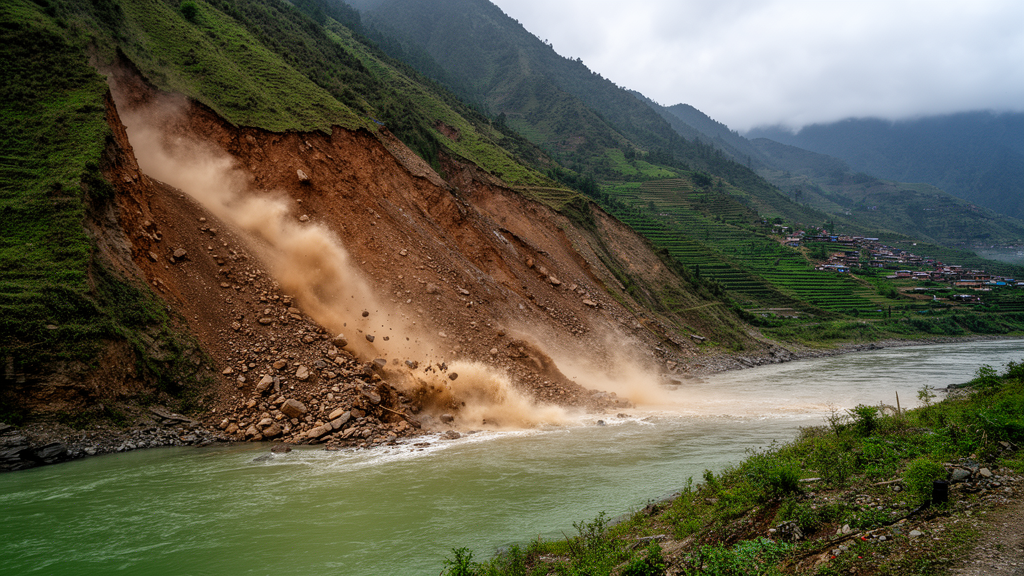
Some of the world’s most destructive landslides do not begin with a bang. They begin with a whisper: millimeters of creep, a slow redistribution of stress deep inside a slope, and a cascade of small adjustments that, taken together, set the stage for catastrophe. A new study published in the journal Natural Hazards dissects exactly such a sequence, showing how a large-scale landslide descended toward the Minjiang River in China not as a single instantaneous collapse, but as a chain of progressively failing blocks that nudged one another toward failure over a period of weeks.
The research, led by Junyang Li and Lina Ma of Lanzhou Jiaotong University together with Qingdong Wang and Chunliang Li of the Geological Survey of Gansu Province, combined detailed field investigation with numerical simulation to reconstruct the initiation mechanism of the landslide. Their central conclusion is that the event followed the signature of progressive failure, a process in which different parts of a slope lose strength at different times, with each local failure transferring load to its neighbors until the entire slope system becomes unstable. Rather than one uniform sliding surface snapping into motion all at once, the slope failed piecemeal, in a domino-like sequence that the authors describe as incremental loading, stepwise stress transfer, and sequential initiation.
To capture this choreography of failure, the team established six monitoring points distributed across three secondary slide zones, labeled HI-1, HI-2, and HI-3. This zonal breakdown proved crucial. The simulations revealed that the three zones did not move together. Instead, each activated on its own schedule, with distinct timing and dramatically different peak velocities, painting a picture of a slope that came apart in stages rather than in a single convulsive moment.
The numbers tell the story with striking clarity. Movement in the HI-1 zone was concentrated within the first twenty days of the simulated event, with peak velocities recorded between 7.42 and 9.88 meters per day. The HI-2 zone was most active between days five and thirty, and it was the fastest of the three, attaining peak velocities of 8.55 to 11.44 meters per day. The HI-3 zone lagged well behind, moving primarily between days twenty-five and forty-five, with peak velocities of only 1.63 to 2.55 meters per day, roughly a quarter of the speed of its upstream neighbor. This staggered timing, in which the upper and middle portions of the slope accelerated first and the lower portion followed weeks later, is exactly the pattern expected when stress is transferred incrementally through a failing mass.
Progressive failure is one of the most important yet underappreciated concepts in landslide science. In an idealized slope, failure would occur simultaneously along a single continuous slip surface once the driving forces exceeded the resisting strength everywhere at once. Real slopes, however, are heterogeneous. Weak layers, joints, variations in water content, and differences in material properties mean that some pockets of soil or rock reach their strength limit long before others. When one pocket fails, the load it was carrying does not simply vanish; it is redistributed to adjacent material, pushing that material closer to its own threshold. The result is a self-propagating chain of local failures that can unfold over hours, days, or even years before the slope finally gives way as a coherent, fast-moving mass.
In the case examined by the Chinese team, this cumulative effect of slow, nudging deformation ultimately drove the slide mass into the Minjiang River as three relatively independent bodies. That detail matters enormously for hazard assessment. A landslide that enters a river as separate blocks behaves very differently from one that arrives as a single integrated mass. Each independent body can generate its own impulse wave, its own deposition lobe, and its own potential for damming the channel. River-blocking landslides in steep mountain terrain are among the most dangerous cascading hazards in existence, because a natural dam formed of landslide debris can impound a lake that later breaches catastrophically, sending a flood wave into downstream communities.
The study also examined how soil saturation influences the landslide’s mobility and total displacement. Water is the great accelerant of slope failure. As pore spaces fill with water, the effective stress that holds soil grains together diminishes, weakening the material along potential slip surfaces. Saturated soils can also lose strength rapidly during motion, transforming a sluggish slide into a fluidized, long-runout flow. By varying saturation conditions in their simulations, the researchers were able to isolate how much of the landslide’s mobility and final displacement could be attributed to the state of the water within the mass, providing a quantitative bridge between hydrological conditions and the ultimate reach of the hazard.
Methodologically, the work reflects a broader shift in landslide research toward numerical techniques capable of handling large deformations. Traditional slope stability methods, which compare driving and resisting forces on an assumed failure surface, are poorly suited to problems where the sliding mass travels hundreds of meters and undergoes extreme distortion. Modern approaches, including the material point method referenced in the wider literature on landslide dynamics, allow scientists to simulate the full life cycle of a landslide, from initial creep through initiation, transport, and deposition. By anchoring such simulations to field observations from six monitoring points, the team ensured that their model was not merely a theoretical exercise but a calibrated reconstruction of a real event.
The implications extend well beyond a single slope above the Minjiang River. Slow-moving landslides are widespread across mountainous regions worldwide, from the Himalaya and the Karakoram to the Alps and the Andes, and satellite radar interferometry has revealed thousands of previously unrecognized creeping slopes. The key question for hazard managers has always been which of these slow movers will suddenly accelerate into a catastrophic failure. The answer, according to this study, lies in recognizing the fingerprints of progressive failure: zones that activate at different times, stress being passed stepwise through the mass, and velocities that differ sharply from one part of the slope to another. A slope exhibiting such spatially and temporally segmented behavior may be far closer to catastrophic failure than its slow average creep rate would suggest.
For communities living beneath steep slopes in river valleys, the message is sobering but actionable. Monitoring networks that track multiple points across a landslide, rather than a single representative location, can detect the sequential activation pattern that precedes a cascade failure. Numerical models calibrated with such data can then forecast which zones will move fastest, when they will peak, and how far the mass is likely to travel under different saturation scenarios. As extreme rainfall events become more frequent in a warming climate, loading mountain slopes with water at unprecedented rates, the kind of integrated field-and-simulation approach demonstrated in this study offers a template for turning the slow whispers of a creeping slope into an early warning that arrives before the roar.
Subject of Research: Progressive failure initiation mechanism of a large-scale cascade landslide entering the Minjiang River
Article Title: Initiation mechanism of a large-scale cascade landslide: a case study of progressive failure
Article References: Li, J., Ma, L., Wang, Q., & Li, C. (2026). Initiation mechanism of a large-scale cascade landslide: a case study of progressive failure. Natural Hazards, 122(21), Article 662. https://doi.org/10.1007/s11069-026-08440-y
Image Credits: AI Generated
DOI: 10.1007/s11069-026-08440-y
Keywords: landslide, progressive failure, Minjiang River, slope stability, numerical simulation, soil saturation, cascade hazard, stress transfer, monitoring, debris flow, geohazards, Natural Hazards
Cite Scienmag News
Violet Maxwell. (October 8, 2026). Slow Nudges, Sudden Collapse: How Progressive Failure Unleashed a Cascade Landslide Into the Minjiang River. Scienmag. https://scienmag.com/slow-nudges-sudden-collapse-how-progressive-failure-unleashed-a-cascade-landslide-into-the-minjiang-river/
Violet Maxwell. "Slow Nudges, Sudden Collapse: How Progressive Failure Unleashed a Cascade Landslide Into the Minjiang River." Scienmag, 8 October 2026, https://scienmag.com/slow-nudges-sudden-collapse-how-progressive-failure-unleashed-a-cascade-landslide-into-the-minjiang-river/. Accessed 8 October 2026.
Violet Maxwell. "Slow Nudges, Sudden Collapse: How Progressive Failure Unleashed a Cascade Landslide Into the Minjiang River." Scienmag. October 8, 2026. https://scienmag.com/slow-nudges-sudden-collapse-how-progressive-failure-unleashed-a-cascade-landslide-into-the-minjiang-river/


