


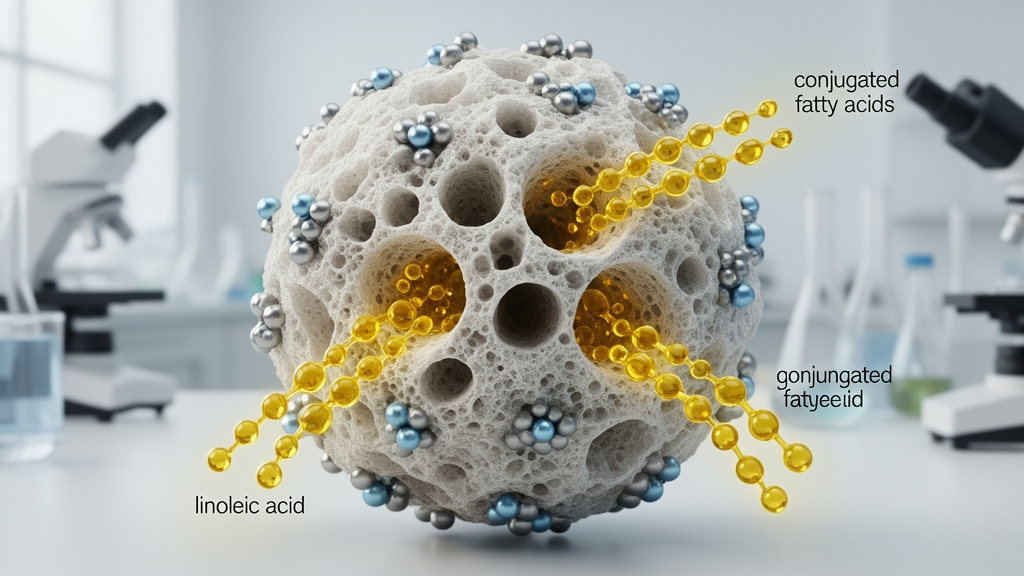
Conjugated linoleic acid, or CLA, has spent decades in the scientific spotlight as a fatty acid with an intriguing portfolio of reported biological effects, from influences on body composition and inflammation to immunomodulatory properties noted in the nutrition literature. Yet producing this compound cleanly and at scale has remained a stubborn chemical challenge. A team of researchers at Jiangnan University in Wuxi, China, now reports a catalyst design that could change that calculus. Writing in Catalysis Letters, Yigao Li, Shouteng Zheng, and colleagues describe a ruthenium-nickel bimetallic catalyst anchored inside the ordered channels of SBA-15 mesoporous silica, a system that converts linoleic acid into conjugated linoleic acid with a yield of 65 percent under optimized conditions while remaining active through four reuse cycles.
The appeal of the new work lies in its marriage of two ideas that catalyst designers have pursued separately for years: bimetallic synergy and structured mesoporous supports. Ruthenium has long been known as an active metal for the isomerization of linoleic acid, with earlier studies demonstrating that supported ruthenium catalysts can shift the double bonds of this C18 fatty acid from their natural methylene-interrupted positions into the conjugated arrangements that define CLA. Nickel, by contrast, is a cheaper metal with a well-documented tendency to drive hydrogenation, the very side reaction that consumes linoleic acid and turns it into saturated stearic acid instead of the desired conjugated product. On paper, pairing the two metals seems risky. In practice, the Jiangnan team found that the combination delivers something neither metal achieves alone.
The fabrication route is deliberately straightforward. The researchers first synthesized SBA-15, a well-known ordered mesoporous silica, using the triblock copolymer P123 as a structure-directing template and tetraethyl orthosilicate as the silicon source, following a hydrothermal method. SBA-15 is prized in catalysis for its uniform, cylindrical pores arranged in a two-dimensional hexagonal lattice, with pore diameters large enough, in this context, to accommodate bulky long-chain fatty acid molecules. The team then loaded the two metals by equal-volume co-impregnation, a technique in which a solution containing both metal precursors is introduced into the support in a controlled volume that matches the pore volume of the material, allowing the metals to deposit together throughout the porous network.
Characterization was central to establishing what actually formed inside the support. The researchers deployed a battery of standard techniques: X-ray diffraction to probe both the long-range order of the silica framework and the dispersion of the metal phases, scanning electron microscopy to image morphology, Brunauer-Emmett-Teller analysis to quantify surface area and porosity, and X-ray photoelectron spectroscopy to interrogate the electronic states of the metals. The results confirmed that the catalyst retains the intact ordered two-dimensional hexagonal cylindrical mesoporous structure of SBA-15 even after metal loading. Equally important, the metals were found to be highly dispersed rather than aggregated into large particles, a critical property because catalytic activity in these systems depends on exposing as many active surface atoms as possible to the reactant.
The electronic story that emerged from the characterization is where the work becomes genuinely interesting. X-ray photoelectron spectroscopy indicated that ruthenium and nickel interact electronically when co-deposited on the silica, forming what the authors describe as an electronic synergistic effect. In this division of labor, ruthenium serves as the dominant active site responsible for activating the carbon-carbon double bonds of linoleic acid, the essential first step in shifting those bonds into conjugated positions. Nickel, meanwhile, modulates the electron distribution at the active sites and, crucially, suppresses the unwanted hydrogenation side reactions that would otherwise degrade the fatty acid into saturated products. In other words, nickel does not merely dilute the ruthenium; it tunes the electronic environment so that the catalyst favors isomerization over full saturation.
This kind of metal-metal cooperation has precedent in the literature, which the authors situate carefully. A study dating back to 1988 reported isomerization of methyl linoleate over supported ruthenium-nickel catalysts, suggesting the pairing has historical roots. More recent work has explored related synergies, including ruthenium catalysts combined with basic sites on magnesium-aluminum supports for the same linoleic acid transformation, and ruthenium systems interacting with grafted niobium on SBA-15 for other reactions. The Jiangnan contribution is to bring this bimetallic concept together with the mesoporous architecture of SBA-15 in a single, recyclable system aimed specifically at green CLA synthesis, and to document the structural and electronic evidence for why it works.
The mesoporous support itself is not a passive bystander. The large pore size and straight, unobstructed channels of SBA-15 facilitate the diffusion of long-chain linoleic acid molecules, a nontrivial consideration when the reactant is an eighteen-carbon fatty acid that must physically reach the metal sites buried within the pore network. Smaller-pore supports can throttle this transport, limiting conversion and encouraging side reactions at the pore mouths. By preserving the ordered channel structure through synthesis and metal loading, the researchers ensured that the reactant can access the dispersed bimetallic sites efficiently, and that the products can diffuse back out without becoming trapped or over-reacted.
Performance testing under optimized conditions in an ethylene glycol solvent system delivered the headline result: a conjugated linoleic acid yield of 65 percent from linoleic acid isomerization. For a heterogeneous catalytic route to CLA, this figure represents a meaningful benchmark, particularly given the persistent challenge of balancing isomerization activity against hydrogenation selectivity. The choice of ethylene glycol as the reaction medium also aligns with the green chemistry framing of the work, since the overall system is presented as simple to prepare, cost-controllable, and environmentally friendly, in contrast to homogeneous routes that rely on expensive rhodium catalysts or generate separation burdens that complicate food-grade applications.
Recyclability may prove to be the most commercially consequential aspect of the report. Homogeneous catalysts, however active, are notoriously difficult to separate from fatty acid products, which is one reason heterogeneous approaches to CLA production have attracted sustained interest. The Ru-Ni/SBA-15 catalyst can be recovered by simple filtration, and the authors report that it remains stably active after being reused four times. That combination of separability and sustained activity addresses two of the biggest practical objections to catalytic CLA synthesis and brings the process closer to something a food or nutraceutical producer could realistically operate. The catalyst preparation itself, based on commodity silica, a polymer template, and relatively inexpensive nickel, also keeps raw material costs in check compared with precious-metal-only alternatives.
The broader significance of the study extends beyond CLA itself. Conjugated linoleic acid sits at the intersection of food science, nutrition, and catalysis, with reviews cataloguing effects on inflammation, oxidative stress, body composition, physical performance, and lipid metabolism in both animal and human contexts, and with biosynthetic routes also under active development. A robust, recyclable heterogeneous catalyst that performs the key isomerization step cleanly gives chemists and engineers a new tool for that supply chain. More generally, the work is a compact demonstration of a principle that continues to reshape catalysis research: that the deliberate pairing of metals, combined with a support architecture engineered for molecular transport, can produce cooperative behavior that no single-component system matches. As the Jiangnan team shows, sometimes the trick is not finding a better metal, but teaching two metals to work together inside a well-designed pore.
Subject of Research: Ruthenium-nickel bimetallic catalysts on mesoporous SBA-15 for the green isomerization of linoleic acid to conjugated linoleic acid
Article Title: Fabrication of Ru-Ni/SBA-15 Bimetallic Catalyst: Synergistic Effect and Application in Linoleic Acid Isomerization
Article References: Fabrication of Ru-Ni/SBA-15 Bimetallic Catalyst: Synergistic Effect and Application in Linoleic Acid Isomerization. (n.d.). https://doi.org/10.1007/s10562-026-05539-6
Image Credits: AI Generated
DOI: 10.1007/s10562-026-05539-6
Keywords: conjugated linoleic acid, linoleic acid isomerization, bimetallic catalyst, ruthenium, nickel, SBA-15, mesoporous silica, heterogeneous catalysis, green catalysis, synergistic effect, catalyst recyclability, fatty acid chemistry
Cite Scienmag News
Bethany Barker. (October 8, 2026). Ruthenium-Nickel Duo on Mesoporous Silica Turns Linoleic Acid into Health-Boosting Conjugated Fatty Acids. Scienmag. https://scienmag.com/ruthenium-nickel-duo-on-mesoporous-silica-turns-linoleic-acid-into-health-boosting-conjugated-fatty-acids/
Bethany Barker. "Ruthenium-Nickel Duo on Mesoporous Silica Turns Linoleic Acid into Health-Boosting Conjugated Fatty Acids." Scienmag, 8 October 2026, https://scienmag.com/ruthenium-nickel-duo-on-mesoporous-silica-turns-linoleic-acid-into-health-boosting-conjugated-fatty-acids/. Accessed 8 October 2026.
Bethany Barker. "Ruthenium-Nickel Duo on Mesoporous Silica Turns Linoleic Acid into Health-Boosting Conjugated Fatty Acids." Scienmag. October 8, 2026. https://scienmag.com/ruthenium-nickel-duo-on-mesoporous-silica-turns-linoleic-acid-into-health-boosting-conjugated-fatty-acids/


