


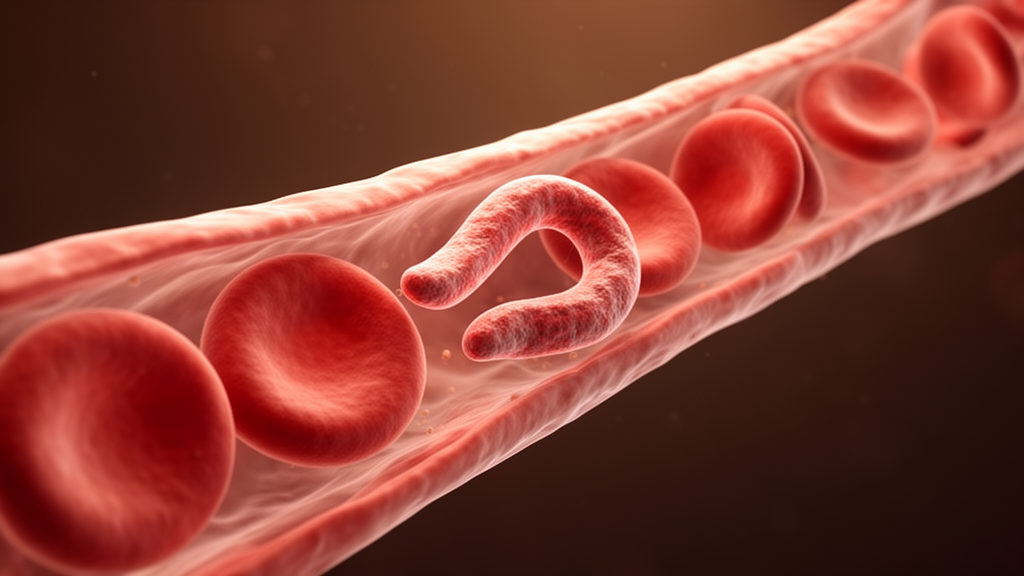
Malaria has stalked humanity for as long as we have written records, and its toll remains staggering. The disease, caused by single-celled parasites of the genus Plasmodium and transmitted by Anopheles mosquitoes, still kills hundreds of thousands of people each year, most of them young children in sub-Saharan Africa. Yet in the very regions where malaria has exerted the strongest evolutionary pressure, human populations carry a genetic paradox: a mutation in the hemoglobin gene that, in two copies, causes the debilitating and often fatal sickle cell disease, but in a single copy confers remarkable protection against the deadliest forms of malaria. For decades, scientists have sought to explain exactly how this protection works, and a new study suggests the answer has been hiding in an unexpected place — inside the parasite itself.
The research, published in Nature Microbiology by a team led by scientists at the University of Utah Health, the University of Douala, and the Centre Pasteur du Cameroun, combined large-scale genetic analysis of human blood samples with equally detailed sequencing of the malaria parasites infecting them. Working in Mfou, a malaria-endemic community in Cameroon, the researchers analyzed genetic material from more than 2,000 people, capturing both symptomatic infections and the far more numerous asymptomatic ones. What emerged was a picture of host-pathogen interaction far more intricate than the conventional narrative of a human mutation simply blocking parasite growth inside red blood cells.
The central discovery is striking: people who carry the sickle cell variant are almost exclusively infected by a genetically distinct variety of malaria parasites. In other words, the parasite population infecting a person is not random with respect to their hemoglobin genotype. Parasites with one genetic signature dominate infections in carriers of the sickle cell trait, while parasites with a different genetic makeup are more commonly found in people without the variant. This pattern held not only in the rare cases where carriers fall ill, but also — and crucially — in the vast pool of asymptomatic infections that make up most malaria transmission in endemic settings.
Asymptomatic infections are the quiet majority of the malaria burden. In the Mfou study population, roughly three-quarters of apparently healthy participants carried malaria parasites in their blood without showing any symptoms. These silent reservoirs are less visible to clinics and surveillance systems than the fevers and hospitalizations of clinical malaria, but they sustain transmission and represent the environment in which the parasite and its human host negotiate their long evolutionary standoff. By extending their analysis to this hidden majority, the researchers uncovered a relationship that earlier work focused on symptomatic disease could not fully reveal.
Perhaps the most consequential finding concerns infection rates versus disease rates. People carrying the sickle cell variant become infected with malaria parasites at roughly the same overall frequency as people without the variant — they simply tend to harbor a different genetic variety of the parasite. Yet carriers are about ten times less likely to develop harmful, symptomatic disease. This observation upends a tempting earlier hypothesis. When the distinct parasite strain was first identified in symptomatic carriers of the sickle cell trait, scientists speculated that it might be a kind of superbug, unusually adept at breaking through the carriers’ defenses and causing illness. The new data suggest nearly the opposite: the biological properties of this parasite variety may themselves contribute to the carriers’ protection, rather than undermining it.
That reframing matters because it changes where researchers should look for answers. The classical explanation for sickle cell trait protection centers on the human host: the altered hemoglobin environment inside red blood cells is thought to stress the parasite, shorten the lifespan of infected cells, and impair the parasite’s ability to replicate and to cause the sequestration in small blood vessels that underlies severe disease. The new findings do not overturn that biology, but they add a second dimension. If the parasites capable of establishing infection in sickle cell trait carriers are systematically different from those infecting other people, then part of the protective effect may lie in the parasite’s own characteristics — how virulent it is, how efficiently it multiplies, or how readily it triggers the inflammatory cascades that produce symptoms.
Sandrine Nsango, associate professor of molecular biology at the University of Douala, researcher at the Centre Pasteur du Cameroun, and one of the senior authors of the study, framed the result as evidence of a two-way evolutionary conversation. The sickle cell mutation, she noted, is one of the clearest examples of how an infectious disease can shape human evolution, but the findings suggest that humans also shape the evolution of the parasite in return. The parasite lineages that can survive in the red blood cells of trait carriers are, in effect, a selected subset of the parasite population — filtered by generations of host genetics. Understanding that filtering process, she argued, may help scientists anticipate how malaria parasites adapt in the future and design more effective strategies for malaria control.
Ellen Leffler, assistant professor of human genetics at University of Utah Health and the study’s other senior author, described the discovery as something that had been hiding in plain sight. Researchers have studied the association between sickle cell trait and malaria protection for more than half a century, but the parasite’s side of the story required tools that only became practical recently: high-throughput DNA sequencing capable of characterizing whole parasite populations directly from human blood samples. As Leffler put it, people have been examining this association for a long time, but you have to be able to ask the parasite for it to tell you this. The new sequencing approach effectively did exactly that, revealing that the genotype of the infecting parasite is a variable that previous study designs largely ignored.
The implications extend beyond evolutionary theory into practical medicine and public health. If specific parasite genotypes are associated with asymptomatic carriage in sickle cell trait carriers, then parasite genetics could become a tool for tracking transmission, identifying which parasite lineages circulate in a community, and monitoring how the parasite population shifts under the pressure of interventions such as bed nets, drugs, and vaccines. Leffler emphasized that the work opens a new dimension for understanding what determines the outcome of an infection, and expressed hope that it will lead to a deeper biological understanding of the parasite and of this co-evolutionary system — one she described as quite unique in humans — and ideally to practical new strategies for tracking or treating infections.
The study also serves as a reminder of how much remains unknown about one of biology’s most famous examples of natural selection. The sickle cell allele’s protective effect was first proposed in the 1950s and has since become a textbook staple, yet the full mechanism has never been a single tidy story. Red blood cell physiology, immune responses, and parasite biology all appear to contribute, and disentangling them requires studying real populations in endemic regions, where people are repeatedly exposed to genetically diverse parasites over a lifetime. The Mfou cohort, sequenced at the level of both human and parasite genomes, offers exactly that kind of window. The work was supported by the Fondation Pierre Fabre under the IMPAS project and by the American Heart Association, and the authors report no competing interests. As malaria control efforts worldwide confront drug resistance and shifting parasite populations, the message of this study is clear: to understand why some people are protected, scientists must listen not only to the human genome but to the parasite’s as well.
Subject of Research: How sickle cell haemoglobin status shapes the genotypes of malaria parasites in asymptomatic human infections
Article Title: Distinct malaria parasites “hidden in plain sight” may contribute to human disease protection
Article References: Distinct malaria parasites “hidden in plain sight” may contribute to human disease protection. (n.d.). Original publication
Image Credits: AI Generated
DOI: Not provided
Keywords: malaria, sickle cell trait, Plasmodium, hemoglobin, genomics, asymptomatic infection, coevolution, Cameroon, parasite genetics, Nature Microbiology, human evolution, disease protection
Cite Scienmag News
Juliet Wilcox. (October 8, 2026). Hidden Malaria Parasite Strain May Explain How Sickle Cell Trait Shields People From Disease. Scienmag. https://scienmag.com/hidden-malaria-parasite-strain-may-explain-how-sickle-cell-trait-shields-people-from-disease/
Juliet Wilcox. "Hidden Malaria Parasite Strain May Explain How Sickle Cell Trait Shields People From Disease." Scienmag, 8 October 2026, https://scienmag.com/hidden-malaria-parasite-strain-may-explain-how-sickle-cell-trait-shields-people-from-disease/. Accessed 8 October 2026.
Juliet Wilcox. "Hidden Malaria Parasite Strain May Explain How Sickle Cell Trait Shields People From Disease." Scienmag. October 8, 2026. https://scienmag.com/hidden-malaria-parasite-strain-may-explain-how-sickle-cell-trait-shields-people-from-disease/


