


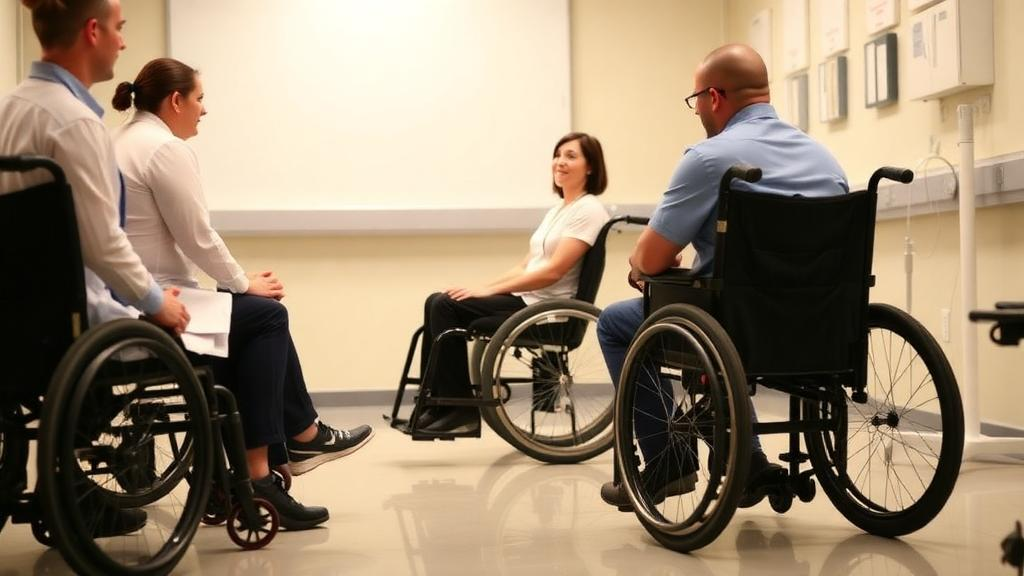
People with disabilities continue to face some of the most stubborn inequities in modern healthcare, and a growing body of evidence suggests that many of those inequities begin not with equipment or policy but with the attitudes and preparedness of the clinicians at the bedside. A new study published in BMC Medical Education reports that a hands-on disability awareness program, in which resident physicians navigated wheelchairs, practiced transfers, and talked candidly with wheelchair users about their lives, significantly improved the attitudes of medical residents toward people with disabilities. The findings offer a rare piece of good news in a field where clinicians themselves frequently admit they feel unprepared to care for patients with disabilities.
The program, known as Come Roll with Me, was implemented across four residency programs at a large academic medical center, the University of Alabama at Birmingham. Fifty-five resident physicians took part in one of four identical two-hour sessions. Rather than relying on lectures or slides, the sessions were built around three interactive stations, each led by a team of wheelchair user facilitators, licensed physical therapists, and Doctor of Physical Therapy students. The design deliberately placed people with lived experience of disability in the role of educators, flipping the usual clinical hierarchy in which the physician is the expert and the patient is the subject.
The theoretical backbone of the program is Intergroup Contact Theory, a well-established framework in social psychology holding that direct, structured, and cooperative contact between groups can reduce prejudice and improve intergroup attitudes. In practice, that meant residents did not simply observe or listen. At one station they propelled themselves in wheelchairs, experiencing firsthand the physical demands and environmental obstacles that wheelchair users confront daily. At another they practiced transfer techniques, learning how patients move between wheelchairs, beds, and other surfaces, and how much skill and coordination those movements require. A third station addressed adaptive transportation, an often-overlooked dimension of daily life for wheelchair users, and each session included a facilitated dialogue in which wheelchair users spoke about their lived experiences and answered residents’ questions directly.
To measure whether the experience actually changed attitudes, the researchers used the Attitudes and Perspectives Toward Persons with Disabilities Scale, a validated instrument administered before and after the sessions. Forty-nine residents completed the pre-event survey and nineteen completed the post-event survey, allowing the team to compare responses from the eighteen residents who completed both. Using the Wilcoxon signed-rank test, a non-parametric statistical method suited to paired ordinal data, the researchers found a statistically significant improvement in attitudes following participation, with a p-value of less than 0.001. In practical terms, that means the probability that the observed improvement arose by chance alone is extremely small, lending strong statistical support to what the facilitators observed anecdotally in the room.
The significance of the result is amplified by the context in which it was obtained. Surveys of physicians and medical trainees have repeatedly found that many report limited preparation and considerable discomfort when providing disability-inclusive care, a gap rooted in insufficient training and limited exposure to individuals with disabilities throughout medical education. Those gaps matter because structural, attitudinal, and communication barriers in healthcare contribute to persistent health disparities for people with disabilities. A clinician who is uncomfortable, unfamiliar, or uncertain around a wheelchair user may communicate less effectively, make assumptions about quality of life, or overlook treatable conditions, and those small failures can accumulate into measurable differences in health outcomes.
What distinguishes Come Roll with Me from many one-off sensitivity trainings is its participant-led structure and its track record. The program had already demonstrated effectiveness in increasing attitudes, empathy, and comfort when engaging with wheelchair users in undergraduate medical education, the stage of training that precedes residency. The new study represents the next step in that trajectory, extending the model into graduate medical education, where residents are already making independent clinical decisions. The researchers describe the implementation as a deliberate test of whether the benefits observed in medical students would carry over to a population of trainees with heavier clinical workloads, less schedule flexibility, and greater responsibility for patient care.
Evaluation of the implementation itself was built into the study design. Faculty facilitators took part in a nominal group technique, a structured group process for generating and prioritizing ideas, to identify the factors that contributed to successful implementation and the areas where the program could improve. Two elements stood out as key contributors to success. The first was the authentic interaction between residents and the wheelchair user facilitators, confirming the central premise of Intergroup Contact Theory that genuine, person-to-person engagement drives attitudinal change. The second was the team’s prior experience implementing the program with medical students, which meant the logistics, station design, and facilitation approach had already been tested and refined before the residency rollout.
The facilitators also identified clear opportunities for improvement, and their candor about the challenges is instructive for any institution considering a similar program. Enhancing planning and coordination among stakeholders emerged as a priority, reflecting the complexity of aligning the schedules of residents, physical therapists, DPT students, and wheelchair user facilitators across four separate residency programs. The most persistent obstacle, however, was time. Residents’ clinical duties make it difficult to protect even a two-hour block for non-clinical education, and the authors point to strategies for addressing those time constraints as an essential area for future refinement. The finding is a reminder that even the most effective educational intervention will fail at scale if it cannot fit within the unforgiving structure of residency training.
The study was approved by the University of Alabama Institutional Review Board, and participation was voluntary with informed consent obtained from all participants. It was funded through a Health Services Foundation Grant from the University of Alabama at Birmingham, and the authors declare no competing interests. The research team, led by Ashley Parish of the Department of Physical Therapy, included collaborators from medical education, rehabilitation, medicine, and urology, an interdisciplinary composition that mirrors the collaborative structure of the program itself.
The authors conclude that Come Roll with Me shows promise as a model for integrating disability-focused experiential learning into residency and is worth continued refinement. They are careful to note the limits of what the current study can claim: the sample of paired surveys was small, the effects were measured immediately after the sessions rather than months later, and the program was implemented at a single academic medical center. Future research, they write, should examine the sustainability of the attitudinal gains over time and the generalizability of the approach across different training settings. Even so, the study adds to a compelling picture. Two hours of rolling in a wheelchair, practicing a transfer, and listening to a wheelchair user describe their day produced a measurable shift in how future physicians think about disability, suggesting that the most powerful tool against healthcare inequity may sometimes be simply putting clinicians in their patients’ wheels.
Subject of Research: Experiential disability awareness training in graduate medical education
Article Title: Implementing experiential disability awareness training in graduate medical education: evaluation of the Come Roll with Me program
Article References: Implementing experiential disability awareness training in graduate medical education: evaluation of the Come Roll with Me program. (n.d.). https://doi.org/10.1186/s12909-026-10585-0
Image Credits: AI Generated
DOI: 10.1186/s12909-026-10585-0
Keywords: disability awareness, graduate medical education, experiential learning, wheelchair users, resident physicians, Intergroup Contact Theory, attitudes toward disability, medical education, physical therapy, health disparities, Come Roll with Me, BMC Medical Education
Cite Scienmag News
Courtney Benton. (October 8, 2026). Wheelchair-Led Training Program Reshapes How Resident Physicians See Disability. Scienmag. https://scienmag.com/wheelchair-led-training-program-reshapes-how-resident-physicians-see-disability/
Courtney Benton. "Wheelchair-Led Training Program Reshapes How Resident Physicians See Disability." Scienmag, 8 October 2026, https://scienmag.com/wheelchair-led-training-program-reshapes-how-resident-physicians-see-disability/. Accessed 8 October 2026.
Courtney Benton. "Wheelchair-Led Training Program Reshapes How Resident Physicians See Disability." Scienmag. October 8, 2026. https://scienmag.com/wheelchair-led-training-program-reshapes-how-resident-physicians-see-disability/


