

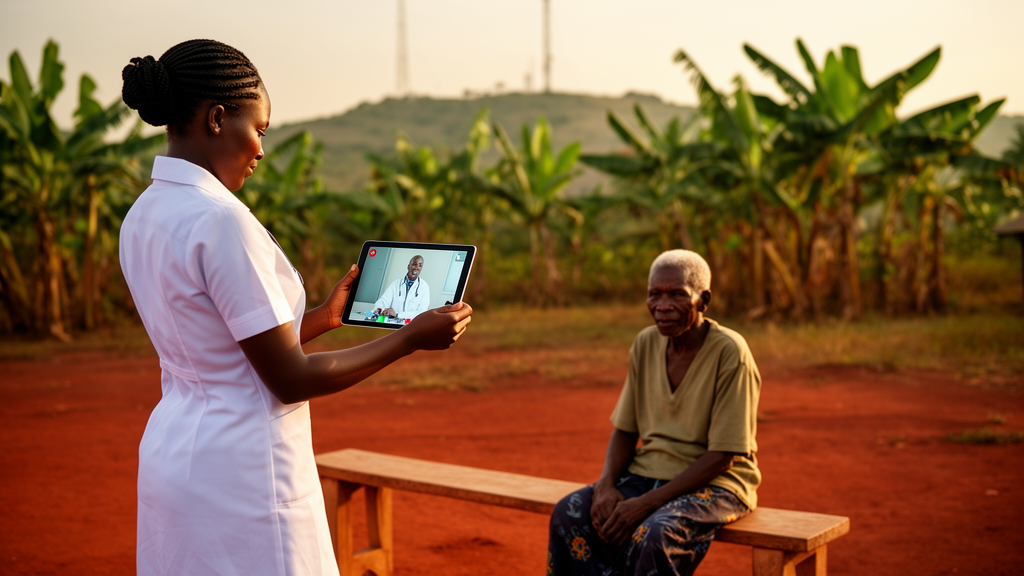
Telemedicine is winning over patients, providers, and policymakers in Uganda, but only where the internet is fast, the users are digitally confident, and the clinical stakes are low. That is the central message of a new qualitative study published in PLOS Global Public Health, which followed how people at four very different institutions in Kampala experience remote healthcare in their daily work and lives. The research, led by Irene Semakula of the Uganda National Council for Science and Technology together with colleagues from Makerere University, the Uganda Cancer Institute, and Butabika National Referral Mental Hospital, offers one of the most detailed portraits yet of how virtual care actually functions on the ground in a low-income country, beyond the emergency-driven boom it enjoyed during the COVID-19 pandemic.
The team conducted an exploratory qualitative study between November 2024 and February 2025 at four purposively selected sites: Rocket Health Uganda, a private digital health company offering round-the-clock virtual consultations and medicine delivery; the Uganda Cancer Institute, a national specialist referral centre; Butabika National Referral Mental Hospital, the country’s main psychiatric facility; and the Ministry of Health, which regulates and coordinates digital health innovation. The researchers carried out twelve key informant interviews with policymakers and healthcare providers, including nurses, clinical officers, doctors, tele-nurses, laboratory technicians, and pharmacists, and three focus group discussions with patients and caregivers who had used telemedicine within the previous year. Interviews were conducted in English or Luganda, audio-recorded with consent, transcribed verbatim, and analysed thematically using Braun and Clarke’s six-phase approach with NVivo 12 software.
To make sense of the different services on offer, the researchers classified telemedicine along two dimensions: the purpose of the interaction, whether patient-to-doctor, doctor-to-doctor, or doctor-to-nurse exchanges, and the delivery mode, whether live calls and video, store-and-forward transmission of clinical data, remote patient monitoring, or mobile health messaging. Across all four sites, participant accounts centred overwhelmingly on patient-to-doctor interactions, with specialist-to-specialist consultations referenced mainly by providers describing internal referral and escalation pathways. This distinction matters, because the study found that acceptance of telemedicine depended heavily on the clinical acuity of the service being delivered through it.
Three overarching themes emerged from the analysis: perceived benefits, perceived challenges, and recommendations for improvement. On the benefit side, participants described telemedicine as convenient and transformative, particularly for people with disabilities and for digitally literate urban users. One focus group participant from Rocket Health explained that many people with disabilities feel relieved from navigating long distances and poorly maintained roads, and that digital platforms with reminder options help ensure adherence to medication. Others described how a patient can remain at home, call or send a message, have a doctor call back, arrange tests, and have medication delivered, all without a single trip to a facility.
The privacy and autonomy gains were equally striking. Virtual consultations were perceived to increase dignity and independence, especially for people with disabilities and individuals worried about stigma. Participants at Butabika valued being able to receive psychiatric follow-up from home, with one participant noting the emotional weight of having loved ones nearby during treatment rather than being alone for months in a distant ward. Cost and time savings recurred across every group: patients described avoiding long queues and expensive transport, and providers noted that follow-up appointments and minor conditions could be handled without unnecessary facility visits. Acceptance was reported to be highest in urban districts such as Kampala, Masaka, Wakiso, and Mukono, where smartphone familiarity is widespread.
But the study is equally candid about the barriers. Poor internet connectivity, unreliable network coverage, lack of smartphones, and language barriers were repeatedly identified as major obstacles, particularly in rural areas. One focus group participant from the Uganda Cancer Institute noted that in village settings, communication problems, weak networks, and language differences create serious difficulties. Digital illiteracy and limited patient awareness compound these technical problems, raising the concern that telemedicine, if scaled without deliberate equity measures, could widen existing health inequalities rather than close them.
The most clinically sensitive challenge is diagnostic uncertainty. Without a physical examination, providers and patients alike worried that remote consultations could miss crucial signs. A key informant from the Uganda Cancer Institute offered a vivid example: if a child has flu and cough but is also developing measles, how do you describe the skin over the phone? A Ministry of Health informant observed that many Ugandans prefer direct interaction, reflecting a widespread belief that physical presence enhances both trust and diagnostic accuracy. These concerns were most pronounced among providers at the tertiary specialist facility, where patients often present with complex conditions, and least pronounced at Rocket Health, whose model focuses on lower-acuity and follow-up care.
The study’s theoretical backbone, the Technology Acceptance Model developed by Fred Davis, helped the researchers interpret these patterns. Acceptance of telemedicine was strongest when lived experience reinforced both perceived usefulness and perceived ease of use. Convenience, reduced travel, privacy, and continuity of care drove perceived usefulness, while digital literacy, reliable connectivity, and clear communication between provider and patient underpinned perceived ease of use. Where those enabling conditions were absent, especially in rural settings, acceptance remained cautious even among participants who acknowledged the technology’s potential. The findings suggest that acceptance is not simply a matter of individual attitude but of the interaction between perception, clinical context, and structural conditions.
Participants did not stop at diagnosis; they offered concrete recommendations. They called for mass media campaigns to raise public awareness, more toll-free and paid helplines to reduce congestion on single numbers, and expansion of telemedicine pilots beyond major urban centres to rural and peri-urban areas. They urged the development of a comprehensive national telehealth policy with robust data protection and privacy regulations to prevent patient data leaks, alongside clear clinical protocols and structured training programmes for healthcare providers. Improving internet coverage and communication infrastructure, especially in villages, was seen as the essential foundation without which none of the other measures would reach the people who need care most.
The study’s authors are careful to acknowledge its limitations. Most participants were drawn from urban-based institutions in Kampala where telemedicine services are relatively established, so the findings may not fully reflect the realities of rural or underserved areas where connectivity and smartphone access are far more limited. The study also focused on sites already implementing telemedicine, meaning the perspectives of facilities without such programmes, and of people who have never used them, were not captured. Even so, the research marks a shift in the literature: much of the existing evidence on telemedicine in sub-Saharan Africa focuses on its role during public health emergencies, whereas this study speaks to the harder question of long-term, routine integration. Its conclusion is measured but clear. Telemedicine is perceived as acceptable and useful in Uganda, and for people with disabilities and those living far from facilities it can be genuinely transformative. Whether it becomes a sustainable pillar of the health system, rather than a pandemic-era stopgap, will depend on investment in infrastructure, strengthened digital literacy, provider training, public awareness, and a robust national telemedicine policy that guarantees both clinical quality and data privacy for every Ugandan, not just the connected urban few.
Subject of Research: Stakeholder acceptance and experiences of telemedicine in Uganda's healthcare system
Article Title: Stakeholder perspectives on telemedicine acceptance and experiences in Uganda: A qualitative study
Article References: Stakeholder perspectives on telemedicine acceptance and experiences in Uganda: A qualitative study. (n.d.). https://doi.org/10.1371/journal.pgph.0007047
Image Credits: AI Generated
DOI: 10.1371/journal.pgph.0007047
Keywords: telemedicine, Uganda, digital health, qualitative research, health policy, Technology Acceptance Model, health equity, internet connectivity, digital literacy, low- and middle-income countries, patient experience, PLOS Global Public Health
Cite Scienmag News
Phoebe Ingram. (October 8, 2026). Telemedicine Wins Trust in Uganda, But Connectivity and Policy Gaps Hold It Back. Scienmag. https://scienmag.com/telemedicine-wins-trust-in-uganda-but-connectivity-and-policy-gaps-hold-it-back/
Phoebe Ingram. "Telemedicine Wins Trust in Uganda, But Connectivity and Policy Gaps Hold It Back." Scienmag, 8 October 2026, https://scienmag.com/telemedicine-wins-trust-in-uganda-but-connectivity-and-policy-gaps-hold-it-back/. Accessed 8 October 2026.
Phoebe Ingram. "Telemedicine Wins Trust in Uganda, But Connectivity and Policy Gaps Hold It Back." Scienmag. October 8, 2026. https://scienmag.com/telemedicine-wins-trust-in-uganda-but-connectivity-and-policy-gaps-hold-it-back/


